
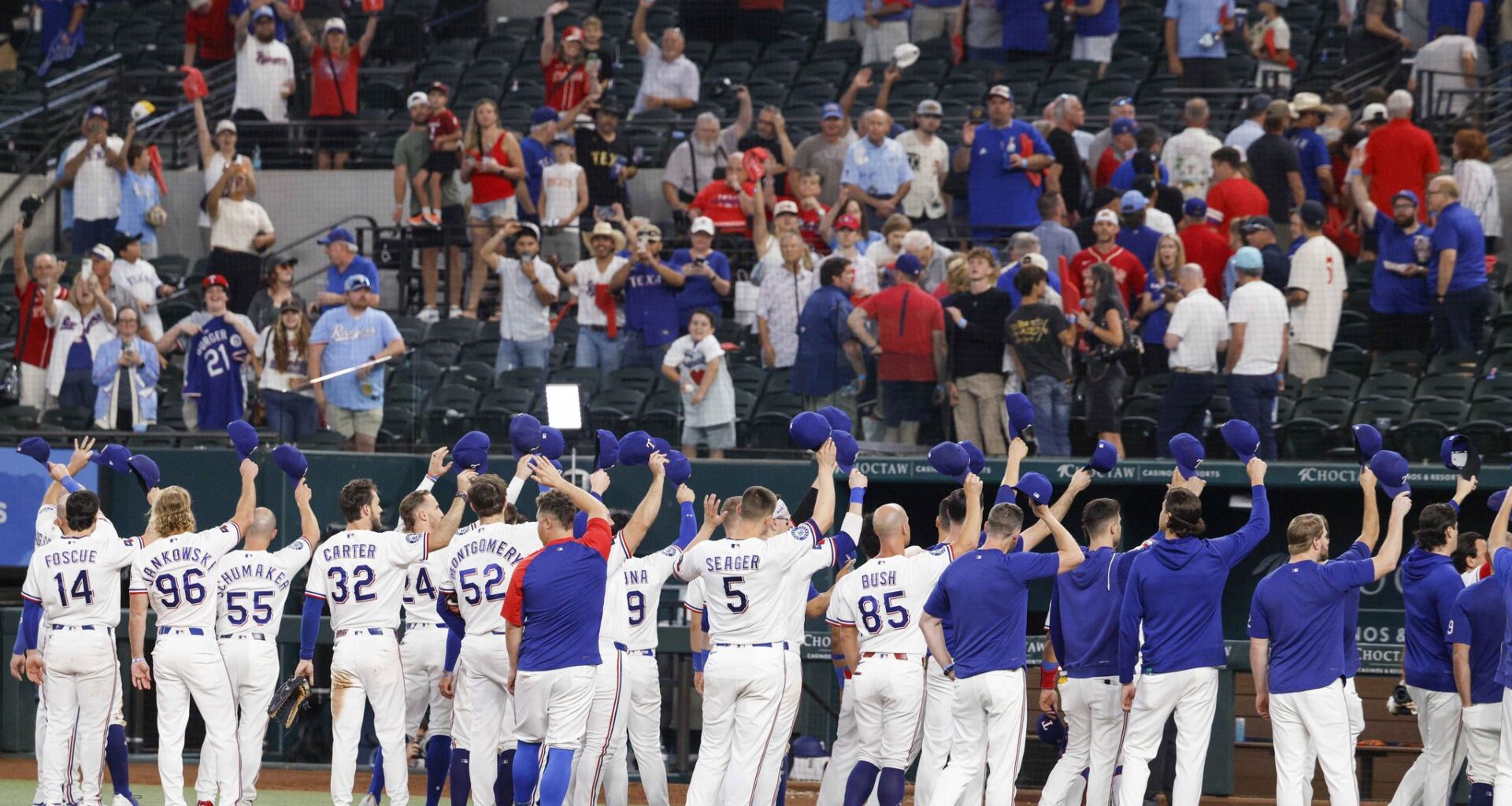
Texas Rangers players thank fans after winning their final regular season home baseball game against the New York Mets at Globe Life Field on Thursday, Sept. 24, 2026, in Arlington.
Elías Valverde II/The Dallas Morning News
The Texas Rangers, who just completed their 55th season, face what could best be described as a midlife existential crisis.

Who are they? What do they want to be? How do they take the steps to break free of the painful cycle of mediocrity they’ve spun through the last few years?
It’s a lot for any person, let alone an entire organization, to ponder over a winter.
Article continues below this ad
The World Series pennant is already dusty.
It is time to face some hard questions and come up with some real answers. Not just answers for what has ailed them, but a plan to revitalize the entire organization with a long-term vision from ownership on down.
Here are five of the biggest of those questions:
Who are they?
Texas Rangers catcher Danny Jansen (9) heads to home plate after talking with pitcher Nathan Eovaldi (17) during the sixth inning of a baseball game against the Boston Red Sox at Globe Life Field on Wednesday, Sept. 16, 2026, in Arlington.
Elías Valverde II/The Dallas Morning News
This is the inevitable payroll question, but it drives the future of the organization. If a team is willing to spend big, there is a quick way to address multiple holes. If not, it dictates a need to be targeted, smart and creative. The one place nobody wants to be: Stuck in the middle, saddled with big contracts from one strategy that may be aging poorly while pivoting to a more cost-conscious structure.
Article continues below this ad
This is currently where the Rangers sit. It is uncomfortable and, dare we say it, untenable for the future as currently constructed.
The payroll portion committed only to salaries (not including benefits and arbitration bonus pool contributions) for 2026 came to about $180 million. While there has been no official declaration on a final figure or future stance, given labor uncertainty, it’s fair to assume that number will not grow significantly for 2027.
Against that, the Rangers have five contracts, worth $120 million in 2027, for players aged 32 or older next season: Corey Seager, Nathan Eovaldi, Jacob deGrom, Brandon Nimmo and Danny Jansen. They have 10 players eligible for salary arbitration, for whom MLB Trade Rumors projects a total of $38 million in salaries. If all return, that leaves 11 spots on the roster. Even if they all make the major league minimum in 2027, that’s another $8.5 million. You’ve spent $166.5 million. Assuming payroll stays flat, that leaves about $14 million, or about what the Rangers spent on Jansen and their assorted low-cost relievers.
That’s a formula for a repeat of 2026, which was largely a repeat of 2025.
To break the cycle, owner Ray Davis has to invest more. Either he’s got to spend it on the major league roster or in player development for R&D, scouting and instruction. But he’s got to spend.
Article continues below this ad
Chris Young and Ross Fenstermaker could create additional flexibility by moving a big contract or two. That creates other holes to fill. Maybe the Rangers could trade Seager and get back 50% of his contract, but, if they do, how they replace that production at a premier spot?
What do they want to be?
Texas Rangers shortstop Corey Seager (5) rounds third base as he scores a run during the seventh inning of a baseball game against the Boston Red Sox at Globe Life Field on Wednesday, Sept. 16, 2026, in Arlington.
Elías Valverde II/The Dallas Morning News
In his season postmortem, Young discussed a lot of attributes the team lacked. Youth. Athleticism. Dynamism. He also mentioned “toughness” and “grit” as mindset elements that were lacking. It was damning.
He could have said it another way: “I want to play like Tampa Bay. Or Milwaukee.”
Article continues below this ad
He wouldn’t be alone.
The Rays and Brewers have brought fundamental baseball back. The two teams, still thriving in the postseason, were built around athletic players, instructed in situational hitting and pushing boundaries on the bases and backed up by good pitching and dynamic defenses. It took all this time for the analytics revolution to realize: Fundamental baseball is winning baseball. Who would have thunk it?
There are multiple issues in turning the Rangers into this. First, there is a wave of roster changes that would likely be necessary. Second, if other teams are thinking the same thing – and, trust us, this is a copycat league – the cost for those kinds of players is going to shoot up exponentially. And that’s not a cost-effective method for a team with a tight allowance.
Which brings us to maybe the more salient point in all of this: The Rangers have to find something, as an organization, that they can do at an elite level that maybe other teams aren’t as invested in yet. For a brief moment there, it was to spend with the big boys. But that’s gone. On the fundamental element, they are playing catch up. At one point, they excelled in plumbing the pitching market for guys undervalued because they didn’t throw that hard. It’s a great way to flesh out a cost-effective staff, but playoff baseball is built around hard-throwing bullpens.
Across the organization, the Rangers need to find something they can make their own. Something that defines whatever “The Rangers Way” will be. It needs to be done with long-term vision, and it needs to be invested in and grown. There have been too many cycles over the last 10 years of start-and-stop strategies, many of them dictated by the financial resources the baseball operations team has been handed or had taken away.
Article continues below this ad
How to use Globe Life Field … as an advantage?
Texas Rangers center fielder Ezequiel Duran (20) nearly collides with left fielder Wyatt Langford (36) as he catches a fly ball from New York Mets second baseman Marcus Semien during the seventh inning of a baseball game at Globe Life Field on Thursday, Sept. 24, 2026, in Arlington.
Elías Valverde II/The Dallas Morning News
Pick an offensive stat – literally any offensive stat of note – and the Rangers probably ranked in the bottom half of the majors. In runs per game, slugging percentage, OPS, stolen bases, productive outs and advances from first to third, it was worse; they were in the bottom 10.
The Rangers did nothing very well offensively.
If this sounds redundant, well, it is. You could say the same thing about the last three years, too, singularly or in total.
Article continues below this ad
Over that period, the Rangers have changed managers, hitting instructors and major pieces of the offense. None of that has worked. The scope of the issue also suggests that changing one or two pieces alone won’t necessarily solve the issue. Doesn’t mean they should just give up.
But perhaps it is also time to consider a more permanent change: Bring in the fences at Globe Life Field.
For three years now, the lack of home runs at Globe Life Field has been evident and duly noted. The park has the second lowest “park factor,” an index that ranks how hospitable stadiums are to offense, according to MLB Savant. Of note, over the last three years, only 38.4% of fly balls that have left the bat at between 100 mph and 106 mph ended up as home runs at Globe Life Field. That ranked as the fifth-lowest percentage among 30 MLB parks.
It’s debatable how much was due to the park vs. the hitters, but a narrative has grown and circulated among players. That being: The Globe sucks the life from power hitters. Whether or not it’s scientifically proven, it’s had a negative effect on hitters who aren’t willing to make changes to their approach and work more on line drives than fly balls. If you can’t fix the players, maybe fix the park.
There has been nothing more than the casual, occasional conversation inside the Rangers offices about the possibility, but if there is a lack of flexibility to the roster, maybe one thing the Rangers could do is make the dimensions a little friendlier.
But there is another side to this argument. What if the Rangers lean into Globe Life Field’s extremes? Pitchers love the place. That’s a selling point. Prioritize outfield speed and fielding, which goes to athleticism and dynamism. On offense, look more for contact hitters and doubles guys than sluggers. Maybe take a page from the St. Louis Cardinals of the 1980s. That could be their new identity.
Changing the ballpark might be the easy short-term fix; changing the organization to fit the park might have more far-reaching impact.
How to get their own young players to take the next step?
Texas Rangers designated hitter Wyatt Langford (36) gets a high-five from his teammate Evan Carter (32) after 7-6 victory against Los Angeles Angels at Globe Life Field, Thursday, July 9, 2026, in Arlington.
Chitose Suzuki/The Dallas Morning News
The Rangers got more than half of their WAR, according to Fangraphs, from players who have played exclusively for them in the majors. That’s a significant accomplishment for any player development system.
But none of Wyatt Langford, Evan Carter, Jack Leiter or Kumar Rocker has stepped into full-fledged stardom. At least one of them must. Langford and Carter regressed in 2026; Leiter and Rocker both struggled. The core of this franchise’s next era is going to be defined by how these players grow. And add one more: Sebastian Walcott.
Both Langford and Carter have all the attributes to be perfect fits for a pitching-friendly Globe Life Field, but Langford must take the same approach Josh Jung did this past year and strive more for line drives than fly balls. Carter needs more confidence, but he also must be presented with competition for playing time. His defensive skills, while elite, do not make up for the lack offensive production.
Both players – and the pitchers – must have some self-awareness of the situation but must also be pushed with real competition. And given the injury histories of all of them, the Rangers need real depth options. It is an area in which they were notably short in 2026, due to lack of resources. It takes money to acquire established veterans
How to proceed with Corey Seager?
Texas Rangers shortstop Corey Seager (5) hits a solo home run during the seventh inning of a baseball game against the New York Mets at Globe Life Field on Thursday, Sept. 24, 2026, in Arlington.
Elías Valverde II/The Dallas Morning News
Alternative title: Or how to proceed without him.
We’ve already established that Seager is going to be 33 next year and will be paid $32 million. Beyond that, there’s the matter of either a temperamental or degenerative back condition. Not sure which. Seager’s not one for deep discussions on injuries. After the season, it was revealed he needed surgery to remove a bone spur in his elbow.
The only thing on his stat line that has gone up over the last three years is time missed. Over the last three years, he’s missed 159 games or, well, you know, the equivalent of one full season. Meanwhile, his OPS has dropped from 1.013 to .864 to .860 to .736. Over a three-year period, it’s .824. It’s still in the top 10% of guys with at least 1,000 plate appearances over that time, but his 1,414 plate appearances in that time rank No. 129. The lack of availability further diminishes the value of his productivity.
The Rangers have three options here: Continue with status quo, with Seager doing his own thing in terms of game prep and physical maintenance; demand changes either to the physical routine or perhaps his position as an attempt to break the cycle; or try to move on from him and reallocate whatever savings they recoup for other needs.
Needless to say, there are challenges associated with all of them. The first suggests status quo is OK. The latter two would require Seager either to accept team-mandated changes or to waive a no-trade clause. To get to either, it’s likely going to include a winter-long standoff.