
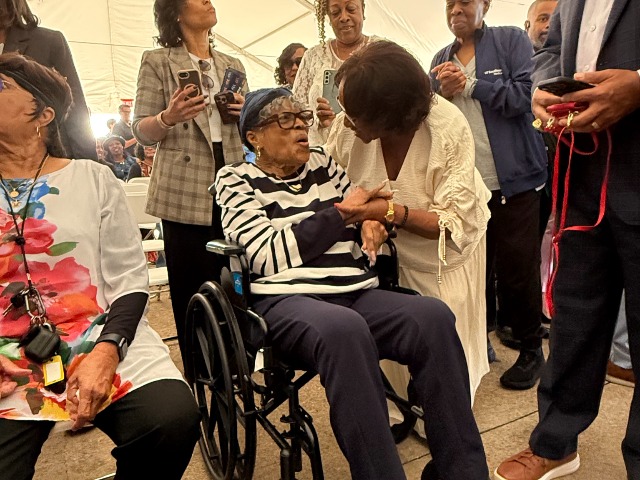
Community leaders and supporters gathered on October 7 to honor Dr. Opal Lee, the civil rights activist known as the “Grandmother of Juneteenth,” on her 100th birthday and celebrate a major milestone for the future National Juneteenth Museum.
Juneteenth commemorates June 19, 1865, when news of emancipation reached enslaved Black Americans in Texas, more than two years after Abraham Lincoln’s Emancipation Proclamation. Lee’s decades of advocacy helped bring national recognition to Juneteenth and contributed to its designation as a United States federal holiday in 2021.
A-woman-in-a-wheelchair-is-greeted-by-another-woman
An artistic rendering of the National Juneteenth Museum in Fort Worth, Texas.
Rendering-of-the-national-juneteenth-museum-with-for-worth-texas-in-the-background
Renderings-of-the-inside-of-the-National-Juneteenth-Museum
An-aerial-view-of-Fort-Worth,-Texas-taken-in-October-2026.-
An-aerial-view-of-Fort-Worth,-Texas-taken-in-early-October-2026.-
Temple Square is always beautiful in the springtime. Gardeners work to prepare the ground for General Conference.
© 2012 Intellectual Reserve, Inc. All rights reserved.
1 / 2
Download Photos
As part of the event, The Church of Jesus Christ of Latter-day Saints announced that it has committed $3 million to support construction of the museum. Plans for the museum include a genealogy center intended to help visitors discover and preserve family histories through experiences powered by FamilySearch. Elder Michael A. Dunn, President of the Church’s United States Southwest Area, joined museum leaders and community organizations for the Wednesday morning gathering.
The collaboration grew from relationships developed over several years, including Lee’s 2022 visit to Church headquarters in Utah. The Church has developed connections with African American community and faith leaders in North Texas over many years. Church members and leaders have participated in local Juneteenth celebrations, supported the Opal Lee Walk for Freedom and worked to strengthen relationships across cultures and faith traditions through service, education and community outreach.
“The National Juneteenth Museum is going to allow us to really help people everywhere understand what Dr. Lee has represented — her tenacity, her verve, her unrelenting quest to be able to bring truth and light to this story of our nation that still needs to be told,” Elder Dunn said. “This is what the National Juneteenth Museum will do.”
“This deed won’t go unnoticed,” Dr. Lee said in brief remarks. “It’ll be where everybody can see how much you appreciated what we are doing in this community — and this is everybody’s contribution.”
The genealogy center will place particular emphasis on helping preserve records and stories that have historically been difficult for many African American families to trace and document.
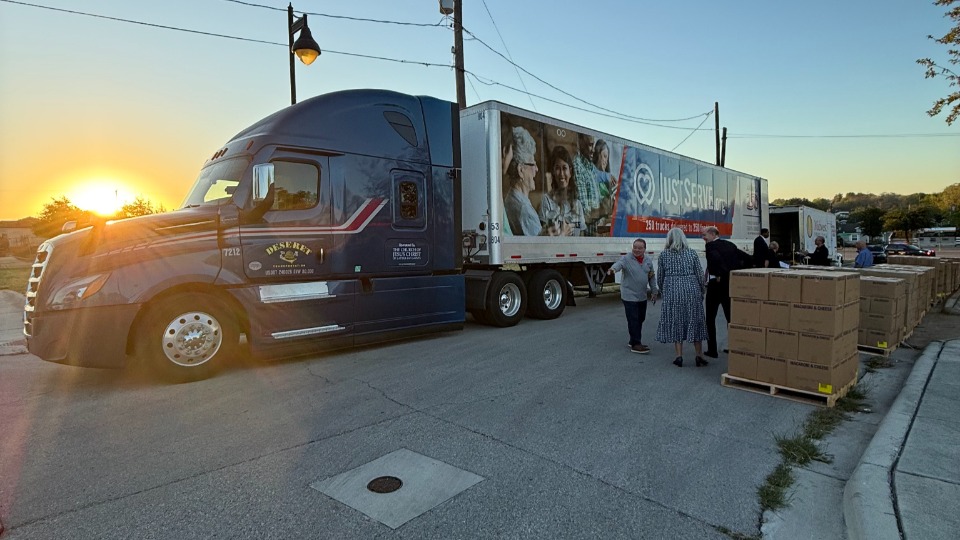 A semitruck delivers food to Midwest Food Bank in Fort Worth, Texas. This is a continuation of the Church’s nationwide effort to honor the nation’s 250th anniversary by delivering 250 truckloads of food and essential supplies to 250 food banks across the country. Midwest Food Bank and four other food pantries in the area will share the goods in this shipment.© 2026 by Intellectual Reserve, Inc. All rights reserved.Download Photo
The event combined community service with the commencement of site-clearing activities for the museum in Fort Worth’s Historic Southside neighborhood. A ceremonial demolition marked the beginning of preparations for construction. In connection with the day’s events, the Church also donated 38,000 pounds of food and other supplies to five local food banks. The donation continues the Church’s nationwide effort to honor the nation’s 250th anniversary by delivering 250 truckloads of food and essential supplies to 250 food banks across the country.
The planned 50,000-square-foot museum traces its origins to a smaller museum Lee has operated for many years in Fort Worth, where she has long championed education and awareness of Juneteenth. The new project is envisioned as a national center dedicated to preserving Juneteenth history and fostering conversations about freedom, unity and opportunity.
The museum will include exhibition galleries, educational spaces, a theater, community gathering areas and resources designed to support both cultural preservation and neighborhood development.
“This is an incredible day in the history of our movement, in the history of the South Side, in the history of the city of Fort Worth,” said National Juneteenth Museum CEO Jarred Howard. “This is not the end. This is the beginning.”
He added that the museum project is “built around the spirit of the venerable Ms. Opal Lee.”
The project aims to preserve the story of Juneteenth while helping future generations better understand the experiences, perseverance and aspirations of those whose pursuit of freedom helped shape American history.
The museum project is one of several efforts over the past decade through which the Church has supported education, self-reliance, humanitarian service and community-building initiatives in Black communities. The Church has also supported efforts to expand access to African American family history records through projects such as the Freedmen’s Bureau Project, the 10 Million Names Project and collaborations with institutions dedicated to African American history and family research.
“We celebrate all as brothers and sisters, sons and daughters of the living God,” Elder Dunn said. “That’s why we are so excited to be a part of this Juneteenth museum.”