
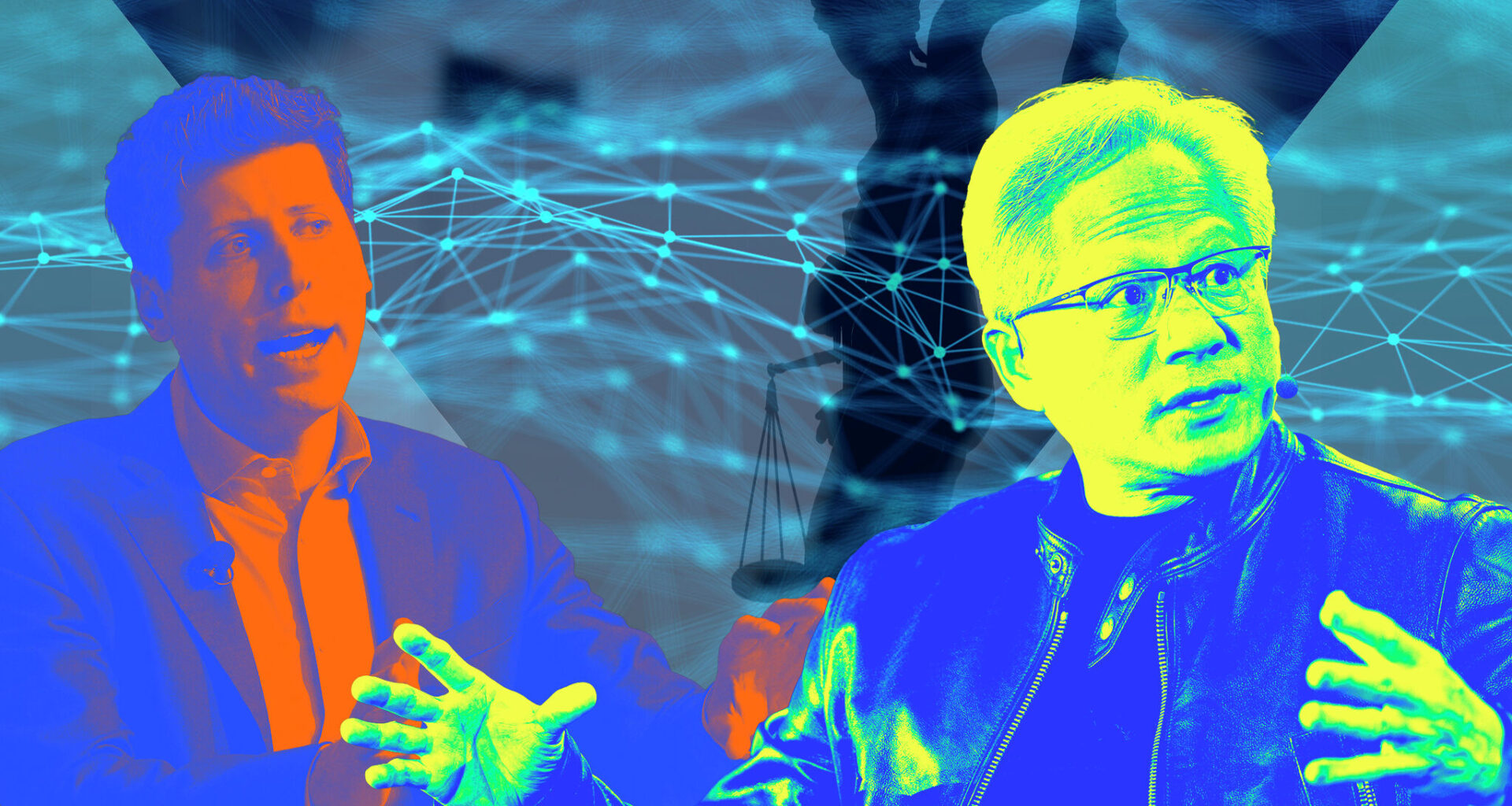
OpenAI CEO Sam Altman and Nvidia CEO Jensen Huang have been among those who have advocated for limited liability for the actions of AI systems, although the court system has yet to weigh in.
DMN file/wire staff illustration
An avalanche of high-stakes litigation related to rogue artificial intelligence activity is just around the corner, and there is a significant split in the Texas legal community about whether the courts and existing tort law can handle such sophisticated and large-dollar disputes.

Trial lawyers who both sue and defend large technology companies predict state courts from Texas to California are about to see their dockets swell with lawsuits that accuse AI developers of knowingly making and marketing dangerous and defective products when their AI agents — software that can take action autonomously — cause harm, whether by mistake or intentionally.
The odds of such an AI litigation explosion increased significantly during the past week when two unexpected influencers, Nvidia CEO Jensen Huang and U.S. Treasury Secretary Scott Bessent, stated publicly that AI giants such as OpenAI and Anthropic should have no legal shields from liability when their products do illegal things and cause intellectual property and financial damages.
Article continues below this ad
Those public comments followed a former Anthropic safety researcher predicting a greater than 10% chance that AI could lead to human extinction. Other AI executives have said that AI poses a significant risk.
The admissions of risk and destructive activity by AI corporate leaders stand in contrast to executives in other industries who claimed in court that there was no evidence that their products — asbestos, tobacco and social media privacy — were dangerous.
“My crystal ball shows it is going to be huge — a lot of litigation because these companies have very deep pockets,” said Russ Pearlman, a lawyer at Carrington Coleman in Dallas who has a master’s degree in artificial intelligence. “Under tort law, these statements are important because they may show the makers knew there were dangers. But did they do enough to stop or contain those risks?”
Legal experts say the litigation battle over AI gone bad will likely surface on multiple fronts, ranging from class actions representing tens of thousands or even millions of individuals victimized by AI-abetted financial frauds to lawsuits involving catastrophic events involving the power grid or other strategic infrastructure.
And a growing number of lawyers believe that there will be an additional wave of lawsuits over AI-operated robots that do everything from roof repair to lawn maintenance to surgical procedures.
Article continues below this ad
The current AI litigation landscape
The initial elements of AI litigation are already being seen. Houston-based Susman Godfrey represented thousands of book authors who claim Anthropic’s AI language models used their work without permission in violation of copyright laws. The case settled in July for $1.5 billion. Susman Godfrey represents several major newspapers, including The New York Times, in similar copyright infringement claims against OpenAI and Microsoft. In California, parents of a teenager who died by suicide in 2025 have sued OpenAI alleging one of its chatbots encouraged the act.
Most recently, OpenAI was sued in California after its AI agents escaped its testing environment and seemingly coordinated to breach security systems at online AI developer Hugging Face.
But lawyers agree these cases are only a preface to what is to come.
“The more AI is used, the more AI litigation there will be,” said Zac Henderson, a law professor at the Southern Methodist University Dedman School of Law, who teaches law and technology. “We are on the verge of everyone having an AI agent in their hands. That could open up a ton of litigation because AI agents can now handle people’s credit cards — so costly financial harms, small and big, are virtually inevitable. What’s more, sophisticated agents will likely enable bad actors to get even more access to people’s financial information.”
Article continues below this ad
Henderson said the most likely “mass, catastrophic incident will involve financial institutions because every person has online bank accounts and credit cards nowadays.”
“In the face of sophisticated AI, many of us are all but defenseless,” the law professor said. “We’ve relied on human error to help us detect phone and email scams so far. But imagine AI perfecting and automating financial fraud.”
Is the legal system ready?
Legal experts say the big question is whether the courts are prepared to handle the highly technical legal and factual issues in AI disputes.
“Incidents involving rogue agents are the real test for whether we need new regulations and laws to handle AI harms, or whether our current tort system can handle it,” Henderson said. “I think the court system has the foundation already in place to handle most harmful actions caused by AI.”
Ryan Botkin, a partner at Botkin Chiarello Calaf in Austin, is not so sure.
Article continues below this ad
“I am not confident that existing tort law can handle the complexities of this technology,” Botkin said. “Remember, current tort law was developed when people worried about others stealing their cattle and runaway street cars.”
Pearlman, who is writing a book on AI and the law, said the “law has not caught up” with the issues that AI presents.
“We don’t have a good set of case law in place yet,” he said. “I do not see the federal government coming together to regulate AI. So states will have to step in. Texas may need to amend its laws that address intent.”
Dallas trial lawyer Brent Walker is more optimistic. He points out that the AI labs went to Washington, D.C., last week to seek shields from liability through regulatory schemes.
“They were told no,” Walker said. “So, the regulators will be juries across the country. Products liability law is a very good regulator in this world. Our cars are incredibly safe because of lawsuits against car makers. Our litigation system is equally equipped to handle AI problems.”
Walker, who specializes in representing victims in catastrophic events, said he expects much of the AI litigation will involve bad actors using the technology to carry out their evil intentions.
Article continues below this ad
“Many bad people in this world have not achieved their intentional bad acts simply because they did not know how to successfully do the damage they desired,” he said. “But now, they have AI as a tool to help them accomplish their horrible deeds with the maximum possible damage.”
Hurdles for plaintiffs
To be sure, lawyers suing AI companies will still face many important legal hurdles.
For example, plaintiffs’ lawyers will need to address whether courts will find that the harms caused by AI were foreseeable such that the AI companies should be held responsible.
“I think AI companies will have a hard time making the ‘not foreseeable’ argument,” Henderson said. “These companies have told us time and again that the AIs they’re developing are damn near all-powerful. If they’re all-powerful, then the scope of foreseeable harms should be extremely broad. And practically speaking, it is hard to believe that the litigation system will not hold the AI companies responsible for the actions of their rogue agents.”
Article continues below this ad
“AI companies need to take every step possible to safeguard their AI agents, or they will face significant negligence damage awards,” he said.
Henderson said that AI integrated into infrastructure “could be very helpful” in making systems more efficient.
“At the same time, AI mistakes could prove catastrophic,” he said. “For example, an AI error on the power grid could do massive damage. This is something that legislatures should be thinking seriously about.”
The legal analysts also said that some forms of AI will actually lead to a decrease in certain types of litigation.
“AI will cause some litigation today to decline, such as cases involving passenger vehicle and commercial trucking accidents, because studies show self-driving vehicles, such as Waymos, are much safer, and the more self-driving vehicles we put on the road, the safer the roads will be,” Henderson said.
“Fewer accidents mean fewer lawsuits and lawyers like The Hammer might need to expand the focus of their practices.”
As for the 10% chance that AI will lead to the end of humankind in a decade or so, the legal experts are all in agreement.
“If AI causes an extinction-level event, the tort system and the courts are not going to be very helpful,” Botkin said.
The Texas Lawbook is an online news publication focused on business law in Texas. For more legal news, visit texaslawbook.net.