
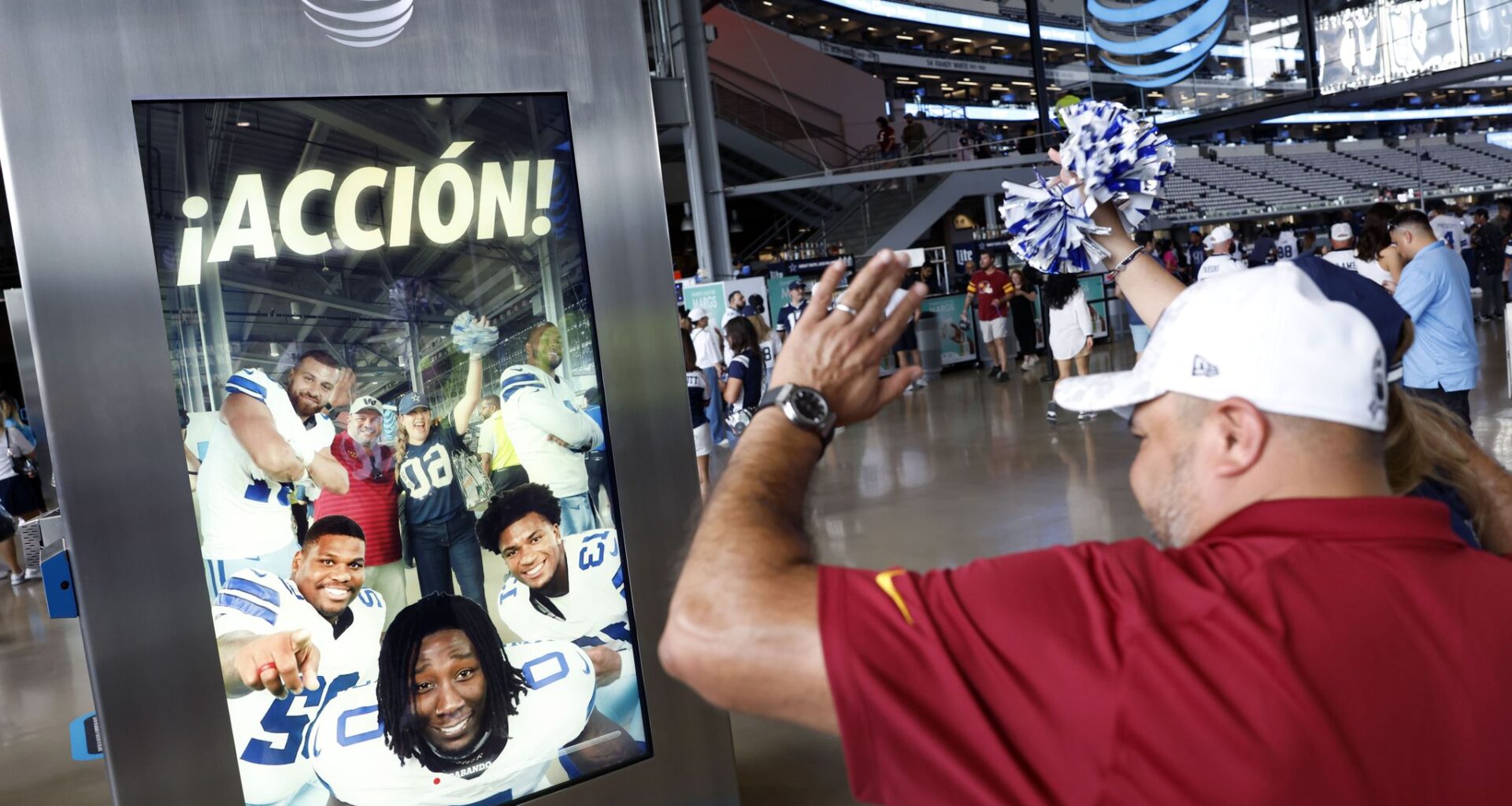
Football fans Carlo Quintanar and his wife Michelle Caballero of Mexico use AT&T’s “Pose with the Pros”, an interactive augmented reality (AR) photo experience, on Dallas Cowboys gameday at AT&T Stadium in Arlington, September 20, 2026. A camera superimposes the fans with Cowboys players then instantly texts or emails your “live portrait” to you.
Tom Fox/The Dallas Morning News
In the hour before the Cowboys 2026 home opener, tens of thousands of fans scanned their tickets — all entirely digital, via smartphones — and streamed into AT&T Stadium’s spacious concourses, where they were met by augmented reality kiosks featuring star players and cheerleaders. Smiling attendants stood next to interactive navigation machines that were available to help them find their seats. Throughout the stadium, nearly 1,000 antennas boosted a Wi-Fi and cell network that supported everything from influencers’ fieldside selfie streaming to an integrated concessions platform that employees use to manage 13 kitchens and some 1,200 points of sale.

“That’s the command center,” one man remarked to his partner as they walked past the stadium’s control room, where a glass window wall separated tech workers huddled around screens from the throngs of passing fans. “Kinda cool,” she replied.
Ever since it opened nearly two decades ago, AT&T Stadium has ranked among the world’s most famous arenas, acclaimed for everything from its retractable glass walls and building-length steel arches to its extensive art collection. Less known is that it’s also among the most high-tech, boasting its own data center, 261 miles of fiber, approximately 3,000 wifi access points and among the world’s largest distributed antenna broadband systems. This year, in addition to the new Wayfinding navigation system and techy upgrades like an AI-powered feature that transforms fans’ photos into custom Cowboys hype videos, the stadium completed a $350 million pre-World Cup glow up that included a top-of-the-line Wi-Fi update.
Article continues below this ad
“In our mind,” said Zee Hussain, AT&T’s head of global enterprise solutions, “this is the most connected venue in the entire world.”
A Super Bowl connectivity burst
The arena then known as Cowboys Stadium opened in 2009, with a price tag of $1.2 billion. And while the outside of the 3 million-square-foot structure was praised for its dramatic glass walls and clean, futuristic curves, inside the showstopper was the screens. The stadium’s Jumbotron was 25,000-square-foot and over 1 million pounds, qualifying as the largest LED screen in the world. Nearly 3,000 more flat-screen monitors were everywhere from the luxury boxes to the concession areas.
Football fan Kiera Wade of Waldorf, Maryland follows the instructions on an AT&T interactive augmented reality and mixed-reality kiosk to play football with Dak Prescott. The AT&T powered kiosks were popular during Dallas Cowboys gameday at AT&T Stadium in Arlington, September 20, 2026.
Tom Fox/The Dallas Morning News
The stadium was built with a high-speed communications network and data center to support all the screens, as well as the nearly 200 security cameras. But even after the opening, a team of engineers spent months installing millions of feet of ethernet cables, hundreds of miles of optic fiber and more than 800 wireless internet access points. With Arlington set to host the 2011 Super Bowl — and smartphones and tablets quickly becoming ubiquitous — the idea was to make the stadium the first Super Bowl host arena to provide fans Wi-Fi.
Article continues below this ad
“You build it, they will come,” said Matt Messick, who leads the stadium’s tech operation as Cowboys’ CIO. “You build it, and then you enable the technology on top, and then you just create that consumption of data.”
That year Aaron Rodgers led the Green Bay Packers to a tight victory over the Pittsburgh Steelers in front of 103,000 fans, and the stadium’s new Wi-Fi system held. But in the years after Arlington’s fancy new stadium opened, several more $1 billion-plus NFL arenas opened, including MetLife Stadium in East Rutherford, New Jersey and U.S. Bank Stadium in Minneapolis.
Using AT&T Turbo Live, Veronica Brevard (left) shows fans how to navigate the stadium using the AT&T Stadium Wayfinding kiosk at AT&T Stadium in Arlington, September 20, 2026.
Tom Fox/The Dallas Morning News
They also went all in on tech, especially Levi’s Stadium, the San Francisco 49ers’ new home in Silicon Valley, which opened in 2014 with tech infrastructure that included over 1,200 antennas, 1,700 Bluetooth beacons — paired with an app for in-stadium navigation — and more than 2,000 high-def Sony TVs.
The consensus was that the business of sports was changing, and teams needed to provide more comprehensive — and digitally-enhanced — stadium experiences to justify soaring ticket prices.
Article continues below this ad
“It is the future of a sporting venue,” Scott Mair, then a senior vice president at AT&T, previously told The Dallas Morning News. “That’s the evolution we’re seeing play out.”
The world’s most valuable sports franchise and its tech-focused owner were keen to maintain its edge. In 2013, the year AT&T inked a deal to take the stadium’s naming rights, the telecoms company also completed an overhaul of the Wi-Fi system by replacing its 750 existing access points and adding 500 more. The following year, the arena debuted a new 130-foot, 40-panel LED “fan experience board” and a stadium app that could temporarily turn fans’ phones into vibrating strobe lights to create a kind of interactive light show. Several years later, AT&T Stadium became among the first major venues to incorporate 5G.
Employees work in the AT&T technology command center on Dallas Cowboys gameday at AT&T Stadium in Arlington, September 20, 2026.
Tom Fox/The Dallas Morning News
“Today’s fan who sits at home has a fantastic experience,” Cowboys executive Charlotte Jones Anderson previously told The News. “We have to take it a step further. We have to give them something they can’t get at home.”
A new global profile
AT&T Stadium’s tech has also been periodically tested by non-Cowboys events, including George Strait’s 2014 farewell concert, which required a floorside signal boost, and recent Monster Jam events, for which the stadium upgraded its audio control room.
Article continues below this ad
Yet there’s nothing quite like the World Cup. In the summer of 2023, after the venue had been selected as one of 11 U.S. sites to host the 2026 tournament, the stadium embarked on a nearly $350 million renovation project that included a redesign of clubrooms and suites, new concessions and bars and upgrades to the seven merchandise shops.
Tech was a major focus. The team upgraded screens, in some cases swapping out designs featuring walls of monitors for simpler presentations, and updated the Jumbotron to a sharper 4K resolution. Anticipating a data spike, AT&T also added over 100 high-powered Wi-Fi macro cell sites outside the stadium and boosted connectivity inside the arena by upgrading to Wi-Fi 7, the fastest currently available Wi-Fi system.
Football fans use an AT&T interactive augmented reality and mixed-reality kiosks to play football with Dak Prescott during Dallas Cowboys gameday at AT&T Stadium in Arlington, September 20, 2026. The AT&T powered kiosks are on the main end zone concourse of the stadium.
Tom Fox/The Dallas Morning News
The network upgrades mean the stadium now has a “backbone” capacity of 400 gigabytes per second, as Messick put it, or roughly 40 times the capacity of the stadium’s original Wi-Fi. “It was the smoothest running venue of all FIFA [stadiums], period,” he said. During the Australia-Egypt match, fans consumed nearly 28 terabytes of mobile data, among the most ever for a sporting event.
A home win, with good Wi-Fi
In late September, ahead of the Cowboys’ home opener against the Washington Commanders, a small team of AT&T and team reps was eager to show a group of reporters the latest innovations. As the stadium’s sound system tested hype music and VIPs began trickling in, the reps highlighted the new AI-enhanced Wayfinding navigation system and the team’s popular Pose with the Pros interactive photo feature, which now includes the likenesses of Dallas Cowboys cheerleaders and team legends including Emmit Smith.
Article continues below this ad
MatSing’s spherical lens antennas hang from the roof structure of AT&T Stadium in Arlington, September 20, 2026. The high-capacity antennas provide mobile capacity antenna coverage with less interference for higher data capacity for fans.
Tom Fox/The Dallas Morning News
Another new feature scores fans on their technique as they catch virtual passes from Dak Prescott. In front of display screens advertising $18 Cowboys Cheesesteaks and $17 chicken tenders, a hospitality executive explained how the stadium’s massive concession operation was all integrated to automatically update inventories. With the Cowboys app, fans can also order nachos or margaritas directly to their seats.
It was all supported by a Wi-Fi and cellular network — heavily monitored by the stadium’s tech team — that AT&T compares in scope to the city of Plano’s. “As you’re walking around, you saw you have perfect connectivity,” Hussain said at one point. “If any of that is not working, you can’t sell food. You can have fans that are not able to enter. You can have folks that are sitting in their seats and wanting to share, and they can’t.”
But it all worked. Throughout the game tens of thousands of fans shared photos, scrolled Instagram and checked game updates — especially around halftime, an AT&T representative said later, when the stadium saw a data usage surge following the abrupt exit of Commanders quarterback Jayden Daniels, who awkwardly crashed to the ground after getting stepped on by a teammate and ended up with a freak elbow injury.
“Everything’s rolling,” one fan, Melissa Lambert, said of the network connection just as the first half was ending. Lambert and her husband, who were finishing a snack in a concourse, are Cowboys fans who live in the Washington, D.C. area, and had been sending pictures and bantering by text with family members who are Commanders fans.
Article continues below this ad
“If my pictures wouldn’t have went through, I would have been like, ‘What the heck!’” she added. “They just went through fine.”
Dallas ended the first half with a 17-10 lead, thanks to a hot performance from Prescott. Then Cowboys linebacker Dee Winters recovered a fumble, to set up another touchdown, and the Commanders missed a long field goal. By early in the fourth, the lead was a comfortable 30-13, and some fans began turning to their phones. In Section C234 one father snapped several pictures of his beaming young son, who held up a Cowboys towel, a young woman texted and an elderly man scrolled through videos of puppies riding on vacuum cleaners. Presumably no one was thinking about their network connection. That was the point.