
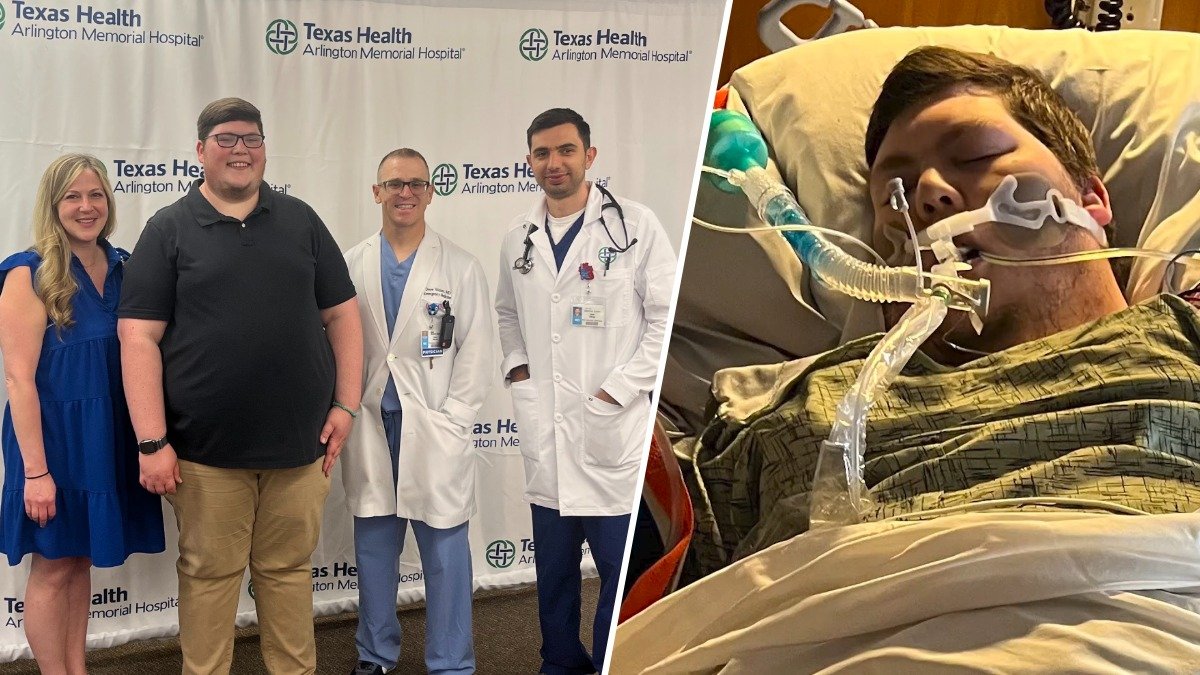
Dalton Lovell was watching his wife and daughter practice martial arts at an Arlington gym when he suddenly began feeling dizzy.
He tried to get his wife’s attention, but something was wrong.
“I do remember feeling like a little dizzy, and like, oh, I need to get Becca. And that’s really the last thing that I remember,” Lovell recalled.
Seconds later, the 35-year-old father went into sudden cardiac arrest.
Fortunately, several people at the gym knew CPR and immediately jumped into action.
For approximately 10 minutes, bystanders took turns performing chest compressions until emergency responders arrived.
Among those helping was Lisa Britt, director of the emergency department at Texas Health Arlington Memorial Hospital, who happened to be at the gym.
“I fully believe that immediate bystander CPR, in addition to just the higher power being with Dalton, helped to save his life,” Britt said.
Lovell was rushed to Texas Health Arlington Memorial Hospital, where a cardiac team was waiting to treat him, but his medical history revealed something unusual.
Years earlier, Lovell had been diagnosed with a condition known as broken heart syndrome. Despite its name, broken heart syndrome isn’t necessarily caused by heartbreak.
The condition, medically known as takotsubo cardiomyopathy, occurs when part of the heart muscle suddenly weakens, making it harder for the heart to pump blood effectively.
According to the American Heart Association, the condition is believed to be linked to a surge of stress hormones following an intense emotional or physical event.
The death of a loved one, a breakup or a frightening experience can trigger it, but so can serious illness, surgery or even an unexpectedly happy event. Symptoms often resemble a heart attack, including chest pain and shortness of breath.
However, unlike a typical heart attack caused by a blocked artery, broken heart syndrome involves a temporary change in how the heart muscle functions.
Most patients recover within days or weeks, but the condition can sometimes cause serious complications, including heart failure, dangerous heart rhythms and cardiac arrest.
The Mayo Clinic reports that broken heart syndrome is more common in women, particularly those older than 50. However, men who develop the condition may face a greater risk of death.
A 2025 study published in the Journal of the American Heart Association found that men hospitalized with broken heart syndrome were more than twice as likely to die as women.
Researchers also found that serious complications remained a concern, even though the condition is often described as temporary.
Lovell said he had continued living a relatively normal life after his earlier diagnosis, keeping an eye on his blood pressure and overall health.
But looking back, he remembers experiencing some discomfort before his cardiac arrest.
“I had felt like a little pain, like maybe shoulder and neck area, which I kind of just brushed off as like being stressed,” he said.
After his cardiac arrest, doctors recommended an implantable cardioverter defibrillator, or ICD, a device that monitors the heart and can deliver a shock to correct certain dangerous rhythms.
Dr. Aref Obagi, an interventional cardiologist at Texas Health Heart & Vascular Hospital Arlington, said the device could help protect Lovell if another life-threatening heart rhythm develops.
Lovell returned home after eight days of hospital care.
His recovery has also brought him back to the martial arts gym where strangers and friends worked together to save his life.
One of the people who performed CPR that day later helped teach Lovell martial arts and tied a white belt around his waist.
“Seeing the guy who saved my life from doing CPR, and now he’s teaching me … and then he tied that white belt on me. It was like a huge moment,” Lovell said.
Lovell’s survival underscores the importance of acting quickly when someone experiences sudden cardiac arrest.
According to the American Heart Association, approximately 350,000 people experience cardiac arrest outside a hospital in the United States each year, and about 90% do not survive.
However, immediate CPR can double or even triple a person’s chances of survival.
The association recommends that anyone who witnesses a teen or adult suddenly collapse and become unresponsive call 911 and begin chest compressions if the person is not breathing normally.
Just three weeks after Lovell’s cardiac arrest, the martial arts gym organized a hands-on CPR training session for approximately 70 children, parents and other family members.
For Lovell and his wife, Becca, the experience has become an opportunity to encourage others to learn a skill that could save someone’s life.
“I have a second chance. God is not done with me yet,” Lovell said.
Medical experts emphasize that unexplained chest pain, shortness of breath, fainting or other sudden symptoms should never be ignored.
Because broken heart syndrome can closely resemble a heart attack, anyone experiencing possible heart attack symptoms should seek emergency medical attention rather than trying to determine the cause themselves.
For more information about the condition, visit the American Heart Association’s guide to broken heart syndrome.