
HOUSTON – For residents living near 419 Emancipation, the debate over Houston’s homelessness response is about more than what happens inside the facility.
It’s about what happens after people leave.
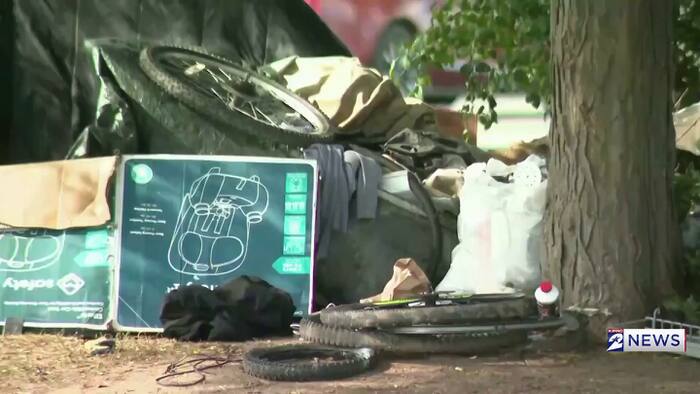
Mark Anthony Rodriguez, who lives and owns businesses in the area, said residents have seen people experiencing homelessness remain in nearby parks, along the Harrisburg Sunset Hike and Bike Trail and around local businesses.
“I would not feel comfortable letting my wife and my six-year-old daughter walk through this trail by themselves,” Rodriguez said.
Rosa Trevino said she supports helping people experiencing homelessness but wants the city to address what happens in the surrounding neighborhood.
“They need help. We understand that,” Trevino said. “But at this point, if we don’t take control of our community, we are going to end up with our whole infrastructure along the rail destroyed because there’s lack of police presence.”
A new approach to homelessness
Those concerns come as Houston and its partners launch a new $48 million regional homelessness initiative called Pathways to Independence.
The three-year effort is backed by local private philanthropy. So far, $34 million has been committed toward the $48 million goal.
The initiative is designed to build on Houston’s existing homeless response system while adding faster and more flexible ways to help people who may not qualify for, or need, permanent housing programs.
Not everyone needs permanent housing
That distinction is at the center of the new strategy.
Kelly Young, president and CEO of the Coalition for the Homeless of Houston/Harris County, said, “Not everyone requires — or can qualify for — permanent housing programs to resolve their homelessness.”
Instead, the initiative will fund what organizers call “rapid resolutions” — essentially quick interventions that can prevent someone from entering homelessness or help someone get out of it without requiring a long-term housing program.
That can include short-term stabilization and creative problem-solving, as well as coordination between housing, behavioral health, health care, criminal justice and community services.
Young said the new funding is intended for people the existing system “cannot currently reach quickly or effectively.”
City says funding will create more pathways out
Mike Nichols, Houston’s director of Housing and Community Development, said the new money will not go directly to 419 Emancipation. Instead, a committee led by philanthropic partners will determine how the funds are distributed.
“The idea is the money will be spent on helping people move off the street, move out of 419, move out of the navigation center, all to more stable lives, more stable housing,” Nichols said.
The fund is expected to complement more than $80 million the city says it has committed to homelessness programs. Philanthropic partners have secured $34 million toward the $48 million goal, with additional commitments expected.
Nichols said the funding could help expand opportunities for people who are staying at 419 Emancipation, waiting for housing or living on the streets
The 90-day goal
The strategy also comes with a 90-day goal: resolving new instances of homelessness within three months.
That could mean connecting someone to permanent housing, but it could also mean solving a short-term crisis before it becomes a longer-term housing problem.
What happens after 419?
That approach is especially relevant at 419 Emancipation.
The facility opened in late May as a temporary, structured setting where people experiencing homelessness can stabilize, receive assessments and connect with treatment, behavioral health care and housing services.
As of the city’s latest data, 423 people had been served. Of those, 124 had moved into permanent housing, while 147 had exited without a documented permanent housing placement.
The city cautions that an exit without a documented placement does not necessarily mean someone returned to homelessness because post-exit information is incomplete.
Filling the gaps
The Coalition says Houston’s existing system has housed more than 38,000 people through The Way Home, which has traditionally focused on permanent housing programs.
The new initiative is intended to fill gaps around that system — not replace it.
That means the $48 million could pay for interventions that happen before someone needs permanent housing, or help people who don’t qualify for traditional programs.
More exit doors
For residents, however, the question remains whether people are ultimately getting to a stable destination — and what happens in the neighborhood while they wait.
Mayor John Whitmire described 419 Emancipation as an important opportunity but acknowledged the need for more “exit doors that lead to lasting stability.”
The Coalition says permanent housing can cost roughly $20,000 to $24,000 per person.
With $48 million spread across three years, the new initiative will have to balance those long-term housing needs with the short-term interventions officials say can resolve homelessness more quickly.
How success will be measured
City officials have not yet determined how many additional people the $48 million will help.
Nichols said he expects the money to increase the number of opportunities available for people to move into more stable housing, but he could not provide a projected total.
“I do not have an answer yet,” Nichols said. “I know it will have a significant impact.”
Officials also plan to evaluate whether people remain outside the homelessness response system after receiving help. Nichols said the city uses data to assess which programs produce the strongest outcomes and inform future funding decisions.
The questions ahead
The $48 million is not a permanent funding stream. The initiative is currently structured for three years, with organizers saying they hope to eventually secure public funding to sustain the work.
For residents around 419 Emancipation, that leaves two questions moving forward: whether the new strategies can help more people leave homelessness permanently, and whether the city can address the concerns of the neighborhoods surrounding the facilities meant to provide that help.
Copyright 2026 by KPRC Click2Houston – All rights reserved.