
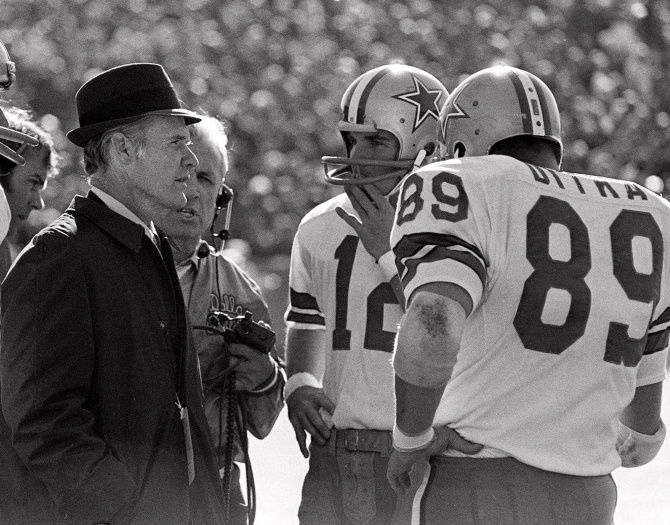
Dallas Cowboys coach Tom Landry talks with quaterback Roger Staubach (12) and tight end Mike Ditka (89) on the sidelines during the 1972 Super Bowl game against Miami in this Jan. 16, 1972 photo, at New Orleans .
AP
Not long after Tom Landry rescued a broken-down Mike Ditka from the Eagles near the end of a Hall of Fame career and plopped him on a path to three Lombardi Trophies as a player and coach, and maybe even saved his life in the bargain, the old tight end proved he could still be, well, Mike Ditka.

The story goes that a couple nights before a Cowboys game, Ditka and Walt Garrison, a kindred spirit, hit the town and at least one stationary object. Ditka went through the windshield. A dentist subsequently saved his smile but wired his broken jaw shut.
Ditka played the next day.
Article continues below this ad
Garrison couldn’t forget the sound of him breathing through clenched teeth.
Hiss-haw . . . hiss-haw . . .
“Sounded like a rabid hound,” the late fullback once said. “And you could hear that mad dog Ditka cussin’ even with his mouth wired shut.”
Many tales will be told about Ditka, who died Friday at 86. Chicago – where he starred first as a boundary-breaking tight end, then as the head coach who restored the Bears to their former glory in the ’80s – is at the hub of most. His ’85 Bears were considered one of the greatest teams ever, a gritty bunch known for its toughness, swagger and personality, a reflection of their gum-chomping, fire-breathing, take-no-prisoners coach.
Case in point: In the Bears’ only loss that year, Ditka challenged his defensive coordinator, Buddy Ryan, to a fight at halftime.
Article continues below this ad
Before Michael Jordan made Chicago the center of the universe with the Bulls in the ’90s, Ditka did the same with the Bears in the ’80s, to the point that fans of the latter became a running skit on Saturday Night Live.
But, if Ditka was the heart and soul of Chicago, Dallas proved to be the turning point in his life and career.
Growing up in Aliquippa, Pa., his father, Mike Sr., a Marine sergeant and welder, instilled in his oldest son the attributes that would remain with him the rest of his life. Tough, hard-working, blue collar. Mike’s competitiveness and temper were evident early. He once chased his younger brother home after a youth baseball game in which the latter dropped a fly ball that cost him a no-hitter.
His unparalleled skills as a tight end who could both catch and block were overshadowed by his temper and toughness as he brawled his way through Chicago, Philadelphia, Dallas, Chicago again and New Orleans on his way to Canton. He famously fought with teammates and opponents alike. He played the entire 1964 season with a dislocated right shoulder that required a harness. He caught 75 passes with one arm.
But his irascibility and insubordination wore down George Halas, the owner and head coach, who traded him to the Eagles in 1967. Ditka hated it in Philadelphia. Drank more than ever. Lost his starting job. At a game near the end of the ’68 season, he broke down on the bench.
Article continues below this ad
After the Eagles were done, he drove straight through a blizzard to Chicago, where he got a call from Landry telling him he was giving him a second chance.
“I never expected to go to a club of the Cowboys’ caliber,” he told reporters after the trade. “When I heard the news, it took a while to sink in. I was more than surprised. I was really shaken up.
“I’m flattered to think that a championship contender thinks I can be of help. I can and, believe me, I’m gonna give Tom Landry 150% effort.”
He moved to Dallas, covered his back yard in artificial turf and worked out every day. Lost 20 pounds. Landry didn’t need him to do it all like he did in Chicago. He snared Roger Staubach’s final touchdown in Super Bowl VI, but he caught more than 17 passes in a season only once in his four years here.
What Landry wanted, instead, was a tight end with impeccable traits who would instill a little toughness in a team that needed a nudge to greatness.
Article continues below this ad
“He was an all-time character,” Charlie Waters said Friday. “You wouldn’t think Tom Landry would tolerate it, but I don’t think Coach Landry ever reprimanded him about anything. He would call him out at meetings to talk about certain technique.
“Ditka loved football and in a strange way had a great relationship with Tom Landry because of it.”
In a tribute Friday to Ditka, journalist Tyler Dunne wrote about Landry’s influence on Ditka. The tight end had been in such despair after the ’68 season that he thought about quitting the game. Maybe even life.
The call from Dallas changed everything.
“The best thing that happened to me was when I met Tom Landry,” Ditka told Dunne. “He really made me. He made me understand what it was to be a team player. He was fantastic. He was just absolutely the best.
Article continues below this ad
“I went there and cleaned up my act and became a pretty good team player.”
Not so much that you wouldn’t have recognized him anymore. He still had his moments. Like the night he was at Handlebar, the bar/restaurant on the northeast corner of LBJ and 635 he co-owned with Dave Edwards, Pat Toomay, Cliff Harris and Waters. A scuffle broke out. Waters heard someone ask who the hell someone else was. The customer didn’t get the name and asked again.
“Ditka,” the tight end responded, then, for emphasis, added, “D-I-T-K-A.”
Punctuated it with a right cross.
Or there was the time the same Cowboys investors bought into a Colorado ski resort. First day, Ditka showed up decked out in a full-blown ski suit, black from head to toe. The teammates all took the lift to the top of the hill for their inaugural run.
Article continues below this ad
“We all skiied down,” Harris said Friday. “Except Ditka. He came down about an hour later. He was covered in snow. You couldn’t even tell his suit was black.
“He took his ski poles and broke ’em over his skis, and that was that.”
As noted above, Landry was never one to tolerate such outbursts as a rule, but he made an exception for Ditka. Like the time in 1977 when he was on Landry’s staff and an official threw a flag that landed at Ditka’s feet.
“Mr. Official,” Ditka said, smiling, “are you a member of the Fellowship of Christian Athletes?”
“No, Mike, I’m not. Why?”
“Because that was the worst effing call I’ve ever seen in 40 effing years of football!”
Mark Oristano, who wrote for Cowboys Weekly, watched Landry hide his face with his play sheet while Ditka went up one side and down the other of the ref. Later, in the locker room, Oristano told the head coach he’d keep their secret.
“But it was pretty funny, wasn’t it?” Landry said.
Brad Sham remembers team flights where Ditka and his best friend, Dan Reeves, would play cribbage. You could tell who was winning by the number of cribbage pieces flying about the first-class cabin.
Despite what you might think, Ditka was also an excellent special teams coach who taught Waters all the ins and outs of blocking punts. The next game after his first lesson, Waters blocked a punt, the first of a half-dozen in his career.
By the time he left the Cowboys for the Bears in ’82, he was a fully-formed coach and man, his destiny written. Even met the woman who became his widow 49 years later at a bar he owned here. If that isn’t a debt to an organization, I don’t know what is.