
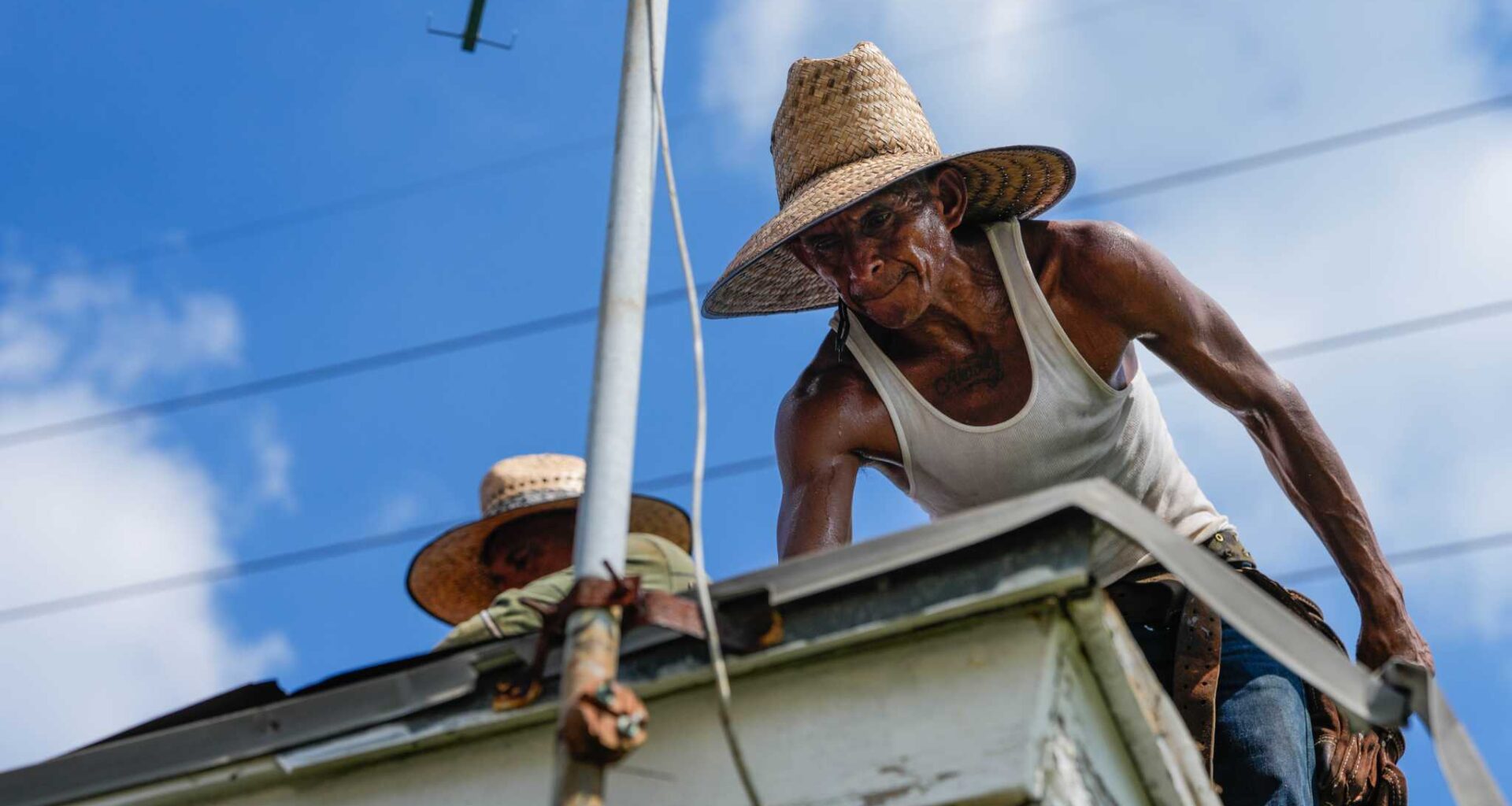
Jose Perez Leon is photographed working on the roof of Deborah Powell, then 72, on Sunday, Aug. 11, 2024 in Houston. His team repaired roof damage from the powerful derecho storm and Hurricane Beryl.
Raquel Natalicchio/Staff photographer
Chewy Guzman and Jose Perez Leon are photographed working on the roof of Deborah Powell, then 72, on Sunday, Aug. 11, 2024 in Houston. They repaired damage from the powerful derecho storm and Hurricane Beryl.
Raquel Natalicchio/Staff photographer
Pedro Rosales, 41, is photographed working on the roof of Deborah Powell, then 72, on Sunday, Aug. 11, 2024 in Houston. His team repaired damage from the powerful derecho storm and Hurricane Beryl.
Raquel Natalicchio/Staff photographer
Months after the damaging storms, Derecho and Beryl, the home of Deborah Powell, then 72, is still under repair from major water and wind damage, she is photographed watching the repair work on Sunday, Aug. 11, 2024 in Houston.
Raquel Natalicchio/Staff photographer
Chewy Guzman is photographed working on the roof of Deborah Powell, then 72, on Sunday, Aug. 11, 2024 in Houston. Her house sustained major damages from the derecho and Hurricane Beryl.
Raquel Natalicchio/Staff photographer
The family of Lorenzo Salgado Araujo, killed in Houston by an immigration agent in July, endorsed a namesake federal bill that U.S. Rep. Sylvia Garcia plans to introduce later this month.
The legislation focuses on protecting construction workers from heat stroke, injury and exhaustion by guaranteeing paid rest and water breaks.
“Lorenzo Salgado Araujo was a proud Houston homebuilder, a husband, and a father of three whose life was taken by an ICE agent on his way to work,” said Garcia, D-Houston. She has spent the past three months acting as fact-finder, intermediary and advocate for his family, and hopes the bill will honor his life.
Article continues below this ad
Salgado Araujo’s adult sons, Ronaldo and Lorenzo, said they hope it will keep construction workers safe across the country. Many are immigrants like their father.
“It’s amazing to know that our dad, Lorenzo Salgado Araujo, is honored in DC this way,” they said in a statement. “For his name to be forever immortalized in American history is a tragically beautiful feeling, and our hope is that his name continues to be utilized in positive changes for the millions of Americans like him.”
Hot summers strain construction workers
On July 7, the day Salgado Araujo was shot and killed, Houston’s heat index — or “feels-like” temperature — climbed into the triple digits, the onset of a summer full of temperature spikes that led to a surge in emergency room visits and triggered concern for outdoor workers. It turned out to be the hottest season on record in the U.S.
Though a growing number of states have adopted laws to protect against heat injury, Texas has not. Instead, the state passed a 2023 law, dubbed the “Death Star” bill by opponents, to override local rules — including in Austin and Dallas — that used to require water breaks for construction workers.
Article continues below this ad
Adam Dean, a George Washington University professor who has analyzed heat-related worker deaths across the country, said the situation in Texas is particularly worrisome.
He and a colleague published peer-reviewed statistical research in 2025 that calculated the number of outdoor workers likely saved each year by California’s heat protections.
“If a Texas state heat standard were as effective as California, it could save 130 to 200 lives each year,” Dean said, according to data from his analysis.
DANGERS: Texas workers face life-or-death heat risks as state rejects safeguards
At the federal level, the Occupational Safety and Health Administration requires employers to protect workers from recognized hazards, but does not yet mandate respite from extreme heat. The agency proposed standards in 2024, but they are in limbo and face a new congressional effort to strike them down.
Article continues below this ad
Federal worker protection proposals
Federal lawmakers including Garcia have introduced a range of different bills outlining worker heat protections for years, though none have passed.
Her 2026 bill would expand on legislation she introduced in 2022 and 2023, guaranteeing paid rest breaks for construction workers to hydrate and cool off during their shifts.
A number of Houston-area emergency room doctors worry about these outdoor laborers after seeing many who have missed the signs, thinking they could handle the heat or fearing repercussions for speaking up.
“So many individuals in the construction sector, also within landscaping, have utilized our ERs for elements of heat exhaustion, heat cramps, and heat stroke,” said Neil Gandhi, assistant medical director of emergency medicine at Houston Methodist Hospital-TMC.
Article continues below this ad
Houston hospitals also see a summer uptick in patients with issues like heart attacks that can be exacerbated or triggered by overheating, though the connection often goes unnoticed.
DATA: Houston heat-related illness tracker
The Garcia bill would require employers to offer at least one 15-minute paid rest break for every four hours worked in the heat, in addition to meal breaks. It would also guard against retaliation.
Garcia specified the bill would cover the North American Industry Classification System’s construction sector. This includes homebuilders like Salgado Araujo, as well as technicians who work in heating, ventilation and air conditioning (HVAC).
One local HVAC worker, 22-year-old Eli Bautista-Cortez, spoke at a news conference alongside Garcia in August, when workers, health practitioners and lawmakers shared experiences of how Houston heat can be a silent killer, even for those who are tough, fit and acclimated.
Article continues below this ad
“The world’s getting hotter every year,” he said in an October interview on his decision to come forward, and heat policy affects “even people that may not be interested in politics or government.”
He said he has yet to experience heat stroke, but has felt the early stages of heat illness, and it was scary.
“I’ve a few times been on a rooftop and I’ve had to just go inside and take a break because I start getting dizzy and it starts turning black. You know, you start actually feeling it, getting dehydrated,” he said.
While Bautista-Cortez has the support of coworkers and his union, many construction workers in the city are less protected. And even with protection and knowledge, it can be hard to speak up and say you’re not feeling OK, he said.