
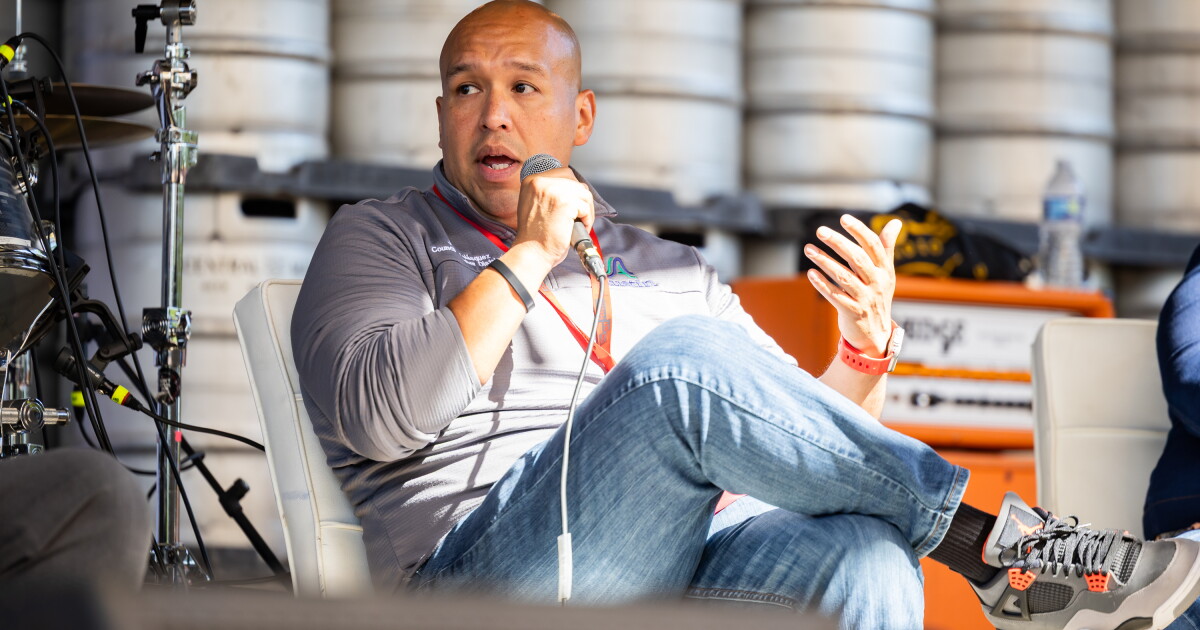
As Council Member José Velásquez prepares for a potential second term, four East Austinites are looking to unseat him and shake up the dais at City Hall.
Gavino Fernandez, Neha Shah, Brock Skinner and Eduardo Romero are all gunning for Velasquez’s seat.
Affordability and the city’s controversial decision to enter into the deal for the so-called Dog’s Head development were central to all candidates’ platforms, as well as the looming vote over a charter amendment to require third-party audits of city spending.
For the uninitiated, the Dog’s Head development is the city plan to build out a 2,600-acre plot of land, anchored by Amazon’s robotics division, in District 3. That council vote sparked outrage from residents across Austin, who felt the vote was rushed and wasn’t vetted by citizen-led commissions.
We asked the candidates about their plans to represent District 3 at City Hall and their priorities ahead of Election Day.
Responses are presented based on the candidates’ placement on the ballot.
If you’re unsure which Austin City Council district you’re in, you can find out on the city’s website.
Eduardo “Lalito” Romero
Eduardo Romero did not respond to a list of questions for this story. He did appear at the city’s District 3 forum.
Brock Skinner
What’s the biggest issue facing District 3?
Brock Skinner’s campaign messaging leads with his lack of experience at City Hall: He’s not a politician. Skinner wants to take aim at the city’s spending to make Austin more affordable.
Skinner thinks the city should be a better steward of taxpayer dollars and rein in spending without increasing property taxes for homeowners.
“I’m all for increasing our tax base, not our tax rate, I guess is the best way to say it,” he said.
What do you think of the Dog’s Head development?
Skinner said the project is an “egregious deal, especially … for District 3.” He said it was “absolutely insane” the city didn’t have environmental impact reports available ahead of the May vote and that the city’s arrangement to pay for infrastructure around the project, known as a TIRZ, shouldn’t have leaned on city incentives. Skinner thinks Endeavor Real Estate Group, which will ultimately develop the site, should foot the bill.
“We should be having [Endeavor] build extra infrastructure around the project to help alleviate the problems that it’s going to create,” Skinner said. “But these deals need to benefit the Austin taxpayer, not the developer.”
Are you supporting the proposition to require a mandatory third-party audit of the city’s expenses?
Skinner said he is a “big supporter” of Proposition I, the charter amendment requiring Austin hire third-party auditors to examine the city’s spending.
Skinner said the city spends too much on contracts — namely for cleaning of homeless encampments and social services writ large. It all amounts to a “terrible return on our investment,” Skinner said.
“I think that the independent audits are extremely necessary and should be regular,” he said. “We need to know how our money is being spent, how it’s performing.”
José Velásquez
What’s the biggest issue facing District 3?
Velásquez said he’s most concerned about affordability in District 3 and said he’s pushed to get affordable housing projects off the ground — one on Bolm Road and another on Chicon Street. He wants city management to take a look at similar properties across Austin to redevelop into affordable housing.
“If we aren’t talking about housing, when we’re talking about affordability, if we aren’t making sure housing is front and center, then I don’t know what we’re talking about,” Velásquez said. “Because if folks can’t afford to live here, then there’s no sense in talking about the rest of it.”
What do you think of the Dog’s Head development?
In May, Velásquez initially supported the city acquisition of the 2,600-acre plot of land known as Dog’s Head to be developed by Endeavor.
But Velásquez throttled back his support in July when he voted against council’s plan to build out the project. He said, in light of recent budget shortfalls, the city needs to grow its tax base. Dog’s Head, Velásquez argues, allows the city to do that, but he understands concern around the timing of the project and the initial vote.
“I wanted to make sure that those folks knew that City Council was listening and that their City Council member was listening, and they were taking their concerns seriously,” he said.
Opponents have argued Velásquez’s campaign contributions from Endeavor-affiliated donors are a form of corporate influence. Velásquez told KUT his “obligation is to the people of District 3, and my record shows that’s who I answer to.”
As of last filing, Velásquez received more than $10,000 in campaign donations from employees of Endeavor.
Are you supporting the proposition to require a mandatory third-party audit of the city’s expenses?
Velásquez does not support the citizen-backed effort to require third-party auditing of Austin’s spending. For one, the incumbent says the city already has an auditor that answers to the City Council and the city manager. Velásquez also argues council’s push this year to conduct third-party audits would make Prop I redundant.
“It’s going to be redundancy. And also it incentivizes them to find areas to cut in the City of Austin,” Velásquez said.
Velásquez also questions the intentions of Save Austin Now, the political action committee that got the item on the ballot. The PAC is headed by former Travis County GOP Chair Matt Mackowiak and has high-dollar Republican donors, though the group maintains it’s bipartisan and that the ordinance was written by former Democratic Travis County Judge Bill Aleshire.
“Honestly, it’s just it’s a DOGE approach to Austin politics, and they know that and it’s not nonpartisan,” Velásquez said.
Gavino Fernandez Jr.
What’s the biggest issue facing District 3?
Longtime Austinite and activist Gavino Fernandez Jr. said the city hasn’t done enough to address rising property taxes for homeowners like him — particularly folks who may be on a fixed income. That’s led to an affordability crisis, displacement and gentrification in District 3, he says.
“Property taxes have consistently been going real high and a lot of people are being displaced, especially where I live here in the Holly neighborhood area,” he said.
What do you think of the Dog’s Head development?
Fernandez does not support the Dog’s Head development.
Fernandez says the vote on the development is an example of a “lack of transparency” at City Hall. Staff rushed the vote on Dog’s Head, Fernandez says, similar to a sped-along vote on a homeless navigation center last year. He says that lack of public input on those votes hurt District 3 constituents.
“All of these are just popping up on council and the council votes for it — even though they … say there’s a lack of transparency. Then why’d you vote for it?” Fernandez said. “Those are big issues as I go out to forums in the community.”
Are you supporting the proposition to require a mandatory third-party audit of the city’s expenses?
Fernandez voted against Prop Q, last year’s proposition to raise city property taxes for parks and public safety funding. Voters across Austin shut down that measure, and Fernandez sees Prop I as a continuation of that push for more oversight on city spending.
“They said enough is enough. You know?” he said. “And that is the voice that I represent on the dais. … We cannot be so liberal in regards to having an open credit card to spend however we want without recognizing the financial impact at the neighborhood level.”
Fernandez said he understands the city has an independent auditor’s office, but that it’s still a city office, comparing it to the “fox guarding the hen.” He said District 3 voters rejected Prop Q last year and he thinks they’ll support Prop I this election.
Neha Shah
What’s the biggest issue facing District 3?
Tech entrepreneur Neha Shah said she thinks the city’s revamp of its development code, known as HOME, was a “band-aid solution” for Austin’s housing woes — and its biggest issue, affordability.
While the HOME initiative sought to allow for denser housing, that hasn’t been the outcome as Shah sees it. It allows for more housing, but Shah says it hasn’t led to more housing developments targeting middle- and low-income families.
“The kind of neighborhoods we’re building now are no longer built for working families. They’re built for a certain kind of high-income individual who has no intentions of setting roots in Austin,” she said. “They’re just riding the wave of what was cool.”
Shah argues the incentives to build denser housing aren’t something working families can take advantage of.
“It’s only the big corporations,” Shah said.
What do you think of the Dog’s Head development?
The May vote on the development pushed Shah to file her paperwork to run for District 3 — particularly because the incumbent, Velásquez, “never said a word on the dais.”
“I don’t know why he’s not showing up as a fighter, as the strong, loud advocate that this district needs,” Shah said.
Shah added that the push by city staff to sign the deal to annex the plot of land was “fake urgency.”
“I think that’s another stunning failure of this council where they approve a 45-year contract with no clear financial benefits for the city,” Shah said. “I still don’t understand why we were approaching this from a position of disadvantage when we were in the position of power.”
Are you supporting the proposition to require a mandatory third-party audit of the city’s expenses?
Shah supports Prop I in theory, though she told KUT she has concerns surrounding the marketing and the political baggage surrounding the measure.
She thinks the discussion around the measure has become an “entire left versus right conversation” online. But Shah says Austinites across the political spectrum voted down Prop Q and pushed City Council to rein in its spending.
“I don’t think caring about accountability and city spending and wanting transparency is a red-versus-blue issue,” she said. “We’re losing sight of the need for oversight.”