
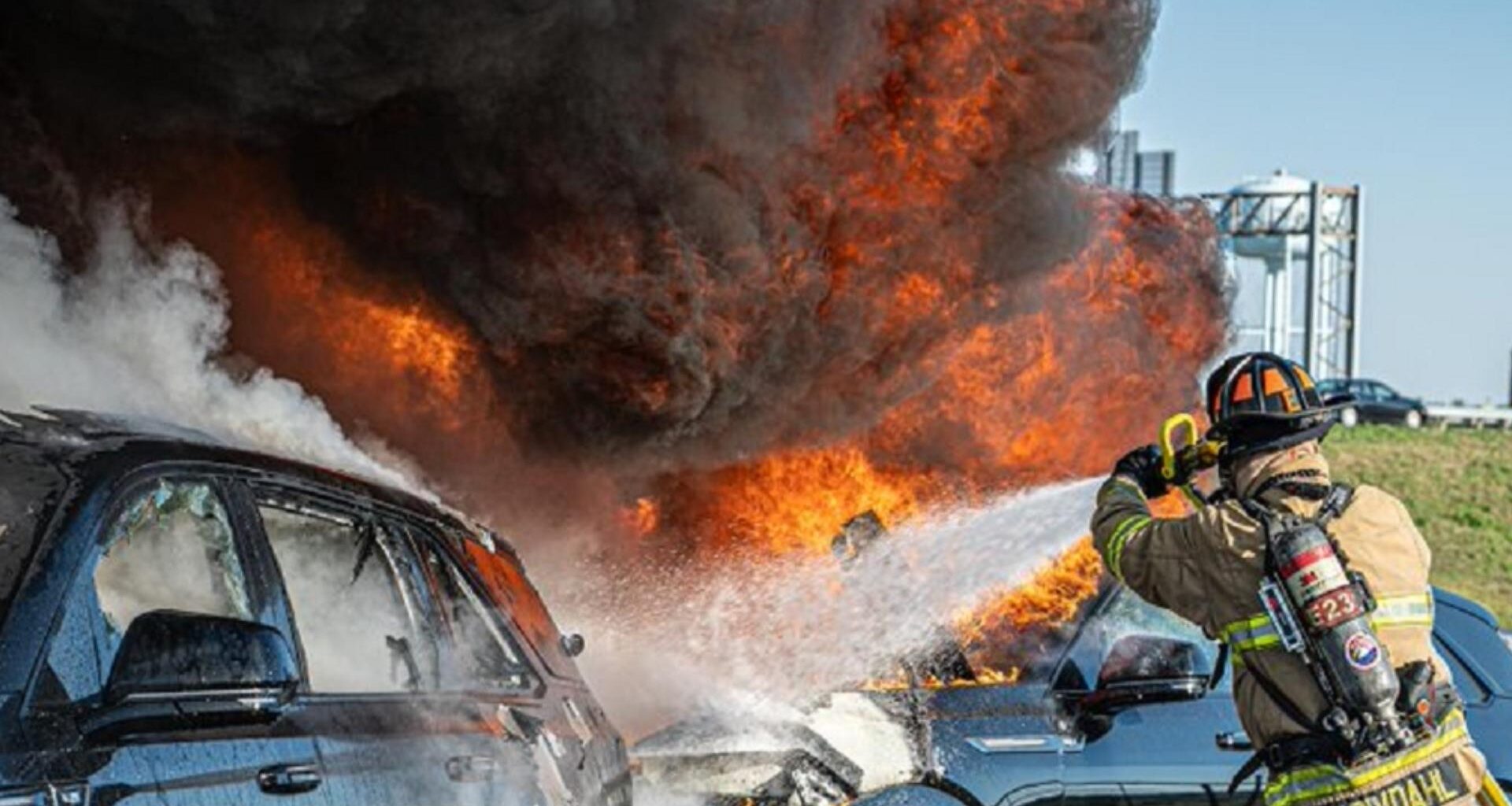
“We have not responded to a scene like this,” a Fort Worth Fire Department spokesperson said.
FORT WORTH, Texas — The smoke has cleared after a fire in West Fort Worth burned for more than 17 hours, destroying several electric vehicles and highlighting the unique challenges and potential health risks firefighters face when responding to electric vehicle fires.
According to the Fort Worth Fire Department, eight electric vehicles caught fire, creating a complex and hazardous scene unlike anything some local responders had previously encountered.

This story continues below.
“We have not responded to a scene like this,” FWFD Spokesperson Craig Trojacek said.
Unlike conventional vehicle fires, electric vehicle fires involving lithium-ion batteries can be particularly difficult to extinguish. Even after flames appear to be out and the smoke is gone, damaged batteries can reignite hours or even days later, complicating firefighting operations and requiring extended monitoring.
“You can’t put them out,” Trojacek said. “There are documented cases that some of these things, you can appear to put them out, and then up to — there have been some cases 28 days later — they’re sitting in a field somewhere, and they reignite.”
But the challenges extend beyond putting out the flames and smoke. Officials and researchers say electric vehicle fires can release hazardous gases and ultrafine metallic particles, creating additional risks for firefighters, the surrounding environment and potentially the public.
The Texas A&M Engineering Extension Service, known as TEEX, has studied the potential dangers associated with lithium-ion battery fires. Its research has examined the toxic substances and metallic particles released during battery thermal runaway, a process in which a battery overheats and can trigger a chain reaction.
Gordon Lohmeyer, assistant agency director for strategic initiatives and business strategy at TEEX, said measurements from battery thermal runaway tests revealed metallic particle concentrations far above established exposure thresholds.
“We measured in these different battery thermal runaways 12,000 to 17,000 times EPA’s allowable threshold for metallic particle that were transferred from the battery into the gear,” Lohmeyer said.
The findings underscore why electric vehicle fires are treated as hazardous materials incidents and why specialized training and protective equipment are critical for first responders.
According to Lohmeyer, a significant portion of a battery’s original mass can be lost during a fire, with a large majority of that material becoming airborne particulate matter.
“There was typically somewhere 50% or less of the battery remaining by weight,” Lohmeyer said. “What happened to the battery? Well, a lot of the battery becomes airborne particulate matter.”
Those particles can settle on firefighters’ protective clothing and equipment, creating potential contamination concerns even after crews leave the scene.
Trojacek said FWFD must evaluate equipment exposed to hazardous smoke and residue to determine whether it can be safely cleaned or needs to be destroyed.
“With our hazmat teams and stuff being out here, sometimes those sets of bunker gear are destroyed,” Trojacek said. “And so they’ll go back and figure out what’s actually in the smoke. They’ll do all the studies to see what that looks like and if that gear can just be cleaned or if that gear needs to be destroyed.”
That process adds time, cost and logistical challenges to an already complicated emergency response. Firefighters must not only extinguish the fire but also account for possible battery reignition, assess contamination and protect personnel from exposure.
As electric vehicles become more common, emergency response agencies across the country are adjusting their standard operating procedures to address the technology’s unique hazards.
TEEX has emphasized the importance of preparing responders through specialized training, hazard awareness and appropriate safety practices.
“We want to make sure that everybody goes into the response with a knowledge, with a training, and with safety in mind,” Lohmeyer said.