
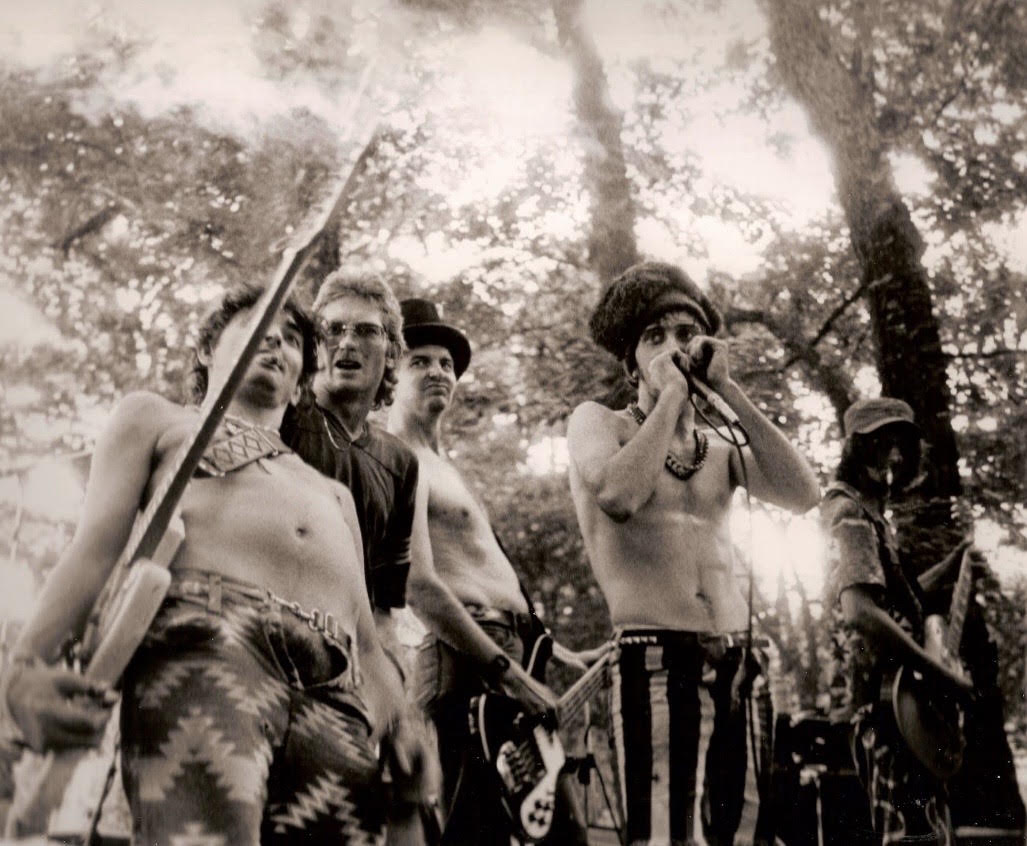
On Friday, close to 75,000 people will pack Zilker Park for the Austin City Limits Music Festival weekend two. ACL’s emergence as a premiere music festival, alongside South by Southwest’s international explosion, demonstrates Austin’s evolution from outsider hub to global music powerhouse. Before the city had starpower, though, it had Woodshock.
After an unhinged first iteration at Waterloo Park in 1981, Woodshock’s attendance grew through the early 80s, becoming a crossroads for the disparate sounds that populated Austin’s DIY punk scene. The 1985 edition at Hurlbut Ranch in Dripping Springs became iconic thanks to an experimental documentary made by “Dazed and Confused” director Richard Linklater, the young filmmaker capturing the all-night festival’s controlled chaos with disorienting shots of its makeshift outdoor stage and cliff jumpers splashing into a nearby swimming hole.
Most bands played for free at Woodshock; the $5 cover fee went to a small production budget that organizer Jeff Smith compared to the cost of 100 beers at ACL. In the 1985 installment, Smith and his country-punk crossover band, the Hickoids, played a delirious sunrise set.
“It’s kind of like the original Woodstock,” said Smith, who spent a few years at UT before dropping out to tour with the Hickoids. “If you remember it, you weren’t there.”
Smith arrived at UT near the height of the Texas punk boom, which had found a home in Austin. After leaving California for UT in 1982, Poison 13 guitarist Bill Anderson (RTF, ‘85) said Austin provided an anything-goes alternative to the exclusive macho energy that defined the Southern California punk scene.
“It wasn’t necessarily a style of music,” Anderson said. “It was more like an approach toward things. The DIY aspect of it, to me, was the most important thing.”
Though Austin punks sounded aggressive, bands often wove absurd humor and earnest positivity into their message. UT alumna Deb Pastor, who took countless photos at punk shows, including Woodshock, said beloved acts like the Big Boys added a soulful element.
“They looked scary, but their music was all about love and friendship and good times, and you could dance to it,” Pastor said.
The Big Boys’ local peers, including cult heroes like Daniel Johnston, The Butthole Surfers and Scratch Acid, filled most Woodshock lineups. 1985, however, brought influential visitors in the form of Seattle’s U-Men and Sacramento’s Tales of Terror, bands whose blend of heavy metal and hardcore punk influenced the grunge sound that took over early ‘90s mainstream airwaves.
“There’s a music writer who passed away a couple years ago named Michael Corcoran,” Smith said. “He wrote an article claiming he saw the birth of grunge at Woodshock. I wouldn’t necessarily say that’s the exact case…but that’s where it was headed.”
After being forced out of Dripping Springs in 1987, Woodshock struggled to find a comparable venue, and the punk scene’s gradual decline spelled the end for the festival. Smith made an “ill-advised” revival attempt in 2001, and former Austin scenester Clay Allison’s endeavor around 2022 also failed to measure up to the original.
“We had really no rules and no budget,” Smith said. “It’s pretty difficult to do anything on that basis nowadays.”