
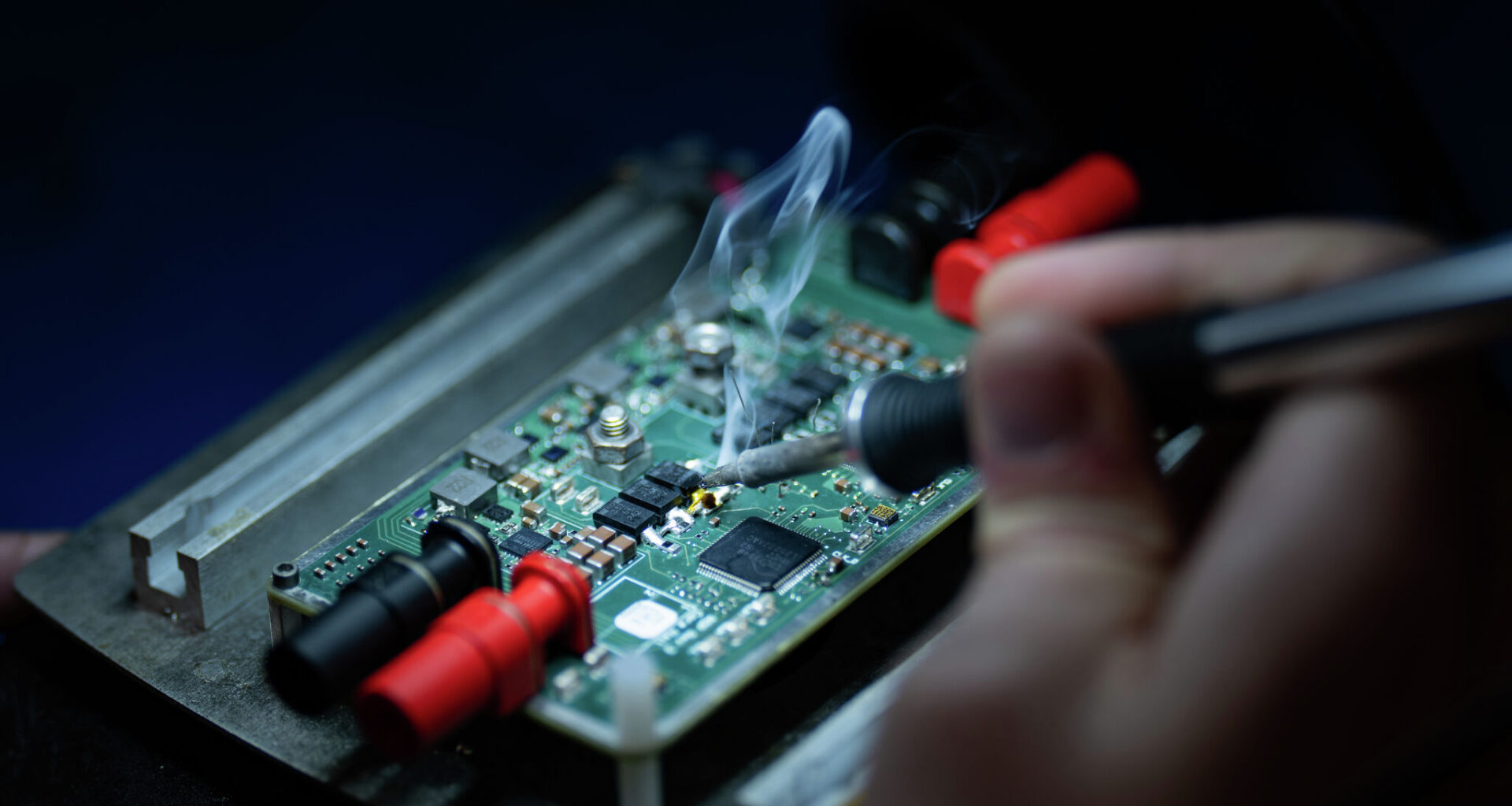
A power electronics engineer works on a circuit board at CesiumAstro in Austin on Oct. 7, 2026.
Mikala Compton/Austin American-Statesman
CesiumAstro needs another 500 people to build communication satellites in Central Texas.
The company launched its first operational satellite this month and is preparing to build hundreds more at its headquarters outside of Austin. Finding and training people to work there is among the company’s top priorities, said Shey Sabripour, founder and CEO of CesiumAstro.
“One of the biggest lessons I’ve learned as we scale CesiumAstro isn’t about technology, manufacturing or even fundraising. It’s talent,” Sabripour said in a statement. “Raising capital is challenging, but finding and developing the workforce required to support the next generation of space innovation is even harder.”
Article continues below this ad
The U.S. space economy could add 300,000 high-paying jobs over the next decade and generate $428 billion in economic value, according to a report from the Space Workforce Incubator for Texas, or SWIFT.
SPACE ACADEMY: Trump announces U.S. Space Academy to train future NASA workforce during trip to Houston
CesiumAstro employees, including Alex Tucker on the left and Marian Shaffer on the bottom right, are seen working on various tasks. The company put its first operational satellite into space this month.
Left and Bottom Right: Mikala Compton/Austin American-Statesman; Top Right: CesiumAstro
CesiumAstro employees, including Alex Tucker on the left and Marian Shaffer on the bottom right, are seen working on various tasks. The company put its first operational satellite into space this month.
Left and Bottom Right: Mikala Compton/Austin American-Statesman; Top Right: CesiumAstro
This need for workers is already being felt across Texas as NASA pushes toward the moon and the commercial sector – benefitting from cheaper rocket launches and advanced technologies – launches more hardware into space.
Community colleges, universities, Texas’ Congressional delegation and the Texas Space Commission are racing to create a workforce that will ensure the state’s space legacy continues.
Article continues below this ad
Space companies struggle to forecast how many workers they’ll need. High school students don’t have a clear path to becoming an industry tradesperson as there aren’t national certifications. Hiring can fluctuate, leaving community colleges unable to have year-round cohorts of students, and workers are being courted by other fast-growing sectors, such as semiconductor and advanced manufacturing.
“As an industry, we are just racing to get to the next thing,” said Elaine Ho, associate administrator for NASA’s Office of STEM Engagement. “We are focused on the mission, on the next requirement, on the next deliverable, and workforce tends to be that secondary thought.”
To address this, NASA is helping the Texas Space Commission create an online platform for jobs that don’t require a bachelor’s degree. Several universities have beefed up their engineering programs. And Texas’ congressional delegation is pushing to become home to the U.S. Space Academy, which will be similar to military academies but led by NASA to mainly train civilians.
CesiumAstro has an internship program, and Sabripour said he’s focused on recruiting talent at every level. It currently has more than 850 employees.
Article continues below this ad
“This isn’t just a CesiumAstro challenge,” he said. “It’s an industry-wide opportunity.”
Space cowboys
Skilled technical workers – people without a college degree who are trained in welding, electronics and other trades – are becoming increasingly important as companies like CesiumAstro move from research and development into production, said Leon Vanstone, vice president of SWIFT.
Last year, SWIFT found that 47% of the nation’s entry-level space job openings required only a high school diploma. One-third of the jobs sought a technical certificate or standard for positions that included welders, machinists and crane operators.
“The majority of the economic value created by the space economy over the next decade will not come from people who design rockets,” the organization stated in a new report shared first with the Houston Chronicle. “It will come from the people who build them, at scale, on schedule, day after day. That workforce is the space cowboy.”
Article continues below this ad
SWIFT is analyzing thousands of job listings to build a profile for each type of job, including descriptions of the positions and the experience, education and certifications that employers ask for, Vanstone said. SWIFT is using this information to help high schools and community colleges build curricula around what employers actually need.
SKILLED WORKERS: Texas needs ‘space cowboys’ and statewide talent pipeline to become a hub for space companies
Yaohui Lu, a professor of engineering technology, and Arnad Roy, an aerospace instructor, work with San Jacinto College Engineering Tech students during a composites lesson at the EDGE Center at the Houston Spaceport in Houston on Oct. 6, 2026.
Raquel Natalicchio/Houston Chronicle
San Jacinto College Engineering Tech students learn about composite materials and the process used to manufacture composite components for aerospace and space hardware at the college’s EDGE Center at the Houston Spaceport in Houston on Oct. 6, 2026.
Raquel Natalicchio/Houston Chronicle
San Jacinto College Engineering Tech students learn about composite materials and the process used to manufacture composite components for aerospace and space hardware at the college’s EDGE Center at the Houston Spaceport in Houston on Oct. 6, 2026.
Raquel Natalicchio/Houston Chronicle
In Houston, San Jacinto College began its aerospace programs at the Houston Spaceport after the region lost a rocket engine manufacturing deal in 2017. It also designs and provides specialized training for local businesses, said Sallie Kay Janes, associate vice chancellor of continuing and professional development at San Jacinto College.
When these companies have an opening, Janes said, it gets filled quickly. But the businesses are focused on a handful of large structures rather than mass production. San Jacinto College is starting to look at the industry’s suppliers for additional places where students could find jobs. Because right now, there isn’t enough work to have large cohorts of students year round.
Article continues below this ad
Hiring from these companies can also fluctuate based on NASA’s budget and contracts. “The demand on the aerospace side has its ebbs and flows,” Janes said. “When they get a contract, one company may send us quite a few.”
SWIFT believes it’s time for schools to become picky about their students – and for companies to know where they can recruit the best talent, Vanstone said. The nonprofit is using its job profiles to create a nationwide ranking system.
“Every single community college in this country cannot start a titanium orbital tube welding program because the whole country maybe only needs 100 of them a year,” he said. “You have to find your centers of excellence.”
‘More than just a jobs.com’
The Texas Space Commission is creating an online platform for space jobs that don’t require a bachelor’s degree. This platform, funded by $1.5 million from NASA, will connect job seekers to companies and walk them through the training and certification required for certain positions.
It should be available in the Houston area next year and then later expanded across the state.
Norman Garza Jr., executive director of the Texas Space Commission, compared the platform to shopping for a car online – which he said is currently easier than learning how to become qualified for space jobs – but promised it will be “more than just a jobs.com.”
“Why isn’t there something as simple,” Garza said, “as me saying, ‘I live here. I want to work there. Where can I get trained? What are the programs? Who does it? How long is it going to take?’”
Abbott’s challenge
After Gov. Greg Abbott challenged schools to create a space engineering degree in 2024, Texas A&M started space engineering graduate and undergraduate programs. These are different from its aerospace engineering degrees because aerospace engineering gets people off the Earth while space engineering enables them to live there.
Texas Tech University added a bachelor’s degree and minor in aerospace engineering this fall, and the University of Houston is developing a bachelor’s degree in aerospace engineering that should be available in 2028 – complementing its current master’s degree and undergraduate minor. Rice University is working to add an aerospace engineering concentration.
FUNDING: Rice University wins $22.3 million to launch two new space research centers
SWIFT President Geoff Tudor (left) poses for a photo with the Rice University Eclipse Rocket Team and their Archimedes II rocket in 2025 at the International Rocket Engineering Competition in Midland, Texas. The team, which was funded by SWIFT, won first place in the 30,000-foot hybrid division.
SWIFT
At the doctoral level, UT San Antonio started an aerospace engineering Ph.D. program this year. Its analysis found that Texas has 200 doctoral-level aerospace engineering job openings each year while state universities only graduate 40 students.
A doctorate was the next logical step from its aerospace engineering master’s degree and undergraduate certificate, which have both had “immense student interest,” said Chris Combs, associate dean of research at the University of Texas at San Antonio.
“We’re in a bit of a golden age of space that we haven’t seen in a long time,” Combs said. “People want to be part of that, and there is a big job demand.”
And as NASA becomes increasingly dependent on commercial companies, the University of Houston isn’t just seeing demand for engineers. It’s seeing a need for managers and business majors, too, said Karolos Grigoriadis, chair of the University of Houston’s Department of Mechanical and Aerospace Engineering.
“It’s not just the typical notion of a rocket scientist,” Grigoriadis said. “The need is increasingly interdisciplinary.”
A diverse talent pool is important to Blue Origin, said Summer Webb, Blue Origin’s government relations director for Texas, who spoke at SWIFT’s Ecosystem Space happy hour in Austin.
She said Blue Origin chose to build a new satellite manufacturing campus outside of Austin partly because of the area’s engineering talent from the University of Texas at Austin – which also has aerospace engineering degree programs – and from local community colleges and trade schools.
“If you want to continue to grow aerospace in Texas, you have to grow the support systems, the technicians, the engineers, the actual labor force to do it,” Webb said. “I would just really, really encourage you to continue to do that and focus in on the jobs, the skills and the supply chain.”
Moon and Mars
Universities are also opening space labs and facilities to give students hands-on experience.
Rice University opened a center in June that’s developing technologies to turn the moon’s dirt into hand tools or vehicle parts. David Sholl, executive vice president for research at Rice, said it will become cheaper to make these items on the moon than to launch them into space.
And in late November, Texas A&M is opening a facility outside the Johnson Space Center that will have the equivalent of two football fields recreating the moon and Mars. This will allow companies and researchers to test spacesuits, tools and rovers before sending them into space.
“The real advantage for Houston is that we’re a place where people can make things for the physical world,” Sholl said, “and then scale those technologies.”