
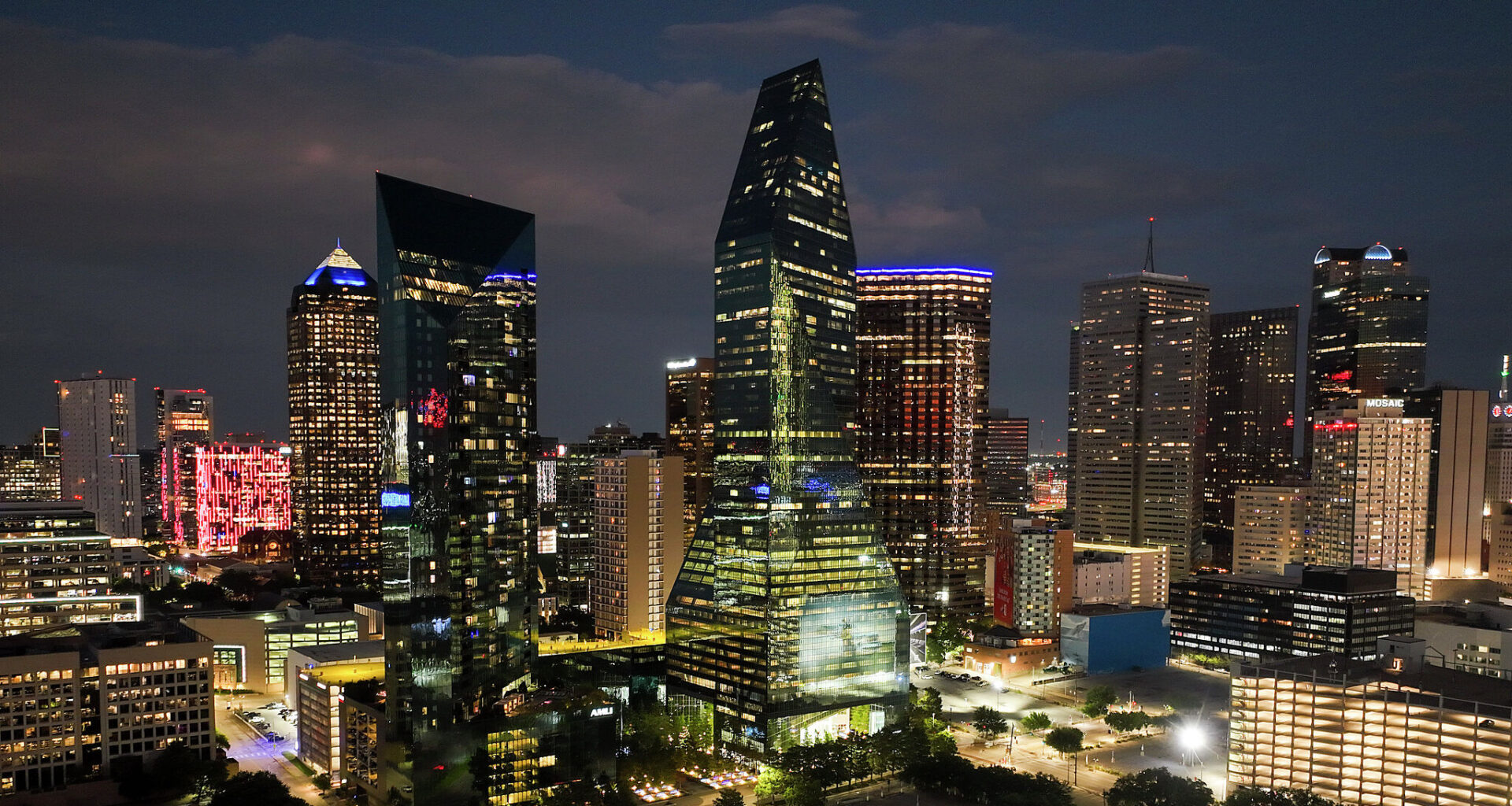
Downtown is entering a new chapter — one that is less dependent on traditional office space and increasingly defined by residents, visitors, entertainment, culture and new experiences, writes Kimberly Bizor Tolbert.
Smiley N. Pool/The Dallas Morning News
Dallas is in the midst of a major transformation. As city manager, I see that momentum reaching more corners of our city every day — not simply as growth, but as an opportunity to lift every neighborhood, especially those in the urban core and southern Dallas.
Dallas is investing, building and redefining what a major American city can be. Our responsibility is to ensure the benefits of that progress are widely shared.
Article continues below this ad
For decades, Dallas was known as a lower-cost alternative to the coasts. Today, we are increasingly emerging as a financial capital in our own right. Companies are choosing Dallas for our talented workforce, central location, global connectivity, quality of life and pro-business environment.
Morgan Stanley’s decision to establish a major U.S. hub here is a powerful affirmation of that trajectory. The company plans to create more than 3,800 jobs, anchored by a new 700,000-square-foot Uptown office. The project represents $1.2 billion in new investment in Dallas and reinforces our growing role as a center for finance, talent and innovation.
The rise of “Y’all Street” reflects this evolution. Financial firms are clustering around downtown, Uptown and Victory Park, creating a genuine financial corridor in the heart of the city. The Texas Stock Exchange, which began trading this year, adds another important piece to that ecosystem. Together, these investments are helping establish Dallas as a place where capital is raised, deals are made and companies make strategic decisions.
But the transformation of the urban core extends well beyond finance. Downtown is entering a new chapter — one that is less dependent on traditional office space and increasingly defined by residents, visitors, entertainment, culture and new experiences. Downtown Dallas Inc.’s Big Ideas. Bold Action. Downtown Vision 2036 provides an ambitious roadmap for that evolution, and we are excited to partner with DDI to help bring it to life.
Downtown’s transition from a traditional office center into a more diverse, 24-hour neighborhood creates an opportunity to create a stronger, more vibrant urban core.
Article continues below this ad
The expansion of the Kay Bailey Hutchison Convention Center Dallas will accelerate that transformation. One of the largest civic investments in a generation, the reimagined 2.1-million-square-foot campus is planned to open in 2030 and anchor a walkable new district with hotels, housing, restaurants, retail and public spaces. It will strengthen Dallas as a destination for conventions, tourism and entertainment while creating new connections between the urban core, The Cedars, South Dallas and surrounding communities.
Taken together, these investments are reshaping the heart of Dallas — from a place where people primarily come to work into a place where people work, live, visit, invest and build the future.
Southern Dallas at the center
At the same time, some of Dallas’ most consequential growth opportunities are unfolding in southern Dallas. This is not simply a story about bringing investment to communities that have been historically underserved. It is about recognizing southern Dallas as a major growth frontier for the entire city — one with the land, talent, institutions and cultural assets to drive Dallas’ next chapter of economic growth.
Across southern Dallas, we are pairing infrastructure and public investment with private development, housing, education and business growth. From Fair Park to University Hills, from RedBird to Hensley Field, these investments are creating the foundation for new neighborhoods, new businesses, new jobs and new destinations.
Article continues below this ad
Halperin Park, the new deck park over Interstate 35E, illustrates what transformational infrastructure can accomplish. The five-acre “park with a purpose” reconnects Oak Cliff neighborhoods divided by mid-century freeway construction while creating new public space, pedestrian connections and amenities for residents. The $300 million public-private investment is projected to attract roughly two million visitors annually and generate about $1 billion in economic impact during its first five years. Just as important, it creates a lasting community asset with playgrounds, gathering spaces and shaded promenades.
University Hills, a 280-acre mixed-use development by Hoque Global near the University of North Texas at Dallas, demonstrates the scale of private investment taking root in southern Dallas. The more than $1 billion development is transforming previously undeveloped land into a new community with housing, commercial space, green space and neighborhood amenities. With the first phase now under construction, University Hills shows how public infrastructure and private investment can work together to create new places to live, work, invest and do business in southern Dallas.
The Forest Theater represents another kind of catalytic investment — one rooted in culture, history and community identity. The historic South Dallas landmark is being restored and expanded by Forest Forward into a new performing arts and creative education hub, with performance venues, creative studios, educational space and neighborhood-serving retail. The project is bringing a treasured community landmark back to life while creating a new anchor for revitalization along Martin Luther King Jr. Boulevard.
And in just a few weeks, Dallas will see a powerful symbol of that renewal: on Nov. 1, the Forest Theater’s iconic tower and marquee will be illuminated for the first time in more than 50 years. It is a visible reminder that southern Dallas is not waiting for its future — it is building it.
These projects represent different kinds of investment, but together they tell the same story: Southern Dallas is becoming a center of growth, opportunity and destination-making for the entire city.
Article continues below this ad
The responsibility ahead
These investments reflect a simple strategy: Quality job growth in the urban core, combined with catalytic investment in southern Dallas, can create a stronger and more connected city.
Our responsibility is to sustain that momentum while building on recent progress in public safety and homelessness, and continuing to protect affordability. We will remain focused on making Dallas safer, more welcoming and more livable as the city grows. Growth is most meaningful when it expands opportunity and improves quality of life for all Dallas residents.
The future of Dallas is a stronger urban core and a stronger southern Dallas, growing together to create opportunity across the entire city.
Article continues below this ad
Kimberly Bizor Tolbert is the city manager of Dallas.