

The Hideout Theatre never expected to hold performances at an office park in North Austin.
Last year, it was forced to leave its home of 26 years on Congress Avenue after the building’s new owner decided to turn the space into a bar. The theater signed a lease for a new location in South Austin, but that plan fell through.
With a move-out deadline approaching, the Hideout turned to its annex on North Lamar, where it already held improv classes and workshops. What had been a typical office with a couple of large rooms, a kitchenette and a bathroom has become its temporary performance home.
“Now that we’re using it as our home base, we’ve completely transformed it,” artistic director and co-owner Roy Janik said.
Recapturing an old feeling
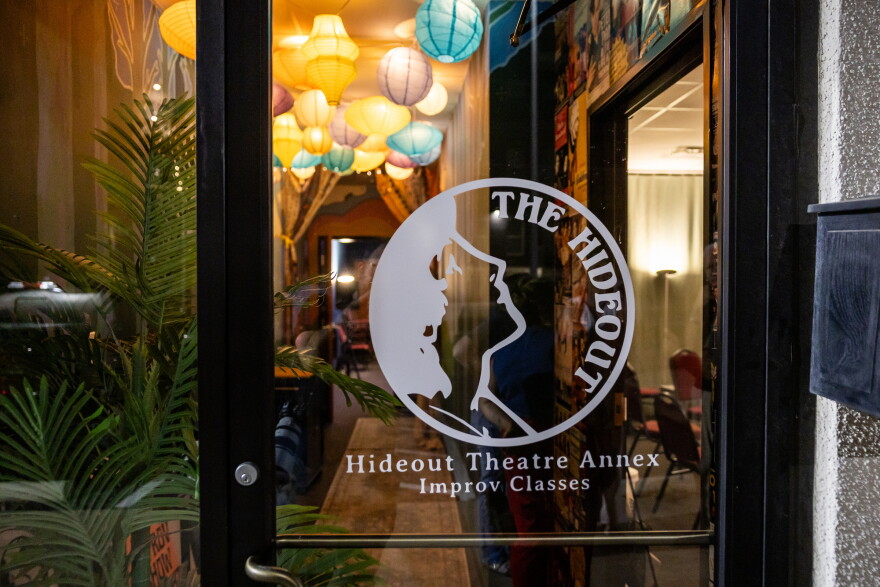
The hallway is decorated like a forest. Paper lanterns sparkle overhead.
A team of volunteers helped designer and improviser Kaci Beeler convert the front room into the Stargazer Lounge and the back room into a 40-seat theater. They brought along a mural Beeler painted in 2009 for the Congress Avenue location and installed it in the lounge.
“So now that same mural that everyone walked past for, you know, 16 years, is here to provide some continuity,” Janik said.
The stage came from the old location’s upstairs theater. Behind it, Beeler painted a new mountain vista mural on removable panels. The Hideout’s logo is the centerpiece.
“The back mural is so pretty,” education director and co-owner Jessica Arjet said, “and it’s so enlivening that having our little stage and our risers there just transformed the space into feeling like it really is a space dedicated toward creating improv.”
Michael Minasi
/
KUT News
The Hideout Theatre converted the front room of its annex on North Lamar into a lounge and the back room into a 40-seat theater.
The annex is smaller than the Hideout’s former home, which had an 89-seat theater downstairs and a 49-seat theater upstairs.
“Until we did the first show here, I was really worried that it wasn’t going to work,” Janik said.
But the smaller room has brought its own advantages, including new neighbors who have become regular audience members and a closer connection between performers and the crowd.
“You feel immediate connection to the audience even in a way that our smaller theater at the old space didn’t have,” Janik said.
“There’s a coziness in this theater,” Arjet added. “There’s a feeling of intimacy and just possibilities.”
‘A weird middle place’
For Janik, the annex’s design reflects where the Hideout finds itself: a stop along a longer journey.
“You’re hiking through the woods as you come in through the hallway. Then you come out here to basically an outpost, where you take a breath and a moment to relax, and that is kind of the story of the annex as well,” he said. “It’s our outpost as we gather our strength for the journey ahead.”
To help plan that journey, the Hideout is participating in a program called Immersion, created by Artspace, a national nonprofit that helps arts organizations develop plans for their space needs and learn about the real estate industry.
“It’s our outpost as we gather our strength for the journey ahead.”
Roy Janik, Hideout Theatre co-owner
The Hideout is one of six Austin arts organizations selected for the cohort, funded by the Moody Foundation. The program began in May and runs through December. Each month, participants develop plans for their space needs and learn about the real estate industry.
“The thing I find hopeful is that we’re paring down to the essentials,” Janik said. “And it’s an opportunity to be like, ‘What do we really value? What’s worth growing? What’s worth redirecting in terms of what we do?’”
Over the past 10 years, many Austin theaters have had to relocate or close.
“We find ourselves in a weird middle place, which is not what I expected, but I think is a really interesting place to be,” Arjet said. “And frankly, it’s very improv-like, you know? Instead of choice A or choice B, you go choice banana, and that’s what we’re in right now is the banana choice. And we’ll see how that plays out. I really have a lot of profound hope and vision that this is gonna be really cool.”
Dreams for the future Hideout
At the annex, that future is taking shape alongside the everyday work of classes and performances. On a recent evening, students arrived for an advanced improv class.
“The Hideout is a place where anybody can show up any way and explore who they are right then, even if they have goals for who they want to be in the future,” longtime Hideout performer Danielle Devorona, who was teaching the class, said. “You know, you can be yourself and you can dream big.”
The owners are doing some dreaming of their own. Janik hopes a future Hideout will have a 200-seat theater, a second theater, classrooms, and a coffeehouse again.
For now, Arjet said, the transition has its own rewards.
“It’s just gonna maybe take us a little bit longer to get there, but even this transition process, even being in this smaller space, is just, it’s a kick,” she said.
The annex gives the Hideout a place to keep performing while its owners work toward that larger vision.
“We’re laying the foundations now,” Janik said. “We’re doing that work of figuring out what’s important to the Hideout and showing the community that we have a place to perform, and the magic is still there.”