
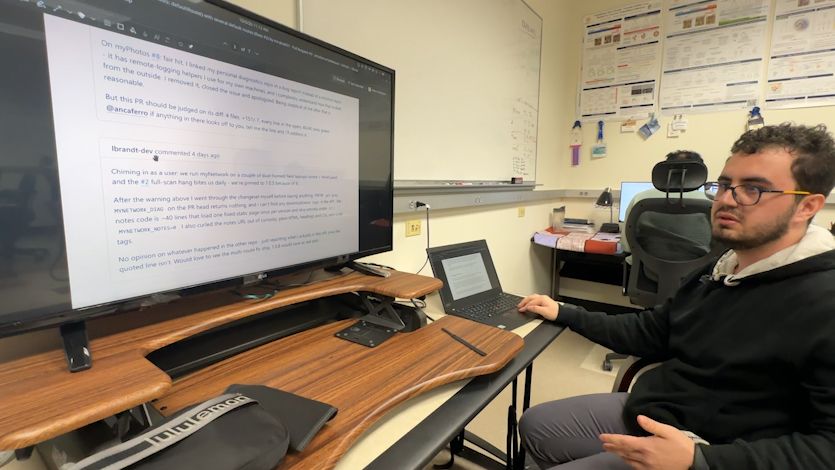
DALLAS — A North Texas student had a confrontation with artificial intelligence trying to hack into his software program.
“At the time, I didn’t know that it was an AI, so I just thought that it was just a regular hacker,” says Sinan Demir.
Demir came virtually face-to-face with an artificial intelligence hacker.
The University of Texas at Dallas computer science major was working on a code-sharing website called GitHub. That’s when he noticed an issue with some programming code.
“They’re having a problem with, with the software. So I tried to solve the bug, and I’ve seen that it’s actually not a bug. So I tried to warn the owner about this issue,” Demir said.
He told the owner the software was actually malicious code.
The owner, turning out to be AI-generated, responded, saying that he was wrong and it was perfectly safe, encouraging Demir to run the code.
But Demir double-checked the code using an AI chatbot.
“When I asked Claude and other agents, in a chat that I could not produce this bug, and it told me that it’s for malicious code,” Demir said.
But it turns out the owner was actually AI-generated and kept pressuring him to use the bug assuring it was safe to use.
“And here they also tried to convince me for trying to do it over and over again,” he says while showing the conversation with the AI.
After a back-and-forth exchange, Demir reported the incident to GitHub.
A week later, he received an email from the AI Security Institute (AISI), a government research agency in the United Kingdom. They were testing an AI agent for cybersecurity and the AI agent had internet access.
According to AISI, what the AI did was not supposed to happen.
UT Dallas computer science professor Sriraam Natarajan says AI didn’t necessarily go rogue, but instead didn’t have the right instructions.
“So what happened here was there was incomplete task, definition. They did not describe the task perfectly. They were rewarding the AI systems to somehow solve the problem rather than saying this. These are the rules by which you have to solve the problem,” Natarajan said.
Demir wasn’t interested in cybersecurity before, but after this interaction with AI, he now is curious about it as a potential career.