
Digital subscribers can listen to this article.
Subscribe today for unlimited access to Texas Monthly. Already a subscriber? Log in.
Travis Iles was rarely summoned for a sit-down meeting with the governor’s team. The call had come late in the workday, and an adviser to Greg Abbott had told him to report to the state insurance building in the morning for an urgent discussion.
A tall 53-year-old with short, dark hair and deep-set eyes, Iles had spent nearly 25 years at the Texas State Securities Board, including 7 as commissioner. He took great pride in leading an agency that cracked down on unscrupulous cryptocurrency lenders and oil and gas grifters all while serving as the state’s “cash cow,” as he puts it. Under his watch, the securities board had brought more than a billion dollars into the state’s coffers. He had worked with the governor’s team many times before, and he rearranged his schedule to accommodate theirs.
Around mid-morning on March 25, 2025, the adviser who had called him, Daniel Mittnacht, a seasoned policy hand with thick black hair, met him in the lobby and escorted him to a windowless fourth-floor conference room. Two of Abbott’s lawyers joined them, each holding a document.
As Iles took a seat, he picked up a copy printed for him and slowly flipped through it. It bore no letterhead, date, subject line, or any indication of who, exactly, the author was. Each page was stamped with a confidentiality marking. The text opened with a grave warning that “foreign adversarial interests” might be seeking to “abuse” Texas’s economic opportunities and religious freedom, “exploit” the state’s resources, and “undermine our communities from the inside.” From there, the memo identified the threat: the East Plano Islamic Center, a mosque and Muslim community in North Texas known as EPIC.
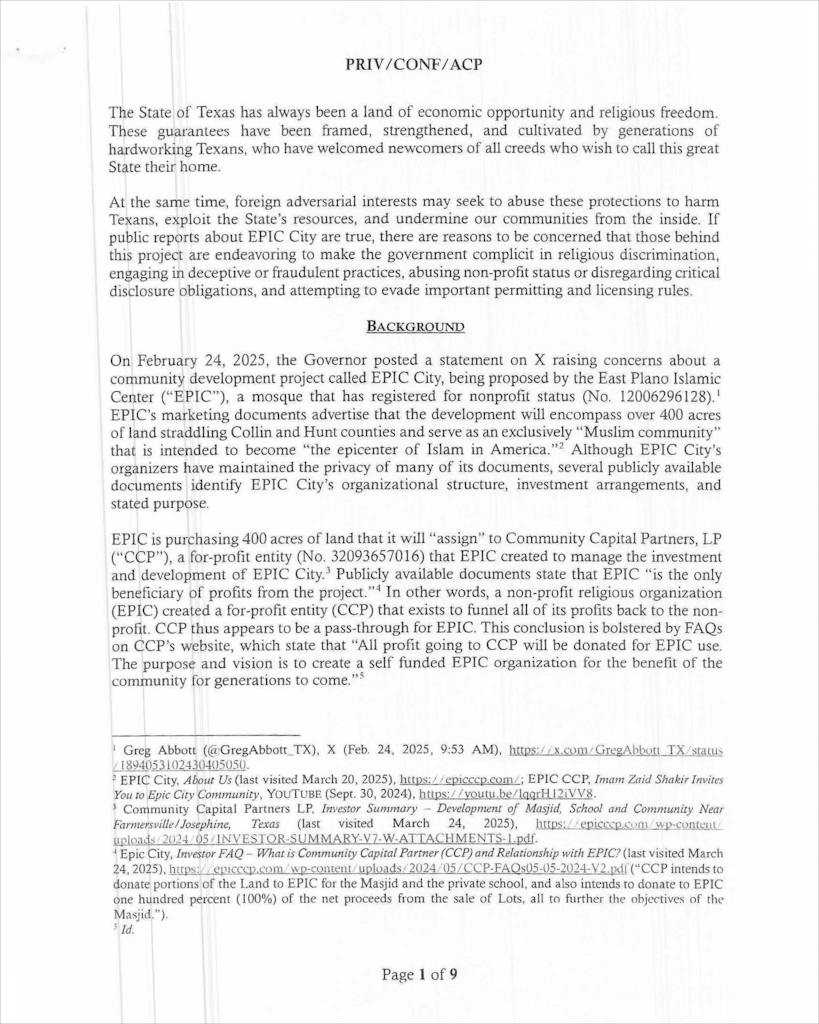 The first page of a nine-page memorandum laying out a plan for official government action against EPIC, obtained via public information request.Obtained via public information request
EPIC had been facing escalating right-wing backlash after anti-Muslim activists had begun spreading unfounded claims that the mosque was building a Muslims-only housing development in Collin and Hunt Counties. It was not. The congregation, which has called Plano home for more than two decades, had been pushing forward with a 402-acre project called EPIC City that would bring more than a thousand homes, plus a school, a mosque, and retail stores, to the growing Dallas–Fort Worth area. The falsehoods gained traction online—and in short order, Abbott amplified them. “To be clear, Sharia law is not allowed in Texas,” he tweeted in February 2025. “Nor are Sharia cities.”
That post was referenced in the document Iles scanned, a copy of which was obtained by Texas Monthly. Across its nine pages, the document examined the parts of the Texas government that could conceivably be brought to bear against the mosque and Muslim community, laying out a road map for turning the online Islamophobic campaign against EPIC into official government action. It advanced theories that the mosque might be subject to constitutional restrictions ordinarily applied to governments, as well as to laws pertaining to fair housing, consumer protection, investor disclosures, corporate and nonprofit governance, taxes, and funeral licensing. One paragraph suggested EPIC could be prosecuted for material support for terrorism.
Sitting across from Iles, Trevor Ezell, Abbott’s general counsel, and Caleb Gunnels, an assistant general counsel, explained the document page by page. One section in particular was relevant to Iles’s agency. The memo raised concerns about EPIC City’s investment offerings and whether buyers were being told enough about what they were purchasing. Iles’s investigators possessed the expertise—and statutory authority, if the facts warranted it—to transform suspicions about the housing development’s finances into a securities case that Attorney General Ken Paxton could then take to court.
By the end of the roughly 45-minute briefing, Iles was ready to open an investigation. There was nothing more exciting to him than catching a fraudster hurting the little guy—work, he said, that was “completely apolitical.”
“You protect investors,” he told me. “You can be a Republican, you can be purple, you can be blue. Your constituents are all gonna agree with you if you support protecting investors.”
Knowing that the governor’s office had a special interest in the EPIC probe, Iles pulled together a core team of six career regulators and attorneys to handle the case, including one of the agency’s top financial investigators. Guarded and lawyerly, Iles kept things by the book.
He would soon learn that the EPIC investigation wasn’t like any other he had overseen. His team would conclude there was no case for the agency to bring against EPIC City. That wasn’t the answer some of the state’s top elected officials were looking for, though. And they would find a way to bring a case, no matter Iles’s protestations.
The securities board was not the first agency pulled into the governor’s campaign against EPIC, and it would not be the last. Within days after Iles met with Abbott’s team, the theories in the document he’d been handed began reappearing publicly in press releases announcing inquiries and official investigations by the Office of the Attorney General, the Texas Workforce Commission, the Texas Funeral Service Commission, the Texas Rangers, and the Texas Commission on Environmental Quality.
Each of these agencies launched an investigation in pursuit of potential “discrimination,” “violations,” or “illegal activities.” But thousands of pages of internal emails, court records, memoranda, calendars, and files reviewed by Texas Monthly—alongside interviews with people with direct knowledge of the events—show that some of Abbott’s closest advisers steered many of the probes into EPIC, often breaking well-established state-agency protocols.
In a statement, Andrew Mahaleris, the governor’s press secretary, portrayed the advisers’ involvement in the EPIC investigations as a routine exercise of executive authority, describing state agencies as “ultimately accountable” to Abbott. “The Governor has been clear that entities that seek to impose Sharia law in our communities are not welcome in Texas,” he continued. “Governor Abbott will take action against any group that seeks to violate our Constitution and laws, regardless of faith.”
Texas Monthly has previously reported on the funeral commission’s investigation, documenting how the governor’s inner circle hijacked the agency’s independent probe and steered it to legally harass EPIC. The securities board’s investigation reveals just how far the governor’s staff went to advance the campaign against the mosque—and what happened to officials who stood in the way.
Usually, the securities board does not announce its cases before reaching a determination of fault, so as not to give the impression that potentially innocent entities may have broken the law. That wouldn’t be the case this time. Iles said Mittnacht, who did not respond to multiple interview requests, called him shortly after their meeting at the state insurance building and instructed him to issue a press release announcing the investigation into EPIC.
Iles was initially hesitant, but it wasn’t a hill he wanted to die on. Instead, he sought a middle ground, working with his team to publish a bare-bones, one-sentence statement affirming that the agency had “opened an investigation into the East Plano Islamic Center and affiliated entities.”
The governor’s office trumpeted the investigation the same day with its own press release, announcing the probe into EPIC “for potential failures to comply with applicable state and federal securities requirements, including protections against fraud.” It was accompanied by a statement from Abbott: “All entities in Texas must follow state law, not Sharia law.”
The political fanfare surrounding the EPIC cases made Iles uneasy. But he did not yet see the governor as interfering with his agency’s work. And there was much work to do. In early April 2025, one of Iles’s investigators sent a letter to EPIC City’s developer seeking records in seventeen categories of information, including a spreadsheet that listed each investor’s name, home address, phone number, and email address. Over the next two months, the agency would send another two requests seeking everything from contracts to bank statements.
The requests were sweeping, according to Steve Holmes, a lawyer for EPIC City. “Anything you could think of with respect to this particular offering, they asked for materials on it, and we provided it to them,” he told me. He speculated that the developer probably shared around 100,000 pages of records with the securities board’s investigators. “I mean, just reams and reams of paper.”
EPIC City’s corporate setup turned out to be pretty standard for a nonprofit, and far from the “money laundering” scheme the document from Abbott’s office had suggested. The securities board centered its probe on Community Capital Partners, the company that served as the main development and fundraising vehicle for EPIC City. (Eventually rebranded as the Meadow, EPIC City remains unbuilt and without final development approval.) To fund the purchase of the land and development costs, the company had sold hundreds of initial “units” for $80,000 each, with the promise that those who held units would be guaranteed the opportunity to purchase lots at a discounted price. Lot openings were originally anticipated for mid-2025.
At first blush, there was good reason to believe these investments might have been unregistered securities—the sale of which is a third-degree felony that carries a penalty of as much as a decade in prison. According to Texas law, many kinds of investments can be classified as “securities,” especially those made with the expectation of profit based on someone else’s efforts. (Think of buying stock in a company.) Community Capital Partners described its units as “limited partner interests,” a type of investment that Texas law explicitly lists as a security. And in spring 2024, the company had filed paperwork with the U.S. Securities and Exchange Commission claiming an exemption from registration for the securities it was offering.
But the securities board couldn’t make its decision based on marketing materials and regulatory filings alone; investigators had to look into the units being sold to determine whether they were actually securities in substance. The central question was whether or not EPIC City investors had purchased units with the expectation that they would passively derive profits from them. Iles and members of his team were doubtful that Community Capital Partners had sold securities under Texas law. Because purchasers were buying rights to land for personal use or development—rather than making passive investments for profit—the transactions lacked the passivity required to legally constitute securities dealing.
“Just on the face of it, it sounds more like a real estate transaction than a security,” said Denise Voigt Crawford, a former Texas securities commissioner and two-time president of the North American Securities Administrators Association, who had no direct involvement in the EPIC investigation. “It doesn’t sound like someone would be thinking, ‘Okay, I’m going to pay my eighty thousand, and then somebody else is going to make this worth a whole lot more than it is worth right now, and I’m gonna reap those benefits.’ ”
Mittnacht checked in on the status of the case in fitful bursts: A handful of calls one week could be followed by a month or more of silence on the topic. By the end of summer 2025, Iles felt confident that his agency didn’t have the ability to pursue any sort of legal proceeding, on the basis that EPIC City was not dealing in securities. The governor’s continued interest in EPIC made him somewhat uneasy declaring so, but Iles saw no reason to force a different conclusion. “I asked everybody on that primary team [of regulators], ‘Show me where I’m wrong. Please, I want to be wrong, because our lives would be a lot easier if I was wrong,’ ” Iles told me. “And at the end of the day, it was my final decision: Is it a security or not? But I had nobody on our team that didn’t draw the same conclusion.”
Iles left the investigation open on the chance that new evidence might arise and change his mind. But his agency was occupied with other matters, among them the Texas Stock Exchange, a new Dallas-based venture whose application Iles’s team was reviewing in parallel with the SEC. Iles told me his work approving the project—the first new stock exchange recognized in Texas since 1973—was a career highlight. Over time, the EPIC investigation receded from focus.
But, on a Tuesday morning in the middle of October, Iles would get a harsh reminder of it. Ken Paxton, he learned, was getting involved.
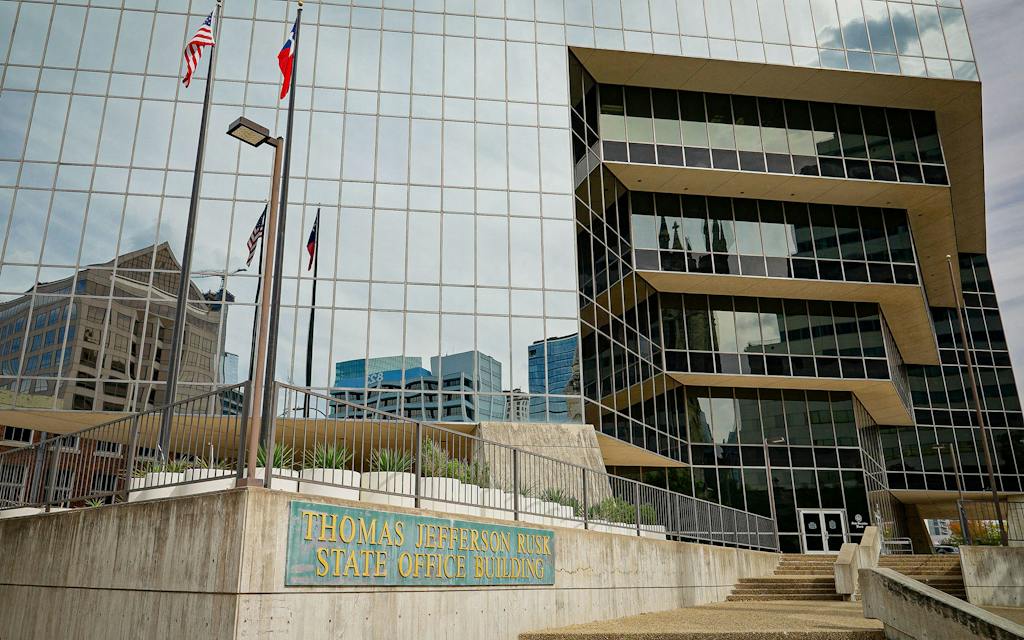 The Thomas Jefferson Rusk State Office Building, in Austin, where Travis Iles worked for the Texas State Securities Board.Alamy
For months, the attorney general had been conducting his own sprawling investigation into EPIC City. In late March 2025, Paxton publicly announced a probe into the housing development. (A month and a half later, he told Fox News’s Will Cain that he had “been directed” to investigate EPIC; by whom, he did not say.)
Paxton’s investigation began with a civil investigative demand to EPIC City’s developer, a legal order the attorney general can issue that requires certain organizations to hand over records, including emails, contracts, and financial statements. This demand, which Texas Monthly obtained through a public information request, is dated March 24, 2025, and metadata indicates the document was finalized late that afternoon. This was immediately after one of Paxton’s regularly scheduled meetings with the governor’s office, according to Paxton’s calendar, which Texas Monthly also obtained.
Paxton soon expanded his investigation, demanding documents from local cities that he alleged had ties to EPIC and even Plano ISD officials, after claims spread online that school board members would visit the mosque. Yet despite the continuously expanding scope of the case, Paxton was seemingly learning little about how EPIC City actually planned to operate. In May 2025, when Cain asked him whether EPIC City would be “an open community for people of other faiths” or “exclusive to Muslims,” Paxton, sitting before a live Dallas audience, demurred. “So, I don’t know that yet,” he responded, gesturing upward with both hands. “I don’t know that for sure.”
Then, on October 14, 2025, Paxton published a blistering press release declaring that he had found evidence that proved the developer of EPIC City “flagrantly and undeniably” broke securities laws. But under the Texas Securities Act, Paxton could not sue EPIC for securities fraud without an official referral from the agency’s commissioner that identified suspected violations. In his statement, he demanded the securities board “review our findings and refer this matter to me for further legal action.”
Alongside the press release, Paxton published a letter addressed to the board’s top officials: Iles and chair E. Wally Kinney, an Abbott appointee. Staff at the securities board were shocked by Paxton’s public announcement. Iles was driving to work when the press release went out, and his phone began lighting up. The attorney general’s office hadn’t discussed the matter with agency officials, nor had it even offered a heads-up that a post was coming. The letter to Kinney and Iles wasn’t even sent to the securities board until after it had been broadcast publicly.
Within minutes of learning of Paxton’s allegations, Iles contacted the attorney general’s office. He asked to see Paxton’s “initial findings and corresponding evidence” supporting the AG’s claim that the developer had “flagrantly and undeniably violated” securities laws. He received no response.
Iles emailed one day later, writing that he looked forward to discussing and reviewing the findings. The following Monday, he followed up a third time to request a meeting with Paxton’s attorneys. He finally got through.
A week later, on a misty morning in late October 2025, Paxton’s team met Iles in the Price Daniel Sr. Building, a jukebox-shaped structure where the Office of the Attorney General’s executive team works. As he entered a conference room on the top floor, he found Forrest Brumbaugh, Paxton’s deputy attorney general for legal counsel, waiting. A balding corporate lawyer who had retired from private practice, Brumbaugh had joined Paxton’s office in 2022, taking over a post once held by one of the senior aides who had reported Paxton to the FBI on allegations of corruption. Brumbaugh was joined by half a dozen staffers from the attorney general’s office.
The meeting immediately became contentious, according to a person with direct knowledge of the events, who described the meeting to Texas Monthly on the condition of anonymity to protect against retribution. Brumbaugh demanded to know what the securities board had found. Iles shared his agency’s analysis, telling Brumbaugh that his team had doubts about whether the units Community Capital Partners was selling constituted securities.
Brumbaugh disagreed. The tenor of the conversation degraded abruptly, as a clearly unhappy Brumbaugh turned “reptilian,” the person with direct knowledge said. When Iles, who had brought an assortment of materials to the meeting, asked to see what evidence Paxton’s team had allegedly uncovered, Brumbaugh brushed the question aside and said that because the attorney general’s staff had reviewed the same records he had, there was no need to share any evidence. (Brumbaugh did not respond to an interview request, and the attorney general’s office didn’t respond to a list of questions about the meeting.)
By the time Iles left the building, his uneasiness about the EPIC case had turned into cynicism. Paxton’s team, he believed, had already set its sights on filing a securities case against EPIC, and his agency was being asked to provide the pretext.
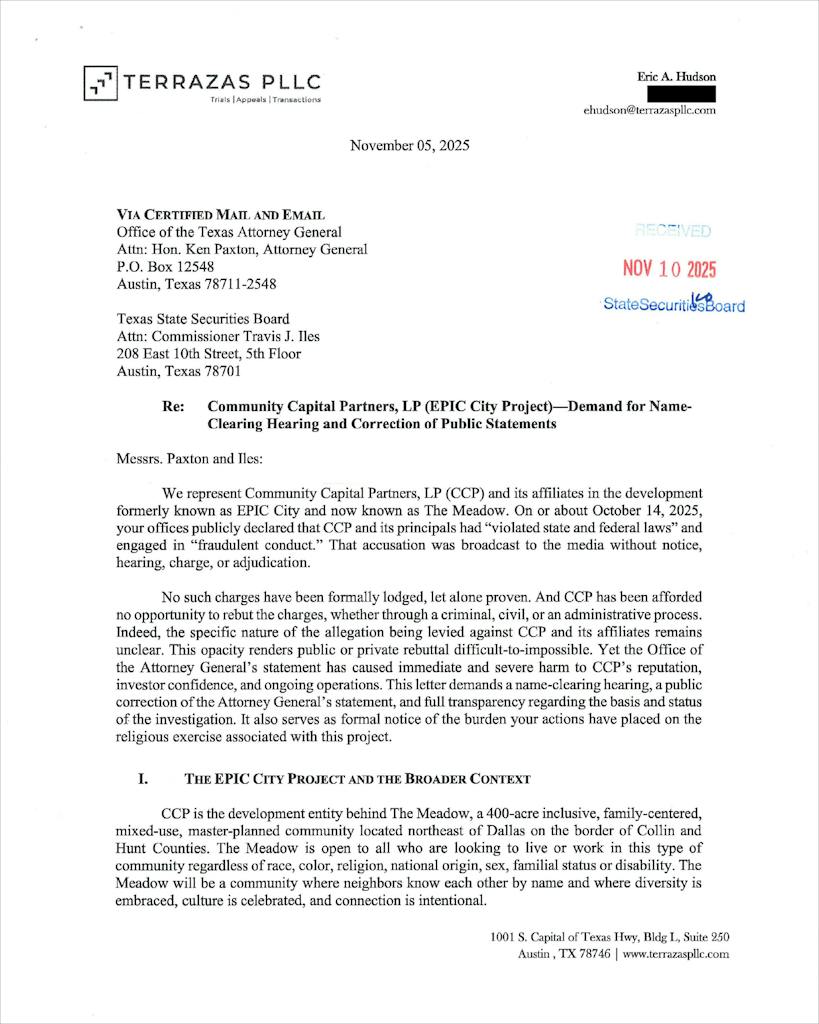 The demand letter from EPIC City’s developers threatening to sue.Obtained by Texas Monthly
Shortly after the contentious meeting, the securities board and attorney general’s office found themselves on the same side of a legal warning from Community Capital Partners. On November 5, 2025, both agencies received a demand letter from the developer, signed by Eric Hudson, a partner at Terrazas PLLC. The Austin-based litigation firm, known for its aggressive approach, had also represented EPIC against the funeral commission. The developer had retained the firm to clear EPIC City’s name.
Hudson asserted that both agencies had given the developer no opportunity to rebut the allegations, “whether through a criminal, civil, or an administrative process,” despite the attorney general’s statement causing “immediate and severe harm” to the developer’s “reputation, investor confidence, and ongoing operations.” Hudson demanded that Paxton issue a public correction of his statement, among other remedies. If the state did not address these concerns within thirty days, the developer would sue. (Paxton, more than anyone, should know the difference between an accusation of securities fraud and a finding of guilt: He was charged with securities fraud in 2015, an indictment that stuck for nearly a decade before he reached a settlement in 2024.)
The demand letter set off a race across the Texas executive branch. Iles told me that throughout the next month, Mittnacht repeatedly asked him to officially refer the case over to the attorney general’s office. He remained hesitant. A father with one daughter in high school and another in college, he was concerned that if he were sued by the law firm EPIC had retained, Paxton’s office—which is supposed to defend state government officials in court—would refuse to represent him.
As the deadline neared, Mittnacht once more summoned Iles to meet—this time at Moody Tower, a looming sixteen-story office building a few blocks from the Capitol complex. Once again, Ezell and Gunnels, the governor’s general counsel and assistant general counsel, also attended. Iles told me that everyone was clear about why they had gathered: to get him to finally refer the securities case to Paxton so the attorney general could sue EPIC and its affiliates, potentially shutting the project down for good. Iles watched as Ezell pulled out his laptop and placed it in front of him; on the screen, ready for review, was a draft of an unsworn declaration, affirming under penalty of perjury Iles’s knowledge of Paxton’s planned lawsuit.
Because unsworn declarations carry the same weight as affidavits, Iles flatly refused to sign any document that labeled EPIC City’s offerings as securities. For about an hour, he said, he and Gunnels huddled around Ezell and rewrote sections of the declaration. The three lawyers went line by line. Iles worked with the governor’s attorneys to change any portions of the declaration that could be interpreted as him accusing EPIC of fraud. “I was taking stuff out, changing language here or there to finally get to something that I could pinch my nose and sign without feeling like I was perjuring myself,” Iles said. (Ezell didn’t respond to multiple interview requests, while Gunnels directed questions to Mahaleris, the governor’s press secretary, who did not answer any of Texas Monthly’s questions.)
By the end of the meeting, the unsworn declaration did not state that EPIC City’s offerings were securities. Rather, in fewer than five hundred words, the document affirmed that Iles was “familiar with many of the allegations” made in Paxton’s lawsuit. It offered only a brief explanation of the case at hand, explaining Community Capital Partners’ unit system and stating that the company might have misrepresented the offerings to purchasers. “On October 14, 2025, I learned of general findings made from the Office of the Attorney General’s parallel investigation,” the document continued. “The [state securities board] has not been provided with corresponding evidence for review.”
Then the declaration included a broad, sweeping statement—one that gave Paxton authority to sue: “I requested that the Attorney General take action as the Attorney General deemed appropriate.”
Back in his office, Iles began to compose an email, with the finalized declaration attached, to the attorney general’s team. He didn’t feel that he had capitulated. Threading the needle was part of the job, he explained to me. The declaration gave Paxton room to act without saying EPIC had sold securities. But in the body of his email, he made the conclusions of his investigation unmistakable. For months, the securities board had delayed making any official determination on the EPIC case. Now he finally made his agency’s findings official.
“While I do not believe the transactions constitute securities under the [Texas Securities Act] with the evidence available to date; I very much agree they have certainly treated them in such a way as to appear as such,” Iles wrote. He advised that the attorney general sue under the Texas Deceptive Trade Practices Act, the state law that protects consumers from misleading or deceptive business practices, rather than on securities-fraud charges.
Paxton’s team eschewed that advice. Late that afternoon, the day of Hudson’s deadline, Paxton announced that he had sued EPIC and its affiliate companies for violating securities laws. In the lawsuit, Paxton portrayed the securities board’s investigation as having identified the very violations he was now suing over—despite Iles never saying as much anywhere.
Fox News reported on the lawsuit that night under the headline “Texas AG Paxton sues EPIC City developers after probe finds alleged fraud, misleading Muslim-only marketing.” Citing Paxton’s lawsuit, the reporter wrote that Iles had claimed the developer “sold securities without meeting registration or exemption requirements” and subsequently referred the matter to the attorney general “after identifying ‘flagrant’ violations.”
Iles read the story. He was furious. “Horseshit,” he wrote in the subject line of an email to his deputy the next day, which was obtained by Texas Monthly. In the body, he pasted the link to Fox News’s report and wrote, bluntly, what he thought of Paxton’s lawsuit against EPIC: “Corrupt.”
Iles wasn’t willing to let Paxton’s account stand. On Monday, December 8, 2025, he published a news release on the securities board’s website, writing that the claim that EPIC had sold securities was “a wholly false statement” that had been improperly attributed to him. Iles emailed his statement to the developer’s counsel, Hudson. He then emailed it to the Fox News reporter, as “a professional courtesy,” and to Mittnacht.
In Abbott’s Texas, stepping out of line has its consequences. Shortly after Iles emailed Mittnacht, the adviser called Kinney, the securities board’s chair, according to call records obtained by Texas Monthly. They spoke for 33 minutes; immediately after that, Kinney called Iles. According to Iles’s recollection of the conversation, Kinney told him that the governor’s office wanted him to resign immediately. (Kinney declined an interview request.)
Iles refused to step down that day. Near the close of business, he emailed Mittnacht one more time. “No hard feelings from my end,” he began. “While I sleep on the opportunity to resign for delivering results to Texans, business and investors alike, I’ll share the last decade or so of performance evaluations of my efforts to make it truly The Lone Star State.” He attached 29 pages of performance evaluations dating from 2014 to 2025. He had received top marks in each one. “Good deeds and public service go punished,” he concluded.
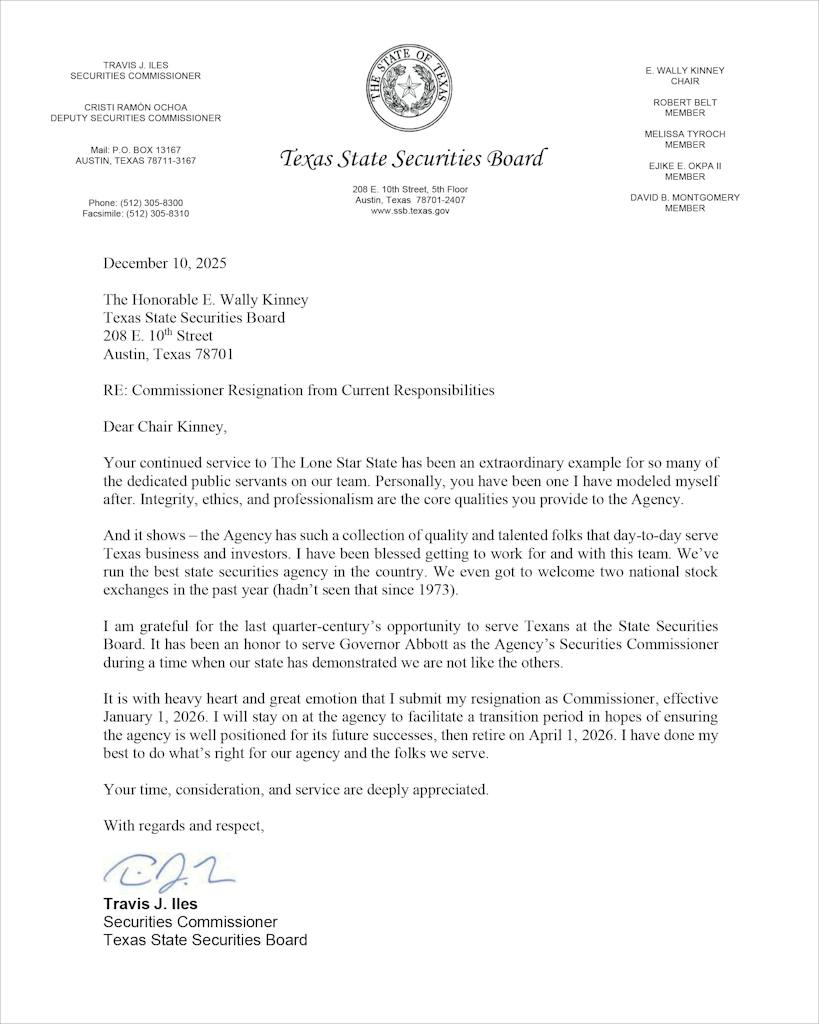 Travis Iles’s letter of resignation from the Texas State Securities Board, dated December 10, 2025, two days after his public correction of Paxton’s claims in a lawsuit.Obtained via public information request
Iles told me his anger was not directed at Mittnacht. He viewed the adviser much as he viewed himself: as someone caught in a political fight being waged by officials far above them. “I’m not going to shoot the mailman,” he told me. His contempt was reserved for Paxton, whom he blamed for putting everyone else in this position to begin with.
Over the next two days, the demand for Iles’s immediate resignation softened into a negotiated exit, he told me. By Wednesday he had submitted his resignation letter, “with heavy heart and great emotion.” He quietly stepped down as commissioner at the end of the month, and he stayed on as a staff attorney for the agency to help with the transition while he prepared to retire.
He eventually left the agency altogether in April 2026. Iles told me he is convinced he handled the EPIC case properly. But the state has marched on, and the securities-fraud case is set for a jury trial in June 2027. What Iles believes no longer matters.
Featured image credits: East Plano Islamic Center: Photograph by Tamir Kalifa; Paxton: Al Drago/Bloomberg via Getty; Documents: Obtained via public information requests
Read Next