
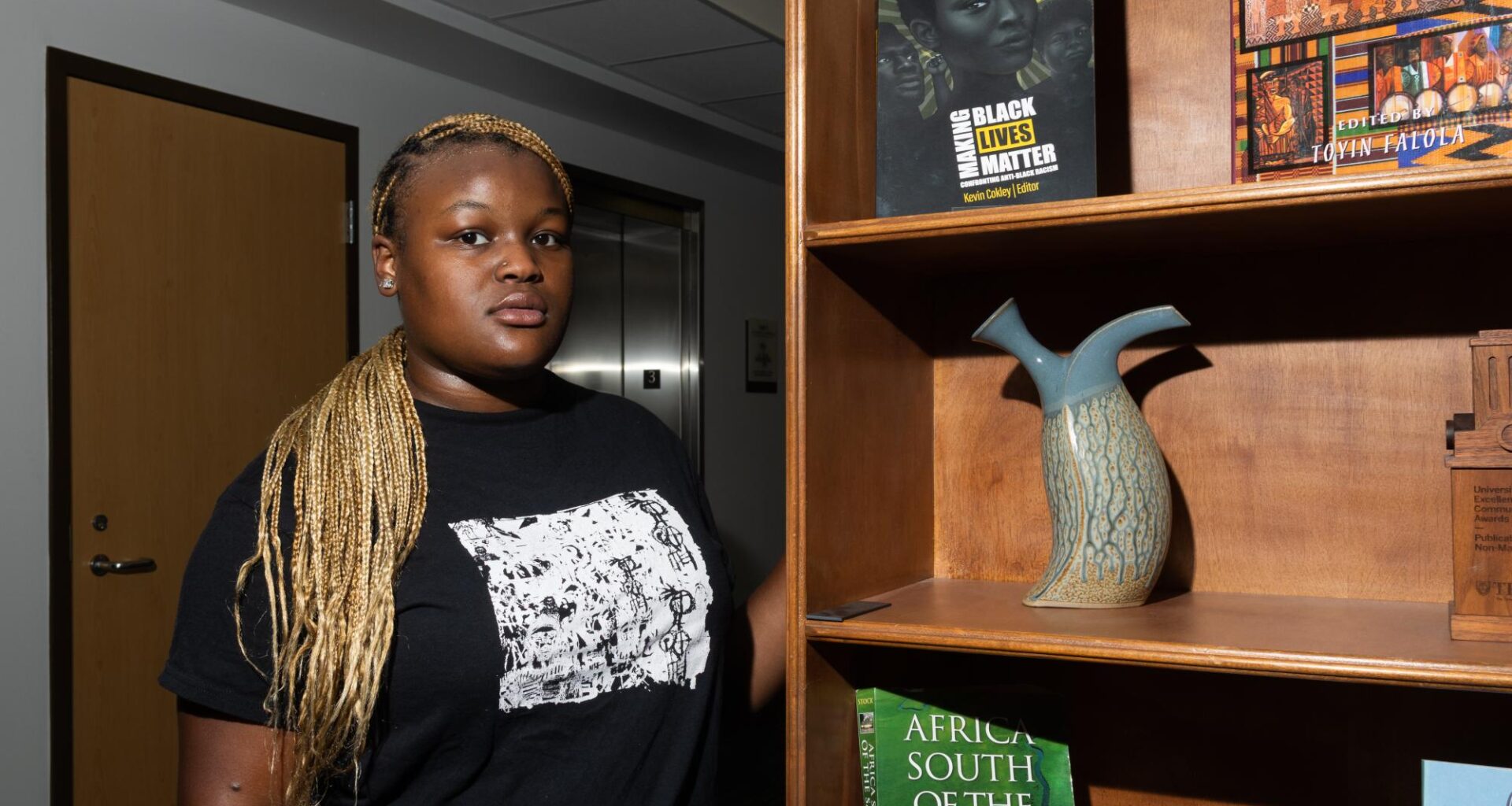
Daijahna Biggs is an African and African diaspora studies and aerospace engineering junior.
Engineering came first: Biggs’ high school allowed her to study on an engineering track at the same time she worked in Civil Air Patrol, an auxiliary organization of the United States Air Force. After getting into UT, she chose to add African and African diaspora studies to stay connected with her identity as a Black woman.
“It was more so just a ‘me’ decision,” Biggs said. “Just me knowing that I’ll still have a piece of my identity that I can still learn about, and it’s not just me trying to assimilate to what’s around me.”
Biggs said that when she began African and African diaspora studies, she did not expect to learn much beyond what she already knew about the experience of being Black. After starting classes though, she was surprised to learn of the program’s scope, which covers prominent works and ideologies of African American and diaspora studies on a global scale.
“There’s so much to it that you can do,” Biggs said. “And a lot of people think that everybody in (African and African diaspora studies) is Black, and that’s not true. There’s actually a lot of non-Black people in (the major), so I liked that when I came. I was like, ‘Okay, I love everybody else is wanting to get involved and learn as well.’”
Biggs said she enjoys the relationships with faculty that the major has allowed her to build, as well as the perspective on current events her classes have given her. She said a current standout is a seminar class with professor Nessette Falu, where students compare white and Black-centric theories of sexuality and feminism.
“I would say that I always thought of being (LGBTQ+) just as a sexuality, but it’s really a plethora of things,” Biggs said. “It means connection, it means joy, it means love.”
Biggs remembers first hearing rumors about African and African diaspora studies losing department status in January through social media. She said the news caught her off-guard.
“It’s been going good since I’ve been here, but then out of nowhere to be targeted … it’s like, ‘Oh, why?’” Biggs said. “I haven’t seen any negative things that have come out of (the department). I haven’t heard any stories. I haven’t seen anything. I haven’t seen any problems. So I was like, ‘Why are we being consolidated?’ That’s really weird.”
Biggs said she can’t come up with a reason for why her department was consolidated. After the change, she said she has perceived a possible shift from the program’s old atmosphere into something “rigid,” with members afraid to speak out for fear of administrative retaliation.
“I think (courses) may be a little altered, not authentic,” Biggs said. “We kind of can’t express what we do in our department freely … We have to play it safe, so nothing else happens to the department.”
As she continues her undergraduate education, Biggs said she plans to transfer from aerospace engineering to physics. Whatever career she finds herself in, though, she said her experience with African and African diaspora studies will inform her views and enable her to bring different perspectives to what she views as a more traditional work environment.
“There’s not a lot of women within that field, so I think having that cultural analysis will kind of bring a more diverse energy to the room, so it’s not just so (many) conservative values,” Biggs said.