
Dallas Mayor Eric Johnson recently said Morgan Stanley’s planned Uptown hub will make up for AT&T’s departure to Plano. The reality, however, is less straightforward.
On Sept. 28, the New York-based investment bank announced plans to open a U.S. hub in a high-rise on McKinney Avenue, near the heart of Uptown. The move is set to bring a $684 million direct capital investment from Morgan Stanley to Dallas, with an overall financial impact expected to run close to $1.3 billion, according to estimates by local officials.
State and city officials quickly hailed the move as a win for Dallas’ rapidly growing financial sector, often dubbed “Y’all Street.” In a release, Texas Gov. Greg Abbott proclaimed, “Opportunity’s address is now Y’all Street,” while Johnson told CBS News the moment marks Dallas “becoming a true financial services hub for this country.”
Johnson has been among the loudest voices promoting Y’all Street’s growth. After recruiting trips to New York City, the two-term mayor told the audience at the Republican midterm convention in Dallas that “we’re choosing to build America’s next financial capital.” In his November 2025 state of the city address, Johnson lauded strides made under his tenure, saying “economic opportunity is also rising” alongside gains in public safety. The address was livestreamed from the new Texas Stock Exchange.
Sign up for the This Week’s Top Stories newsletter to get the latest stories delivered to your inbox
THANK YOU!
You’re all set.
CLOSE
“The truth is, Dallas is a better place to live and to work than it was seven years ago. It’s better for young professionals just starting their careers. It’s better for working families with kids,” Johnson said.
That was, of course, before the news broke on Jan. 5 that AT&T would relocate its corporate headquarters from downtown Dallas to a new campus in Plano. AT&T has about 6,000 downtown employees, and the loss of the Fortune 500 giant could translate into a $2.7 billion hit to nearby property values and tax revenues, as WFAA previously reported. Downtown Dallas already has some of the country’s highest office vacancy rates, and the exit could leave a hole in its center.
With the Dallas Stars and Fifth Third Bank leaving the urban core, along with the closure of Neiman Marcus’ original flagship store, some leaders have raised serious concerns about the city’s economic health beyond downtown. Despite rapid growth in the wider Dallas-Fort Worth area, the city’s population has stagnated in recent years as more jobs move to the suburbs, especially in northern Dallas County and Collin County.
But in a rare joint interview with The Dallas Morning News, alongside City Manager Kimberly Bizor Tolbert, Johnson said that the successful courtship of Morgan Stanley contradicts the often-painted picture of a faltering local economy.
“One Morgan Stanley building is a wash for what AT&T is building in Plano,” Johnson said. “This is real money, and these are very sophisticated people we’re talking about. So I think the scoreboard is all we need to point to.”
‘Hold both thoughts in our head’
The mayor, who told Dallas City Council members that “the wolf is up the tollway” after the Stars announced plans to leave for Plano, is clearly keeping tabs on the intense economic competition from northern suburbs. But is he counting up Dallas’ total realistically?
Cullum Clark, an economist at Southern Methodist University and a fellow at the Bush Center, said the number of jobs Morgan Stanley would bring won’t match AT&T’s current footprint, but they could be more economically impactful on an individual basis.
“It’s a little bit apples and oranges, right? The number of people Morgan Stanley’s bringing, if reports are to be believed, at 3,800 is not nearly as big as 6,000,” Clark said. “On the other hand, it’s also probably the case that, on average, the Morgan Stanley employees are considerably more highly compensated. So the amount of income you could say might be closer, or for all I know, maybe Morgan Stanley would be ahead.”
Beyond the immediate number of jobs added, Clark said Morgan Stanley’s investment in Dallas could catalyze further growth in the Y’all Street sector, which he said has surpassed most expectations in its early run and is significant in its own right. The Texas Stock Exchange, billed as a rival to the New York Stock Exchange and NASDAQ, has gained significant momentum in recent weeks, with companies like Dillard’s and Energy Transfer jumping on the train and making the exchange their primary listing venue.
With other companies like Goldman Sachs and Scotiabank investing heavily in Dallas buildouts, Clark said the city is reaching a point of “critical mass” with the Morgan Stanley news, as companies typically invest near where their competitors are building.
“No other city could claim what we’re claiming,” Clark said. “I mean, you got very different flavors. Like San Francisco can say the number of jobs that like Anthropic and OpenAI is going up in that very specific sector, but you know this is bigger in employment terms… I don’t think you’d want to trade our situation. I don’t mean just the metro area, of course, but you wouldn’t even trade the city of Dallas job growth situation for really any place else.”
But even then, he said, financial jobs cluster around a small area immediately abutting Klyde Warren Park in Uptown and the northernmost reaches of the Central Business District.
“There’s the parts of our city where the job base is shrinking, and there are other parts not that far away from there, where it’s growing, and we just have to be able to hold both thoughts in our head at the same time,” Clark said.
What about downtown?
Johnson’s comparison to the loss of AT&T makes it easy to question the move’s impact on downtown Dallas. The telecommunications giant is the largest employer in the central business district, and its departure highlighted lingering questions about the long-term viability of doing business in the urban core amid lingering concerns about public safety and aging real estate.
Downtown, Clark said, is on a downward growth curve. Crime and out-of-date office space have led to decay in the district, where vacancies linger near 27% and the workforce population has more than halved from pre-COVID highs, he added. Meanwhile, more than 20,000 people work in Uptown Dallas every day, a far cry from the early 2000s, according to prior reporting by D Magazine.
“Too many of the buildings are old, and tenants aren’t going to want to be there,” Clark said. “There are too many better alternatives. So I think there’ll be shrinkage for quite some time to come. I don’t know how fast it will go, but from the pure point of view of health, particularly the southern part of the CBD, well, clearly the employment trends are downwards, the residential trend is upwards, but it’s not explosively upwards right now. So got a lot of work to do.”
The southern end of downtown faces some of the largest hurdles, and the future of the City Hall debate will help shape the “TLC” Clark said the area badly needs. He added that he is concerned about the situation on the southwestern end of downtown, where he is concerned that plans for the renovated Kay Bailey Hutchison Convention Center could be “deteriorating,” amid late-stage design changes, funding cuts and shifting cost estimates.
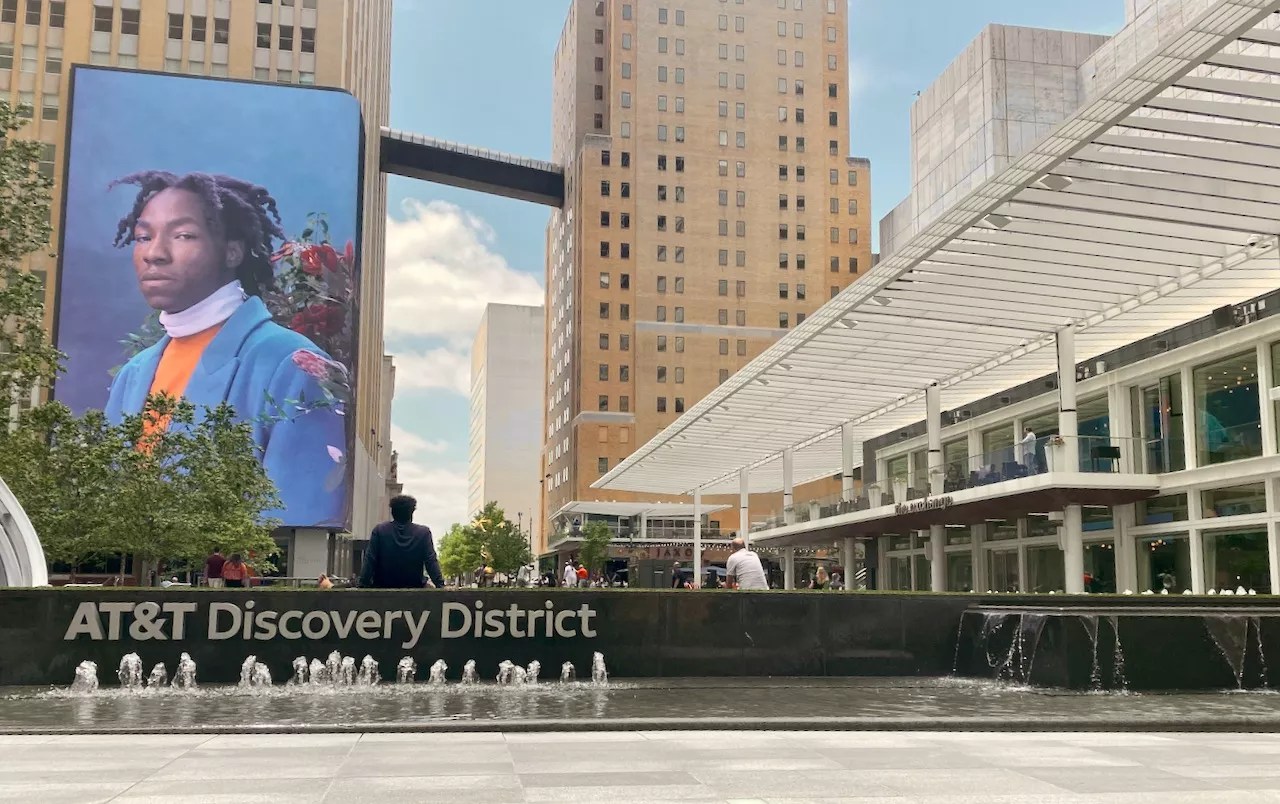
City leaders like Johnson have consistently called for diversifying downtown Dallas into a multi-use district with more vibrant residential neighborhoods and commercial offerings, something Clark supports. Over 16,000 people now live in the CBD, a large increase from earlier decades when only a couple hundred residents had downtown addresses. Downtown Dallas, Inc. recently unveiled a five-pillar revitalization plan to double downtown residents to 32,000 by the end of 2036. The plan also calls for economic redevelopment, including converting downtown office buildings into residential properties or pedestrian amenities, DDI President Jennifer Scripps told D Magazine. AT&T’s soon-to-be-former home, the Discovery District, is expected to be a pivotal property in the planned redevelopment.
Clark said it’s hard to tell whether the Morgan Stanley Hub and Y’all Street investment will bring relief to the traditionally defined downtown area. He can’t say development incentives for the urban core over other areas are the way to go, but he added that investing in public safety and limited teardowns could encourage further growth southward.
“My guess is [Y’all Street] keeps spreading,” he said. “I can’t say for sure in what direction.”
But the urban core, as we’ve known it, is evolving with the new developments in neighborhoods like Uptown and the Cedars. Clark said it could be fitting to think about downtown Dallas in a wider economic sense, in which case it doesn’t make sense to focus exclusively on one area. So even if AT&T’s supposed replacement is planned more than a mile away from the Discovery District, Morgan Stanley is still a win for Dallas’ core, Clark said.
“You don’t want to just say like ‘Oh I dismiss that out of hand because I don’t care about uptown, all I care about is the CBD,’” Clark said. “Well, that would be a little short-sighted. We ought to care. I mean, every area spills over a little bit to other nearby areas, and from the general economic health of the city point of view, we should want like more jobs taking place in the city of Dallas rather than fewer, and we should want them spread about.”