
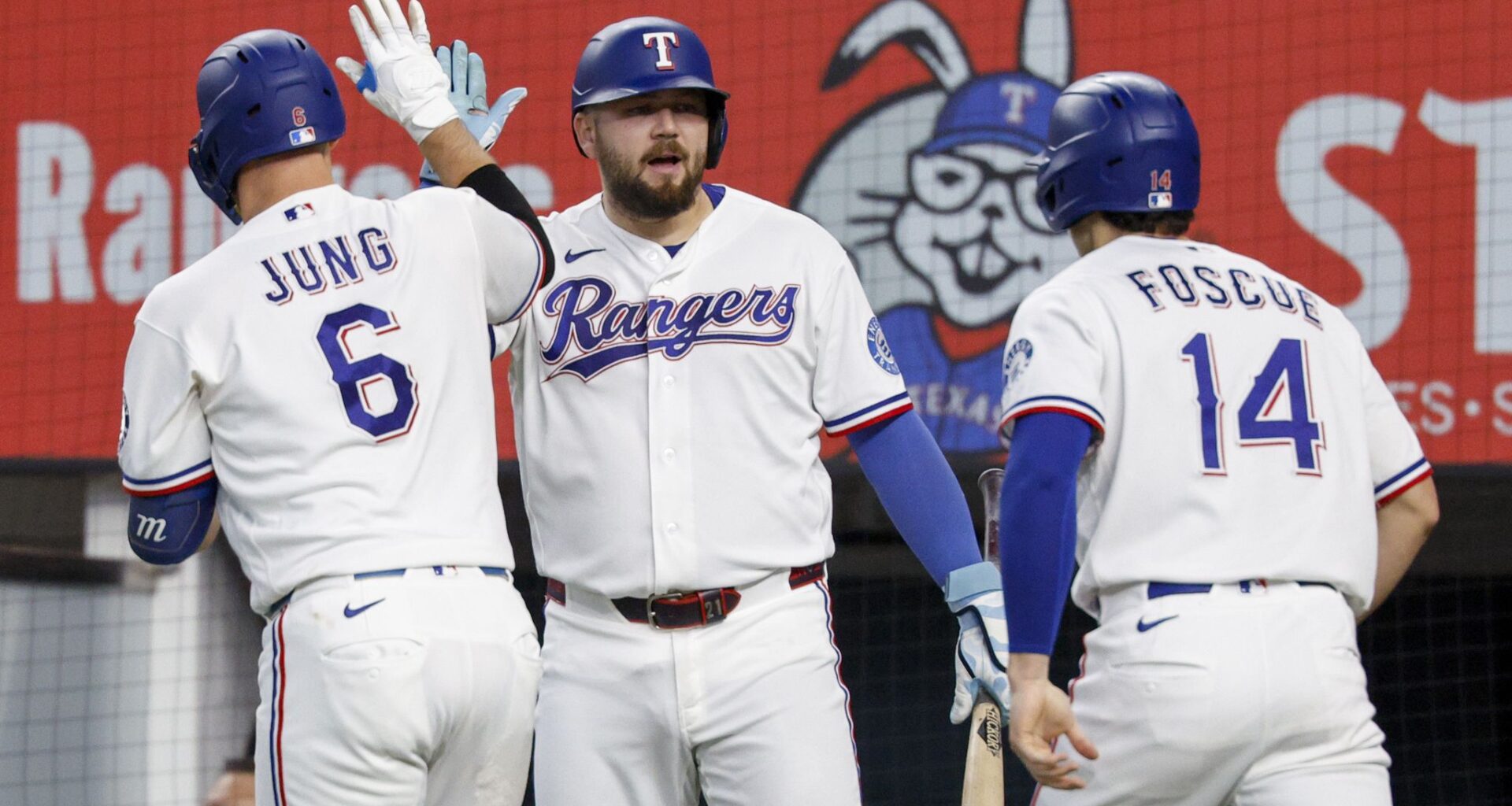
Texas Rangers third baseman Josh Jung (6) celebrates his two-run home run with first baseman Jake Burger (21) and second baseman Justin Foscue (14) during the first inning of a baseball game against the New York Mets at Globe Life Field on Thursday, Sept. 24, 2026, in Arlington.
Elías Valverde II/The Dallas Morning News
We can’t say for certain when, exactly, the Rangers will play baseball again. We can say for certain, though, that much of their roster needs to be evaluated between now and whenever that is.

That’s where we come in.
It’s time to review the Rangers position group-by-position group after a third consecutive postseason-less season. Today, we’ll move on to the infield, the one area of the club that seemed to perform above expectations:
Article continues below this ad
Primary cast: 1B Jake Burger, 2B Nicky Lopez, SS Corey Seager, 3B Josh Jung, UTL Ezequiel Duran, 2B-DH Justin Foscue
What went right: The infield was both the backbone of the team and the one area that seemed to show significant improvement from 2025. The composite 12.2 WAR, according to FanGraphs, for the four infield positions made it the eighth most valuable group in the majors. It graded out better than seven playoff teams. Much of that was built on Duran’s bounce-back year that should net him both a Gold Glove and Silver Slugger Award in the utility category. But Jung, when healthy, also was a revelation, showing the kind of line-drive, doubles-heavy approach necessary to be successful in Globe Life Field. Jung averaged a double every 14.7 at-bats; compare that to his previous career line in which he averaged one every 21.7 at-bats. It made him a far more dangerous hitter.
What went wrong: The Rangers’ one infield experiment flopped and injuries to the last side of the infield were devastating. To break this down, start with the trade of Marcus Semien, which opened the door for Josh Smith to step into the starting job, but that lasted barely a month, leading to multiple demotions and, eventually, a trade to Toronto. The Smith failure could have been countered by Duran’s rise, but, due to injuries, he became needed more at shortstop and third base. Duran ended up starting 90 games on the left side of the infield and only 25 at second. Seager and Jung combined to miss a total of 118 games due to multiple injuries, leaving the infield at less than the best version of itself.
What must be answered: Even with everything that went right, there are a ton of questions here. Start with: Who plays second? It should be Duran, but what if the Rangers trade Seager? Then Duran moves to short. Maybe Luis Arraez, a Skip Schumaker favorite, becomes a target, but that takes money and the Rangers have little idea on what their payroll will be other than it probably won’t be any higher than 2026. All of which means the Rangers may have to get creative if they can’t move Seager’s money. Both Jake Burger and Jung are due for big raises in salary arbitration, likely approaching double what they made in 2026 ($3.2 million and $2.9 million, respectively). Might the Rangers have to consider trading one of them to free up a bit more money? Even if they went that route and got prospects back, could they find suitable replacements for the available dollars? It’s a lot to answer. And that’s in area that was fairly stable.
One number: 213 – The number of games Seager has missed in his five years with the Rangers. That’s the equivalent of 1 1/3 seasons. And 202 of those have come over the last four seasons in which he has not played more than 123 games. If there is a case for trading Seager, the lack of dependability due to debilitating injuries is one of the pillars on which it is built.
Article continues below this ad
Prospects: Every conversation about the Rangers farm system starts and ends with Sebastian Walcott, who began the season recovering from internal brace elbow surgery and finished it by beating the daylights out of the Texas League as a DH. While he wasn’t able to play the field until the final day of the season, Walcott, still not 21, slashed .325/.401/.590/.991 over 187 plate appearance. All but 16 of them were at Frisco. He’s since gone to the Arizona Fall League and, in his first week of play, went 4 for 11 (.364) with full clearance to play shortstop. Despite not playing the field in 2026, he finished the minor league season ranked as the No. 8 prospect in the majors.
Now for the two big questions: Will Walcott open the 2027 season in the majors? And where will he play when he gets there? To the first, the guess is the Rangers would prefer to let him get a month or so of time at Triple-A against more advanced pitching. But that’s just a guess. To the second, there is even bigger mystery. The general consensus around baseball is that at 6-4 he may be too tall to play shortstop, though Elly De La Cruz, at 6-6, seems to do just fine. Also complicating the shortstop situation, currently the Rangers have a very good one who is making $32 million per year. If the Rangers are going to consider a position change for Walcott, it might behoove them to start acting on it. Are they going to try to teach him the outfield in spring training, whenever that eventually takes place? That would be quite a crash course.
Summary: Perhaps nothing better sums up the Rangers situation more than the infield. Even in an area where they had their most success in 2026, they’ve still got a long list of questions. This is a winter of inflection for the Rangers. Given the financial commitment to Seager, the injury issues with him and Jung and the need for a second baseman, there is a lot of discussion to be had.
Grade: B – If we were grading on the curve, this group would merit an A. It was, literally, the only area of the team in which there was significant improvement. It extended even beyond the above-mentioned cases for Duran and Jung. Jake Burger tripled his walk rate, making him a much more viable offensive contributor, even around his slumps. And Justin Foscue has emerged as a legitimate DH option for the future, at the very least, but also graded out well defensively, according to the Rangers. The infield, even with all the injuries, was the one element of the team that belonged in the top tier of MLB.
Article continues below this ad