
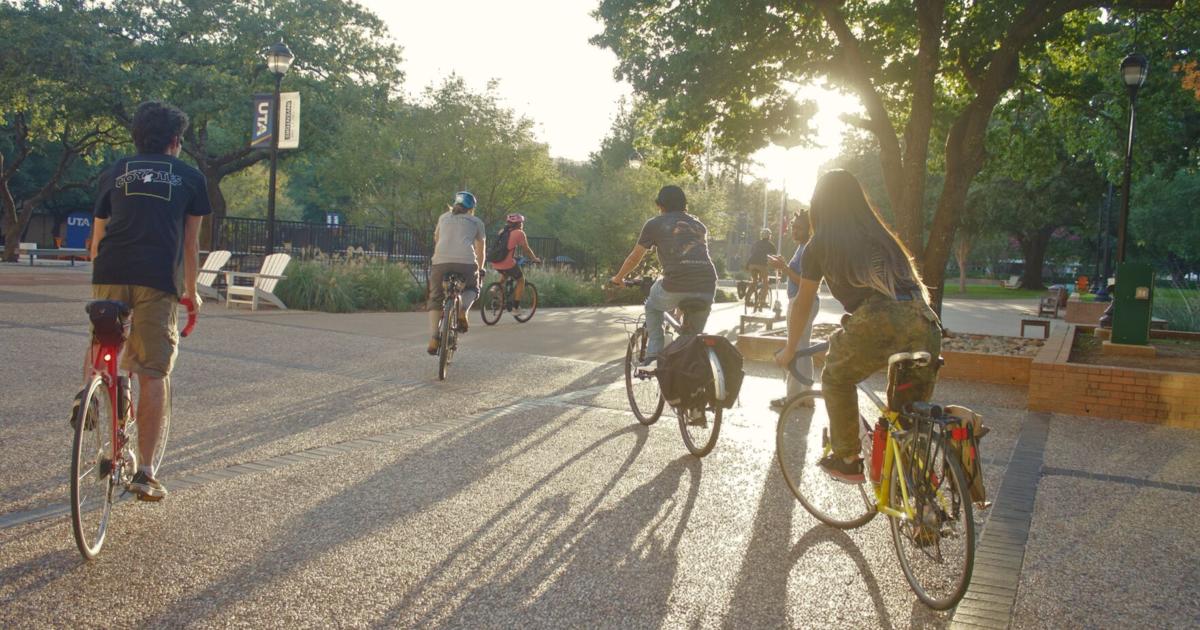

Members of Walkable Arlington ride their bikes Oct. 9 across the Central Library mall. The student-led group’s goal is to give people access to better public transportation.
Getting around without a car can be intimidating for many people, but the members of Walkable Arlington have adjusted to minimal car use, promoting the benefits of prioritizing time outside.
Last week, the group participated in a national campaign called Week Without Driving, which raises awareness about barriers non-drivers face when navigating their communities. According to the campaign’s website, about a third of people living in America don’t drive.
Walkable Arlington adviser Morgan Chivers said that everyone should try to experience what it’s like to get around without a car to build empathy for people who navigate their community without driving.
Chivers said there are many reasons why someone may not drive, including environmental reasons, health reasons, legal reasons and other circumstances.
“What should be a baseline of a good society is one that makes it possible for people to get around safely, without having to expect everyone to own and operate their own private motor vehicle,” he said.
According to a map made by the Parking Reform Network, about 26% of central Arlington is taken up by parking lots. Chivers said this is a waste of space that isn’t pleasant for people to walk through.
“Slowly, the city is changing, but it is only changing because of pressure,” he said. “We are part of that pressure to get the city designers and the city politicians and that whole bureaucracy of the city to move toward making things that are designed more human-scaled.”
Chivers said some ways to make the city more walkable is by planting native plants that provide shade, making sidewalks comfortable to walk on by expanding the space they take up and making use of the available land in a way that promotes walkability.
Walkable Arlington President Liam Crowley said walkable cities create opportunities for building communities that aren’t possible when relying solely on driving.
Crowley said he bikes about 40 to 100 miles a week and has been biking consistently for around five years. He said he has found the experience of relying on biking gainful and enjoys the freedom it offers.
“It’s just a simpler way to live,” Crowley said. “I feel more connected to nature. I feel more connected to my community, just being around other people.”
Chivers said relying on transportation methods other than cars organically encourages connection between people, which he saidis something that makes life worth living.
Chivers brought up an example of walking through a neighborhood when a fruit tree caught his attention. He said he paused to appreciate the way the light caught on the fruit when the owner walked out and offered him a piece.
Civil engineering sophomore Cooper Lantrip sets his bike in a bike rack Oct. 9 on the Central Library mall. Walkable Arlington has community bike rides every Friday except the last week of the month.
“It was this nice sharing experience, which you certainly would not have in a car if you’re like windows up and in this little cocoon you just drive by,” he said. “You certainly aren’t having that type of human-to-human interaction and connection.”
Crowley had a similar experience when dropping something off for a friend on his bike. He stopped at a traffic light when another biker stopped next to him and struck up a conversation.
“If I was stuck in a car, I never would talk to the person next to me,” Crowley said. “It’s all these small things, like, oh wow, there’s somebody else who also likes to ride their bike to UTA campus.”
Walkable Arlington treasurer Brooklynn Nguyen said he has also found spontaneous community when getting around without a car. Nguyen recognized an old friend on a train and reconnected with her.
“We took a photograph together because that’s kind of a neat
thing that happens when you take public transportation and when you walk around,” he said. “People that you know, you might run into them just out and about, but the likelihood of you doing that in a car is significantly lower.”
Chivers said that even if people are not aware of it, humans need meaningful connections as a part of their daily life. He said it’s important to seek out opportunities to build community in person because isolation is becoming more common with the world increasingly dependent on screens.
“It’s just this vicious loop of unpleasant experiences that is a world I don’t really think anyone wants to be part of,” Chivers said. “People do it for a sense of duty or economic necessity. But I think we should be trying to build the world that we want to live in, and that world is human-scaled.”