
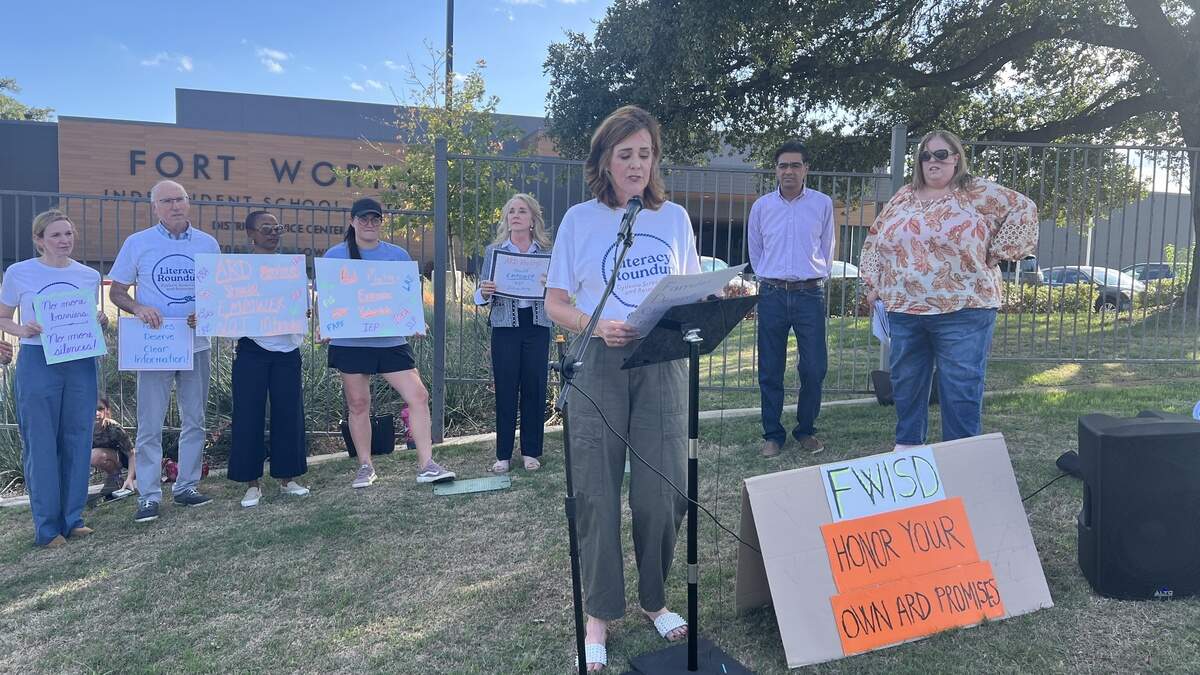
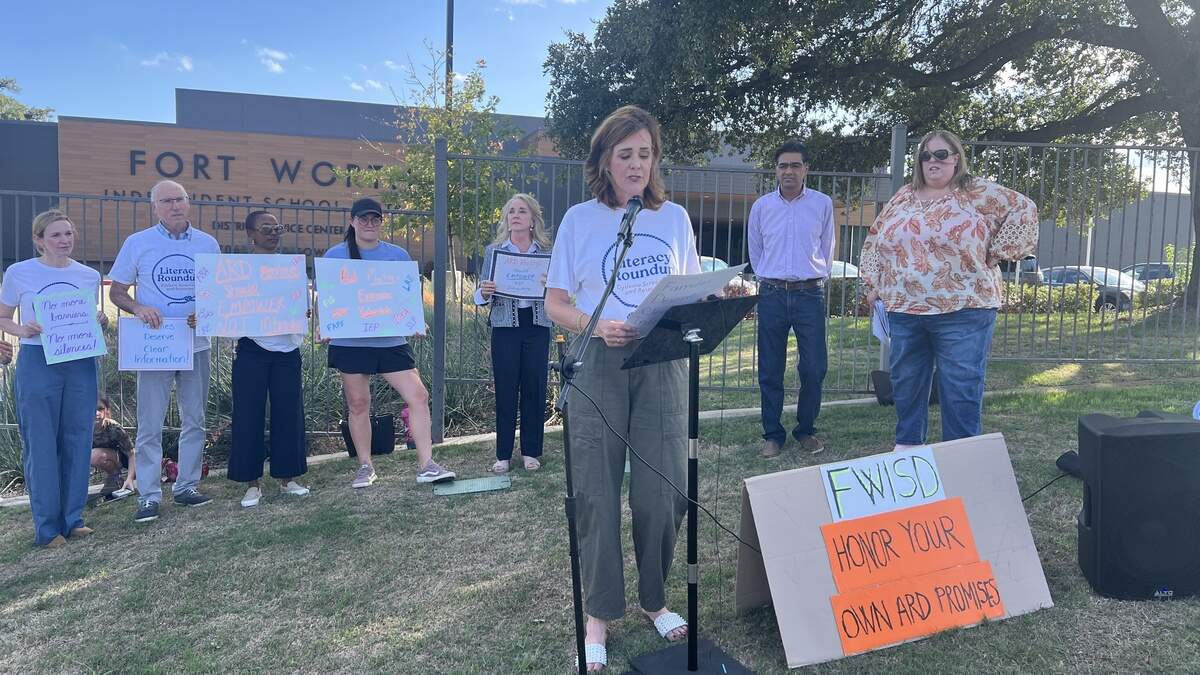
Caroline James, executive director of nonprofit Literacy Fort Worth, speaks during a press conference outside the Fort Worth ISD administration building on Tuesday, Oct. 13, 2026. James, alongside parents and advocates, said the school district has failed to efficiently and properly provide special education services to students.
Lina Ruiz
lruiz@star-telegram.com
Fort Worth parents of special education students are accusing Fort Worth ISD of breaking state and federal law by failing to provide services to students in a timely manner.
Caroline James, executive director of nonprofit Literacy Fort Worth, hosted a press conference on Tuesday evening alongside parents and advocates who say Fort Worth ISD has failed to efficiently provide resources to special education students, calling on them to do better. They shared stories of Individual Education Programs, also known as individual education plans or IEPs, not being followed; educators dismissing concerns raised by parents; and a lag in getting accommodations for their child that spanned years.
The press conference was held outside Fort Worth ISD’s administration building before a board meeting that began at 5 p.m. Parents and advocates branded signs that read, “FWISD honor your own ARD promises” and “ARD meetings should empower not intimidate.” ARD meetings — an Admission, Review and Dismissal meeting — evaluate what services may be needed for a student.
Fort Worth ISD officials said in a statement that the district is committed to serving students with IEPs and takes all concerns seriously.
“Fort Worth ISD is committed to ensuring that students with disabilities receive their services and supports outlined in their individualized education plans. We take all concerns seriously,” district officials said.
James said the issue is widespread across Tarrant County in multiple districts, but speakers at the press conference focused on Fort Worth ISD. Special education meetings between parents and district staff are more complicated than they should be, and they should include experts and educators at the table without “a maze of acronyms, jargon and education-ese that shuts parents out,” she said.
“I know what failure looks like. I’ve attended over 100 special education meetings across Tarrant County in 10 different school districts, and let me be clear: no district is doing an especially great job. There are bright spots, and Literacy Roundup advocates are seeing lessons learned and incremental progress, but the truth remains: we are failing students and families at scale,” James said.
Literacy Roundup is an initiative spearheaded by Literacy Fort Worth, the City of Fort Worth and the Sid Richardson Foundation to help screen and identify students with dyslexia.
In general, if a parent requests their child be tested for special education services, the school must provide 15 school days for the parent to give written consent for the evaluation, according to Disability Rights Texas. The school then has 45 school days to test the student. Afterward, school staff have 30 calendar days to convene an ARD meeting to evaluate what services may be needed for the student.
Fort Worth ISD parent Kim Medford said she struggled for 3½ years to get the testing and accommodations needed for her son’s dyslexia and learning disabilities, noting that he “basically entered sixth grade reading at a first grade level.” She is still facing obstacles with ensuring all of his teachers are following his IEP this school year, she said.
“Two weeks ago, I got a notice from my son’s dyslexia teacher that my son was doing great. He was close to being discharged from services — How is that even possible? And he’s failing reading right now with a 30,” Medford said.
Ashish Talwar, a parent of a Fort Worth ISD first grader, said his family has had to repeatedly insist his son’s A-rated school follow his IEP. Most of his son’s school day is in a special education classroom, but his plan requires him to spend a certain amount of time in a general education classroom alongside his peers. This past school year, those minutes were not provided to Talwar’s family for months, he said.
This current school year, Talwar said, he was told by staff and Superintendent Peter Licata that a federal law exempts a school from following an IEP for the first 10 days of school. Services must be provided “as soon as possible” after an IEP is created, according to the U.S. Department of Education.
“Parents shouldn’t have to keep checking whether their child’s IEP services are actually being provided. It’s not my job. It’s not the job of the parents to act as daily auditors to make sure the IEP services are being provided. If a school lacks the staff or the systems to follow an IEP, that’s a problem for the districts to solve,” Talwar said.
Editor’s note: Fort Worth ISD Board of Managers chair Pete Geren is the president and chief executive officer of the Sid W. Richardson Foundation, which is a funder of the Star-Telegram’s Crossroads Lab. The Star-Telegram retains independence in all coverage decisions.
This story was originally published October 14, 2026 at 4:25 PM.
Related Stories from Fort Worth Star-Telegram

Fort Worth Star-Telegram
Lina Ruiz covers early childhood education in Tarrant County and North Texas for the Fort Worth Star-Telegram. A University of Florida graduate, she previously wrote about local government in South Florida for TCPalm and Treasure Coast Newspapers.