
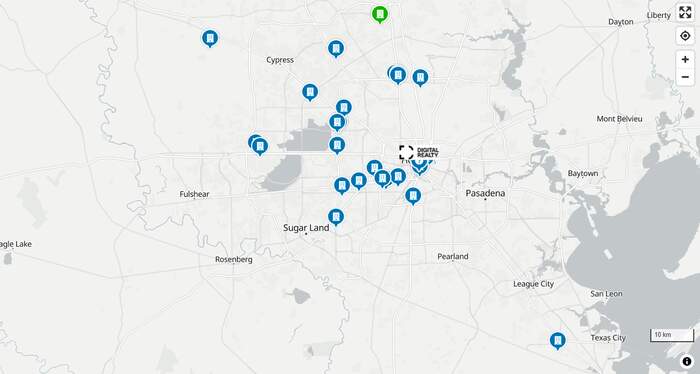
Harris County officials are pushing for greater local control over data center development, citing concerns about electricity demand, water consumption, air quality and neighborhood safety as the industry expands across Texas.
County Attorney Abby Kamen joined Commissioners Lesley Briones and Adrian Garcia at a press conference to outline the county’s limited regulatory authority and discuss potential legislative changes ahead of the Texas Legislature’s next session in January.
The officials said Harris County has 46 operating data centers, with at least six more in various stages of development. They emphasized that the rapid expansion presents immediate challenges for local infrastructure and communities.
“This is something that is here,” Briones said. “The county today wants to make sure that we are taking action to protect our communities, protect our environment, and make sure that we’re leaning in.”
Electricity demand raises concerns
Kamen pointed to projections from CenterPoint Energy indicating that the Houston area is expected to add eight gigawatts of new data center electricity demand by 2029, with approximately four additional gigawatts expected afterward.
That growth could increase peak electricity demand across the utility’s service area by roughly 50%, Kamen said.
Officials also raised concerns about the amount of water data centers consume, potential pollution and the effects of additional demand on local utility bills.
“The biggest question I get is how much power are these centers consuming? And what does that mean to local residents?” Garcia said.
The commissioners connected those concerns to the broader issue of affordability, noting that residents are already feeling pressure from rising electricity and water costs.
They said the impact of a data center depends largely on its location, design and the conditions under which it is approved.
County’s regulatory authority remains limited
Despite the concerns, Harris County faces significant legal restrictions on its ability to regulate data centers.
Kamen said the county generally cannot use zoning to control where data centers are located. Land-use regulation within incorporated cities falls primarily to municipal governments, while the county has limited authority over development in unincorporated areas.
She also pointed to unresolved legal questions about whether counties can impose a moratorium on data center development. Kamen said the county is monitoring the issue as it awaits a determination from Texas Attorney General Ken Paxton.
“The short answer right now is the county has little to no authority to stop them,” Briones said.
County officials plan to seek legal guidance on what measures they can pursue under existing law and what additional powers might require state legislation.
The commissioners also want county departments, including the county engineer and fire marshal’s office, to notify them as early as possible when a data center seeks permitting. They said earlier notice would help officials evaluate potential community and environmental impacts and prepare for safety concerns.
Garcia noted that the county’s fire marshal is responsible for responding to fires at facilities within its jurisdiction, underscoring the need for adequate safety planning and resources.
He said officials also want legislation that could address existing facilities, rather than focusing exclusively on future developments.
Legislative push focuses on local control
Briones said Harris County is working with other Texas counties through the Conference of Urban Counties to develop a legislative agenda for the upcoming session.
The effort will focus on identifying what regulatory authority counties can seek from state lawmakers and examining approaches used in other cities and states.
Officials said they want to understand which policies have effectively addressed data center impacts, particularly those involving water resources, electricity demand, pollution and the distance between facilities and residential neighborhoods.
The commissioners also called on state representatives and senators from both parties to consider legislation that would give local governments more tools to respond to community concerns.
Briones said the goal is to balance the industry’s economic benefits with responsible development.
“How can we both protect the community and environment while bringing the economic impact?” she asked, pointing to potential benefits such as good-paying jobs, local hiring policies, infrastructure investments, parks and trails, and community benefit agreements.
She added that county officials want to establish a framework that accounts for long-term impacts over the next 10, 20 or even 50 years.
The balance between growth and safeguards
County leaders acknowledged that data centers can bring investment and employment opportunities to Texas, but argued that communities should not have to absorb the costs without adequate protections.
Briones said officials are examining how other jurisdictions have approached the issue while recognizing that technology and industry practices continue to evolve.
She also stressed that future development is a priority, even as officials consider how to address facilities that have already been approved.
“The ones that have been approved have been approved under the laws that state leaders have allowed,” Briones said, calling for a more deliberate approach to future projects.
The county’s immediate priorities include bringing residents together to hear their concerns, improving information-sharing about proposed projects, clarifying existing legal authority and preparing legislative proposals.
Questions about timing
When asked why the county was addressing the issue now, given that data centers have been operating in the area for years, Garcia said recent news coverage and growing public concern had pushed the issue to the forefront.
He said residents have increasingly raised questions about electricity bills, water costs and the broader effects of rapid development.
Garcia argued that the county needs more authority to respond meaningfully to those concerns rather than relying on state officials to make decisions for local communities.
He also urged state leaders to ensure that any proposed pause in data center development is accompanied by meaningful action to restore local control.
The press conference comes as officials prepare for the legislative session beginning in January, when county leaders hope to advance proposals addressing data center development.
For now, the commissioners said, Harris County’s options remain constrained by state law. Their stated goal is to secure additional authority to protect residents and natural resources while allowing responsible economic development to continue.
Start Here, Houston
More Stories Like This In Our Email Newsletter
Copyright 2026 by KPRC Click2Houston – All rights reserved.