
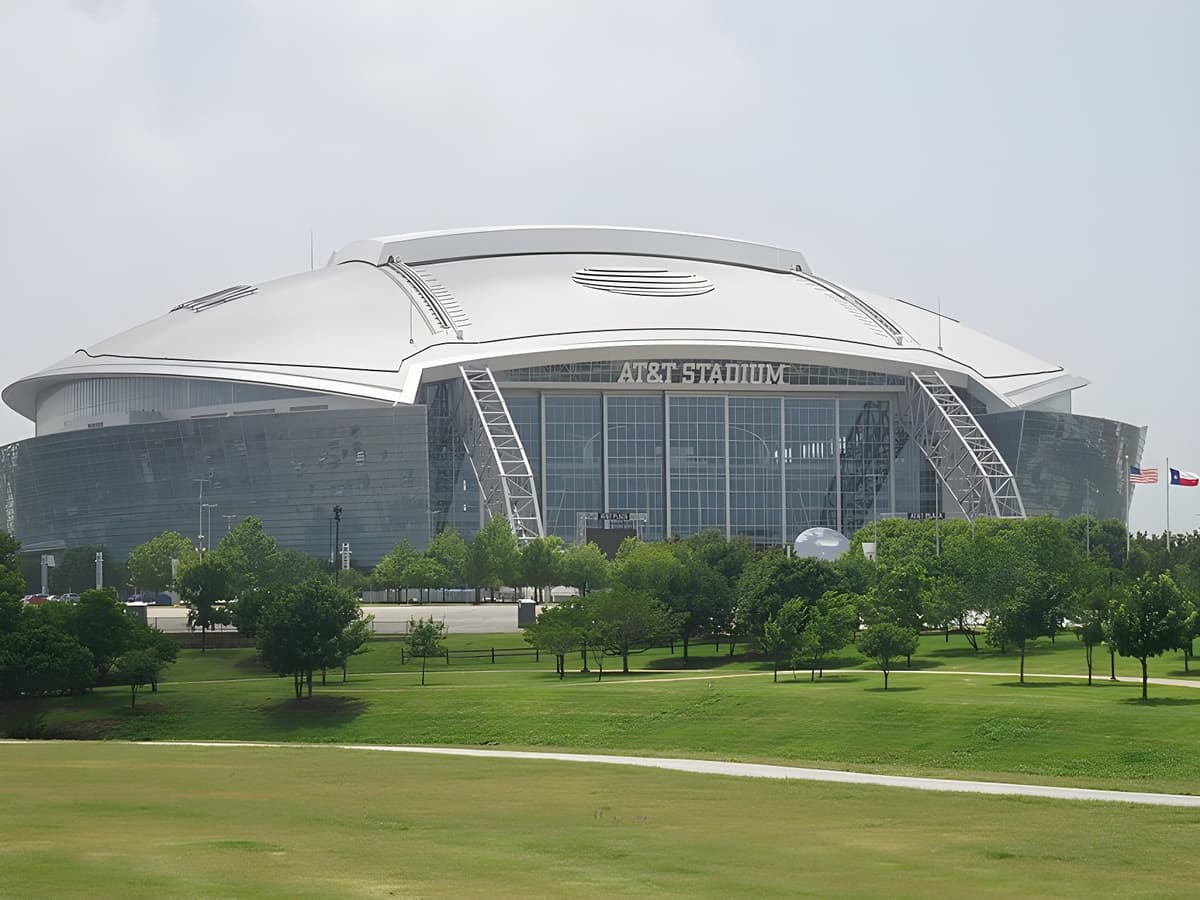
AT&T Stadium’s layout, capacity, retractable roof and fan amenities, plus its 2026 World Cup transformation in Arlington.
AT&T Stadium is built to impress before a single snap is played. The Dallas Cowboys’ home in Arlington pairs a retractable roof and two arches nearly 300 feet tall with one of the largest video boards in sports, a contemporary art collection and standing-room platforms that push capacity past 100,000. It has staged a Super Bowl, a Final Four and WrestleMania, and in 2026 it hosted nine FIFA World Cup matches.
History & Background
The stadium’s ribbon was cut on May 27, 2009, with the first event, a concert, following on June 6. It opened as Cowboys Stadium and was renamed AT&T Stadium on July 25, 2013. Sources disagree on what it cost: the body of its Wikipedia entry says the budget rose from $650 million to $1.15 billion, while the infobox lists $1.3 billion.
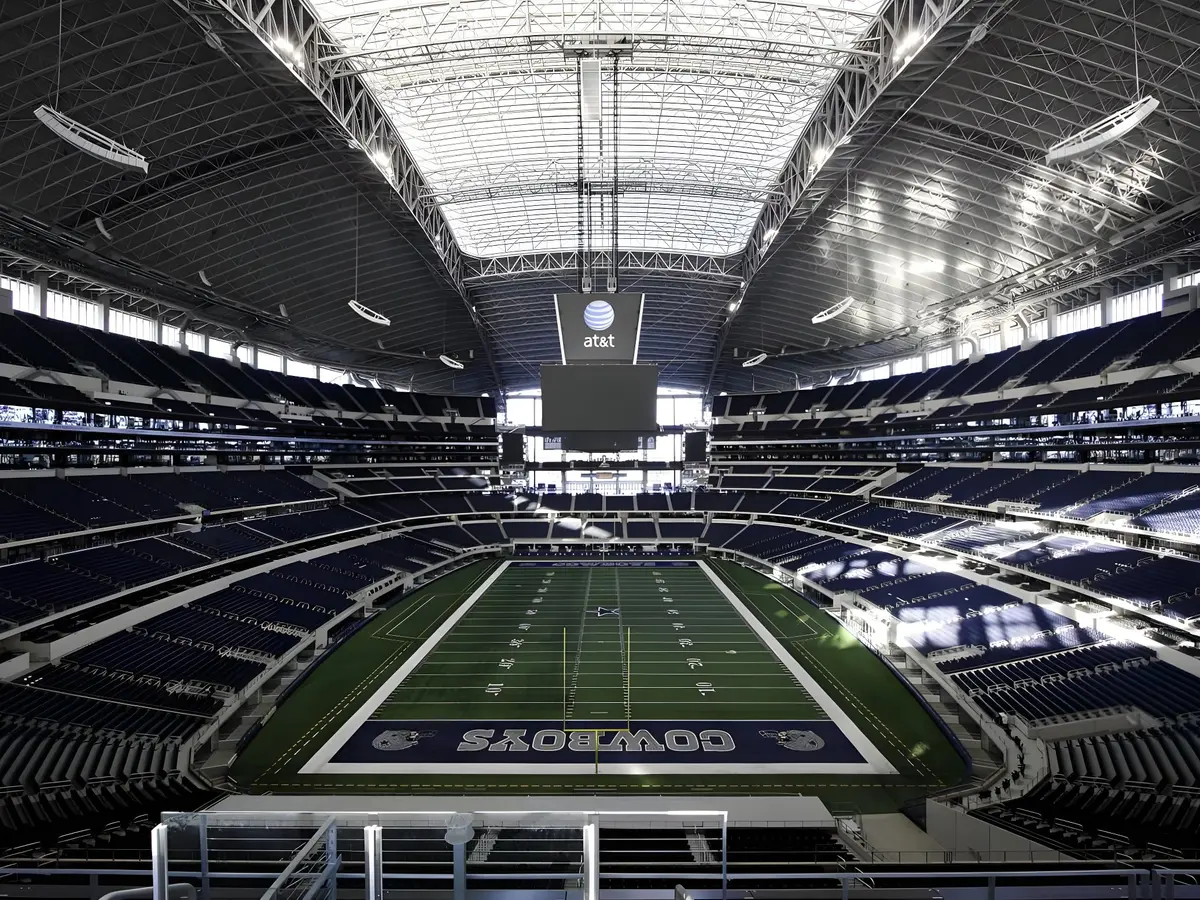 Inside view of the AT&T Stadium · Credits: Wikimedia Commons @Nicole Cordeiro
Funding was a mix of public and private money. Arlington voters approved sales, hotel and car rental tax increases, supporting city bonds of more than $325 million including interest. The NFL provided a $150 million loan, and owner Jerry Jones covered the cost overruns. Early marquee events included NBA All-Star Game (2010), Super Bowl XLV (2011), the 2014 Final Four and the 2015 College Football Playoff Championship.
Capacity & Amenities
Layout and Structure
The stadium seats 80,000 in standard configuration. Six elevated Party Pass platforms in each end zone offer standing-room access, which is how capacity can stretch beyond 100,000. Two arches nearly 300 feet tall span the building, supporting a retractable roof with a trademark opening echoing the Cowboys’ former Texas Stadium. Massive glass doors open each end zone, though they are typically kept closed given Texas weather.
Video and Technology
Twin center-hung Mitsubishi boards measure 160 feet wide by 72 feet tall, with additional end-zone displays of 51 by 29 feet. The boards were the world’s largest HDTV at installation, since surpassed. More than 3,000 Sony LCD screens are spread through the building. Sources cite both 160 and 175 feet for the center boards’ width.
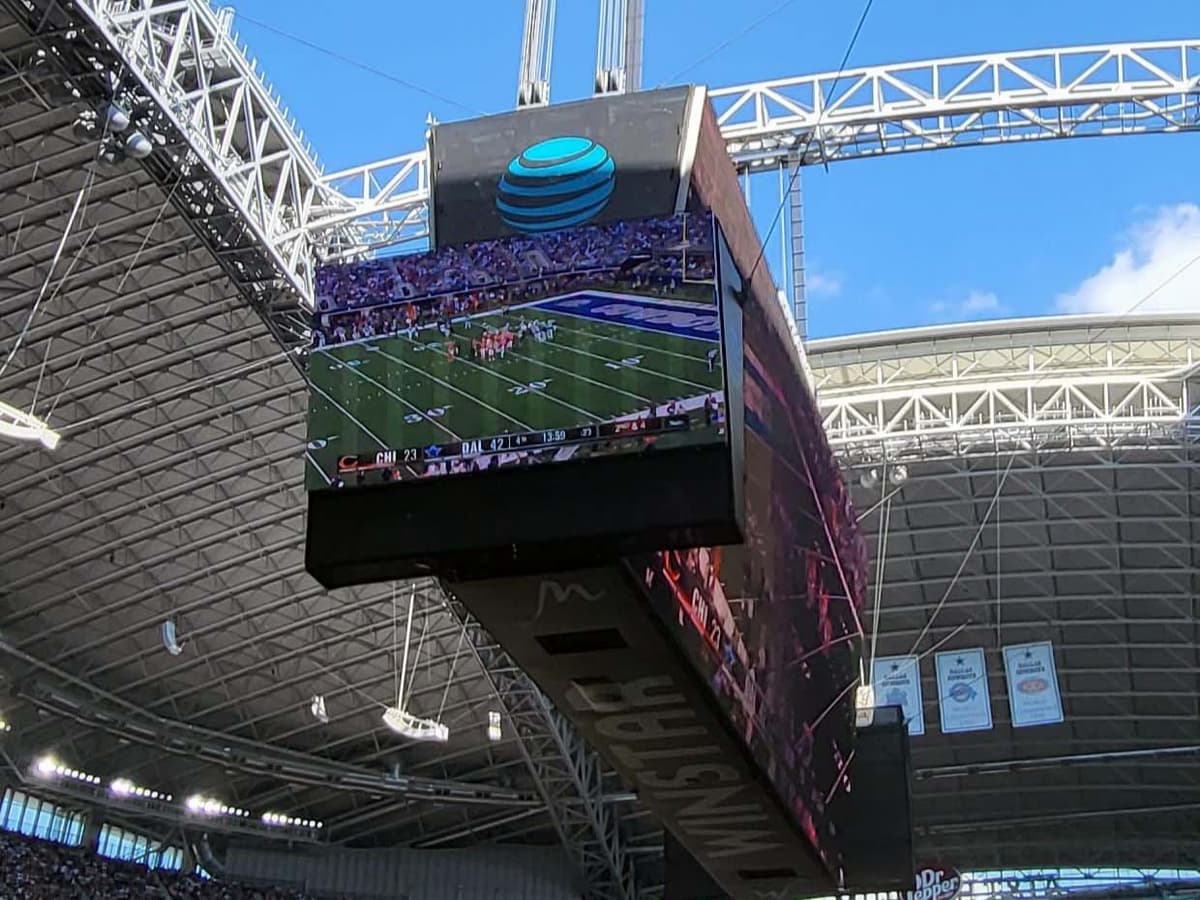 AT&T Stadium video board · Credits: Wikimedia Commons @MurphpicsPremium Seating
The stadium has roughly 380 suites (early blueprints showed 414) stacked across several levels, from field-level suites on each sideline and behind the end zones to higher suite tiers above the club decks. Club seating includes the Hall of Fame Club near the field, the Founders Club at midfield and a Mezzanine Club on the third seating deck. The Stadium Club, opened in 2016, operates as a public restaurant and bar five days a week.
Getting around
The main concourse is wide and well stocked with concessions, though club seating splits it in two, so fans may need to use the upper level to cross sides. Teams enter through the lower club seats at the 50-yard line, with the Cowboys on the south sideline and visitors on the north. There are ten guest entrances, two large pro shops on the main concourse and two smaller ones upstairs.
Field
For the 2026 FIFA World Cup, the surface was a natural pitch of Kentucky bluegrass and ryegrass, grown in Colorado and transported some 800 miles to North Texas. Above an underground network of ventilation and irrigation systems designed to keep it fit for nine matches, the grass sat under 18 pink grow lights suspended from the ceiling.
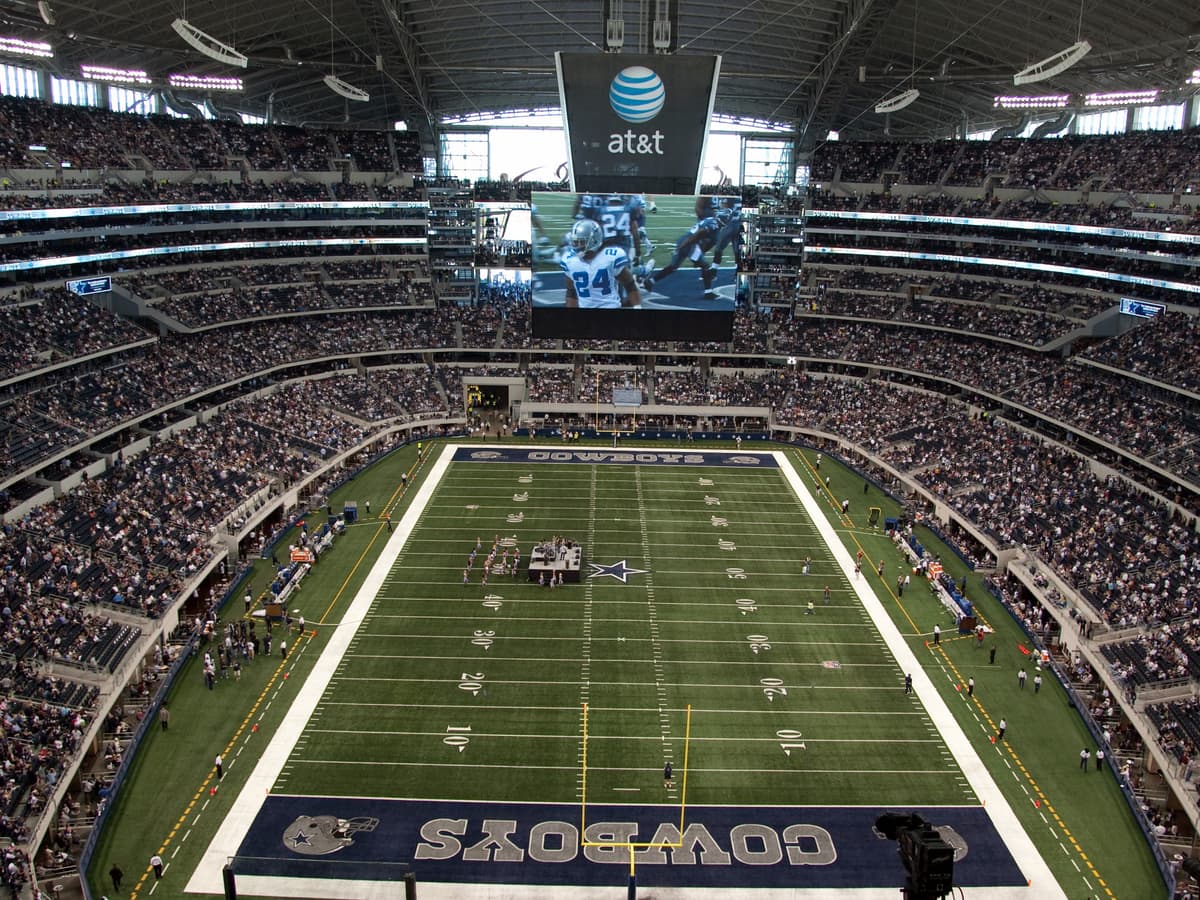 The field of the AT&T Stadium for NFL matches · Credits: Wikimedia Commons @MahangaArt and Heritage
The Jones family commissioned site-specific work from contemporary artists, and Anish Kapoor’s Sky Mirror stands outside the east end. Inside, a Ring of Honor and large historic photographs mark team milestones, and a Tom Landry statue stands near the ticket booth and pro shop. Tours range from guided to self-guided, including art-focused options.
Team & Ownership Context
The City of Arlington owns the stadium and the Dallas Cowboys operate it. The Cowboys have played there since 2009. Other tenants include the Cotton Bowl Classic (since 2010) and the Big 12 Championship Game (2009, 2010 and 2017 onward). The Southwest Classic between Arkansas and Texas A&M was also played there in several periods through 2024. Beyond football, the venue is a regular host for concerts, boxing and wrestling.
Renovation Details
In December 2022, the Cowboys confirmed a budget of about $295 million for upgrades ahead of the 2026 FIFA World Cup, aimed at hosting matches and keeping the stadium competitive for future events such as another Super Bowl. The team did not specify the scope and said the work was not expected to change the building’s overall look. Reports at the time varied on the figure, and I could only verify the $295 million number.
The Cowboys are planning renovations to AT&T Stadium worth up to $295 million in preparation for the 2026 World Cup, per @SBJ.
The upgrades are not intended to alter the general look. https://t.co/ML46wxuoh0
— FOX Sports: NFL (@NFLonFOX) December 9, 2022
For the tournament itself, the stadium was temporarily renamed “Dallas Stadium” under FIFA’s naming rules, and capacity was set at 70,649. A natural grass pitch of Kentucky bluegrass and ryegrass, grown in Colorado and trucked about 800 miles to North Texas, covered the turf for nine matches. It sits over underground ventilation and irrigation systems designed to keep it healthy through the tournament, with 18 pink grow lights hung from the ceiling.