
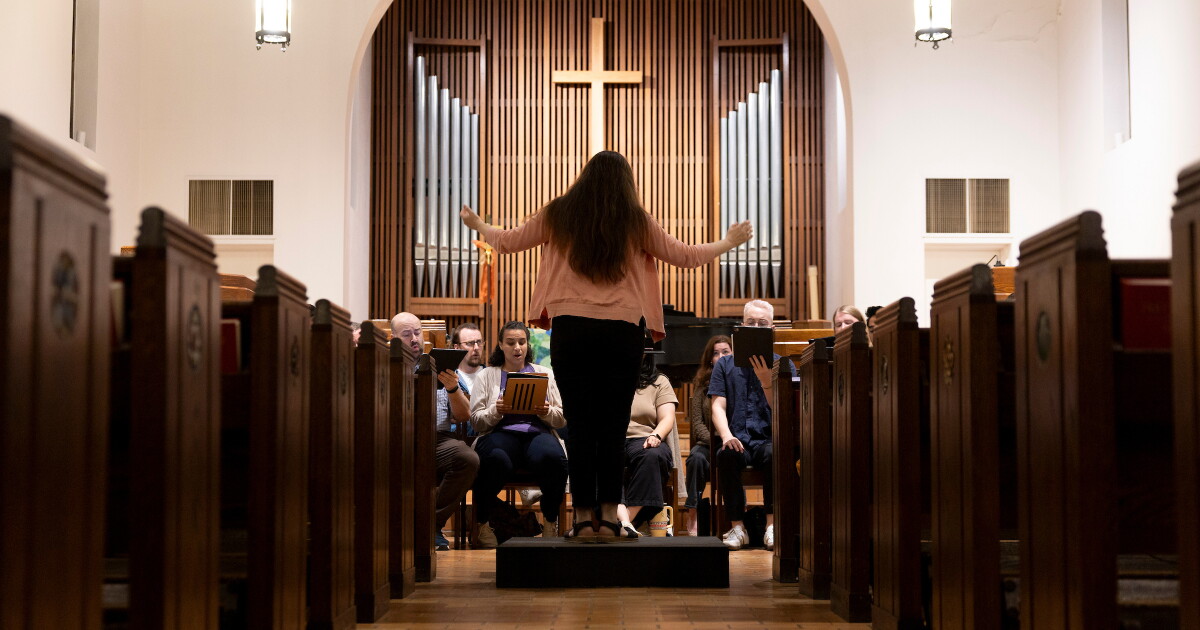
When the artistic director for Austin Cantorum read a story that mentioned a playlist patients listen to while taking psychedelics to treat depression, she had an idea.
“That’d be cool to do a whole concert that was just music from the psychedelic trip playlist,” Adrienne Pedrotti Bingamon said.
Austin Cantorum is a semi-professional chamber choir made up of mostly working adults with day jobs. They’re performing a free concert Saturday called “Visionary” at the First English Lutheran Church in Central Austin.
“We specialize in creating sort of unique emotional experiences with our concerts that actually go on a journey,” Pedrotti Bingamon said. “So this psychedelic concert sort of fit perfectly with what we like to do.”
Johns Hopkins Medicine developed the playlist to support participants in its psilocybin studies. Research has found that the chemical in so-called magic mushrooms can be used to treat adults with major depression and PTSD.
The playlist is nearly eight hours long — the length of a typical mushroom trip. Pedrotti Bingamon condensed it to about an hour and 20 minutes.
The musical arc
Holt Skinner, a tenor and alto in the group, will be playing the role of “trip adviser” during the show.
“I’ll be kind of guiding the audience through the psychedelic trip they’ll be experiencing for this program,” he said.
When Pedrotti Bingamon announced that Austin Cantorum would be doing a concert around the playlist, Holt told her about his own experience using ketamine to treat his depression and anxiety. He had even listened to the playlist during his treatments.
“So she thought it would be kind of a great … experience to have someone who’s experienced this to kind of talk about the different phases and how the playlist is designed to assist patients going through these procedures,” he said.
Lorianne Willett
/
KUT News
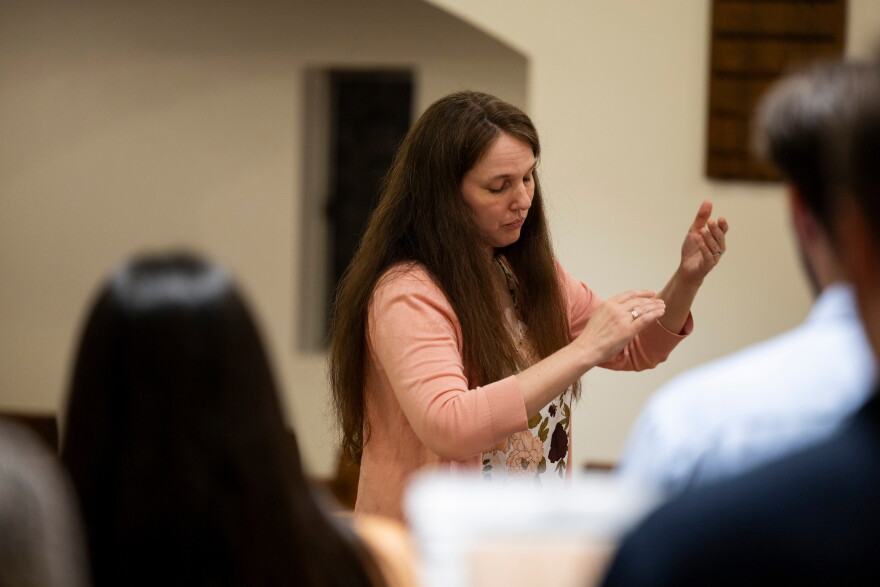
Pedrotti Bingamon said she hopes the audience leaves the concert Saturday feeling emotionally fulfilled.
The program is split into phases, mirroring the arc of a psychedelic trip.
When people arrive, there will be classical guitar playing to help people settle in, get comfortable and “maybe resolve some of the fear they might have around this kind of experience,” Skinner said.
Then the program goes into the onset phase where the medicine starts to take effect. That’s followed by the ascent.
“And the music starts to become a little more unhinged in some ways,” Skinner said.
The climax of the concert is Samuel Barber’s “Agnus Dei,” which is based on his “Adagio for Strings.”
“It’s like the unofficial mourning song of America,” Pedrotti Bingamon said, considered one of the “saddest pieces in the world.”
Skinner said the work is incredibly intense and the most difficult piece Austin Cantorum is doing for the concert.
“It really just tugs your emotions in a lot of different areas,” he said.
As the piece crescendos, “we’re gonna make the room sort of shudder with our sound,” Pedrotti Bingamon said.
After that, the program comes back to earth.
The potential of psychedelics
Austin Cantorum invited Greg Fonzo to deliver some remarks ahead of the concert. He’s a clinical psychologist and co-director of the Center for Psychedelic Research and Therapy at the University of Texas at Austin’s Dell Medical School.
The center is involved in several different studies focused on understanding how psychedelics can be used for the alleviation of various mental health conditions, particularly things like depression and post-traumatic stress disorder.
Fonzo said it makes sense to integrate music into a psychedelic dosing session.
“Even in indigenous use, music was incorporated into the ingestion of the psychedelic plants, typically,” he said. It’s also used in ayahuasca ceremonies, where shamans sing songs meant to convey certain intentions or even powers that can be invoked during the experience. “Similar chanting occurs in Peyote ceremonies.”
The center uses its own playlist during dosing sessions. The results of their studies have varied, but Fonzo said some participants have reported life-changing insights.
He said he wants people to appreciate the power of the substances.
“But also that they should be treated with respect,” he said. “It’s not a recreational sort of drug or experience. … We don’t want to treat them that way.”
Feel the music
Pedrotti Bingamon said music can heal and open you up to different traumas you may not have realized you have.
She wants the audience Saturday to let the music wash over them.
“Just let the music take you where you’re gonna go and don’t fight it, you know?” she said. “If it brings up bad memories — I hope it doesn’t, but if it does — maybe just … let the nerves in your brain take that into a different avenue so that that way you can feel something healthy about it.”
Pedrotti Bingamon said she hopes people leave feeling emotionally fulfilled and with a different understanding of psychedelics.
“[They] can theoretically have really amazing effects on people who need that kind of therapy,” she said.
Austin Cantorum is not condoning drug use at the performance.
“But there is a fire station right over there just in case anybody chooses to do the wrong thing,” she laughed.