
Union presidents warn that stalled negotiations could push experienced first responders toward other departments, complicating Dallas’ ambitious hiring goals.
DALLAS, Texas — Dallas is spending millions to recruit more police officers and firefighters. But the leaders representing those already wearing the city’s uniforms warn that hiring new first responders could become increasingly difficult if experienced employees begin leaving.
The city’s meet-and-confer agreement with its police and fire associations expired Sept. 30, and a new contract has yet to be finalized.
Dallas Police Association President Sean Pease and Dallas Fire Fighters Association President Chris Peterson say negotiations have stalled, leaving questions about pay, benefits and working conditions unresolved.
“It’s hard to meet and confer when you don’t meet,” Pease said.
Both union presidents say the uncertainty is prompting employees to consider opportunities elsewhere, potentially undermining Dallas’ efforts to strengthen public safety staffing.
The concerns come as the city works toward its goals under Proposition U, the voter-approved charter amendment addressing police staffing, compensation and pension funding.
Dallas’ adopted budget calls for adding 750 police officers over two years, reaching 3,651 sworn officers by the end of fiscal year 2026-27 and 3,800 by the end of the following fiscal year.
But union leaders question whether Dallas can reach those goals without addressing the concerns of employees already on the job.
Police association concerned about pay negotiations
Pease says compensation remains one of the biggest obstacles in negotiations.
According to the Dallas Police Association, its leadership believes the city is considering pay increases within a range of 2.65% to 3.2%, with little willingness to negotiate outside those figures.
Pease argues that the proposed increases must be considered alongside what neighboring departments are already paying their officers.
Dallas’ adopted fiscal year 2026-27 budget places starting police officer compensation at $81,232 annually.
Meanwhile, published police salary schedules in neighboring cities show:
Irving: Starting salary of $83,808, increasing to $112,272 after 5½ years of service.
Arlington: Starting salary of $83,665, with a maximum published police officer salary of $112,174 after 20 years.
Plano: The city has expanded its lateral-entry compensation policies to recognize qualifying experience from other law enforcement agencies.
The differences are particularly significant for experienced officers.
Irving’s published lateral-entry salary schedule allows qualifying officers with six full years of prior experience to begin at $112,272 annually.
That means an experienced Dallas officer could potentially move to Irving and immediately qualify for compensation near the top of its police officer salary schedule, subject to hiring requirements.
For Pease, that creates a competitive challenge.
Dallas is investing in attracting recruits, but experienced officers have opportunities to take their training and institutional knowledge elsewhere.
Pease says he has been receiving calls daily from the rank and file over the past two-and-a-half to three months about where the department is heading.
San Antonio approves substantial police raises
The negotiations in Dallas come as another major Texas city has finalized a new police compensation agreement.
On Sept. 10, the San Antonio City Council approved a three-year collective bargaining agreement with the San Antonio Police Officers Association.
The agreement, which runs from Oct. 1, 2026, through Sept. 30, 2029, provides a reported 16.5% cumulative increase in base pay.
The contract includes multiple scheduled raises, beginning with a 4% increase this October, 5% in the second fiscal year and 7.5% in the third.
San Antonio officials estimate the agreement will cost approximately $102.2 million over three years. It also includes changes to shift differential compensation and new weekend differential pay.
The agreement was approved by 61% of San Antonio police officers who voted on it.
San Antonio operates under a collective bargaining framework, which differs from Dallas’ meet-and-confer process.
Still, the agreement illustrates the competitive compensation environment facing major Texas police departments.
While San Antonio has secured a multiyear agreement, Dallas police and fire association leaders say they remain uncertain about the terms of their next contract.
Firefighters want changes to their schedules
For Dallas firefighters, Peterson says the negotiations involve more than pay.
He argues that while firefighter salaries in Dallas are more competitive with surrounding departments than police salaries, the demands of the work schedule are becoming increasingly important.
Peterson says Dallas firefighters currently average approximately 54 hours of work per week.
He wants the city to consider a 24-hours-on, 72-hours-off schedule.
That arrangement would average approximately 42 hours per week, providing firefighters with more time at home.
Peterson says alternative schedules are gaining attention across the country as departments look for ways to improve working conditions and retain experienced personnel.
Without changes, he worries that some firefighters may leave for other departments or even pursue different careers.
“I think they would go for, you know, any type of job that has got more stability to it right now,” Peterson said.
Peterson also questioned whether the city’s handling of negotiations reflects its public commitment to supporting first responders.
“You have the mayor the night before at the RNC speaking about public safety and how it’s a priority, and we’re not a priority. We’re not a priority right now,” Peterson said.
Healthcare changes add another layer of frustration
The contract negotiations are unfolding as Dallas eliminates its longtime preferred provider organization, or PPO, health insurance option.
The city is replacing the plan with options that include lower premiums but generally offer less flexibility for out-of-network care.
For employees who have relied on the PPO for years, the change could mean reconsidering doctors, specialists, and other healthcare arrangements.
Both union presidents say the decision has generated considerable frustration among their members.
“We can’t get a contract on the table, and then you throw on top of it that you’re removing the PPO,” Pease said.
Peterson has expressed similar concerns.
Both leaders say employees are weighing the combined effects of healthcare changes, compensation uncertainty and working conditions when considering their futures.
For some, they fear, the decision may be to leave Dallas altogether.
What happens if negotiations fail?
Dallas negotiates compensation and certain working conditions with police and fire employee associations through a process known as meet and confer.
Unlike traditional collective bargaining, the process does not require the city and employee representatives to reach a final agreement.
Any new meet-and-confer agreement must be ratified by the covered police officers and firefighters and approved by the Dallas City Council.
If negotiations fail, existing state laws, local ordinances and applicable civil service rules continue to govern employment conditions unless lawfully changed.
The city can also make compensation and budget decisions through its established governmental processes without necessarily reaching a new meet-and-confer agreement.
Dallas has already approved police and fire salary schedule adjustments as part of its fiscal year 2026-27 budget, including schedules scheduled to take effect in January 2027.
However, the unresolved negotiations leave uncertainty about whether the associations and city will agree on a broader package of employment terms.
City manager says Dallas remains committed to employees
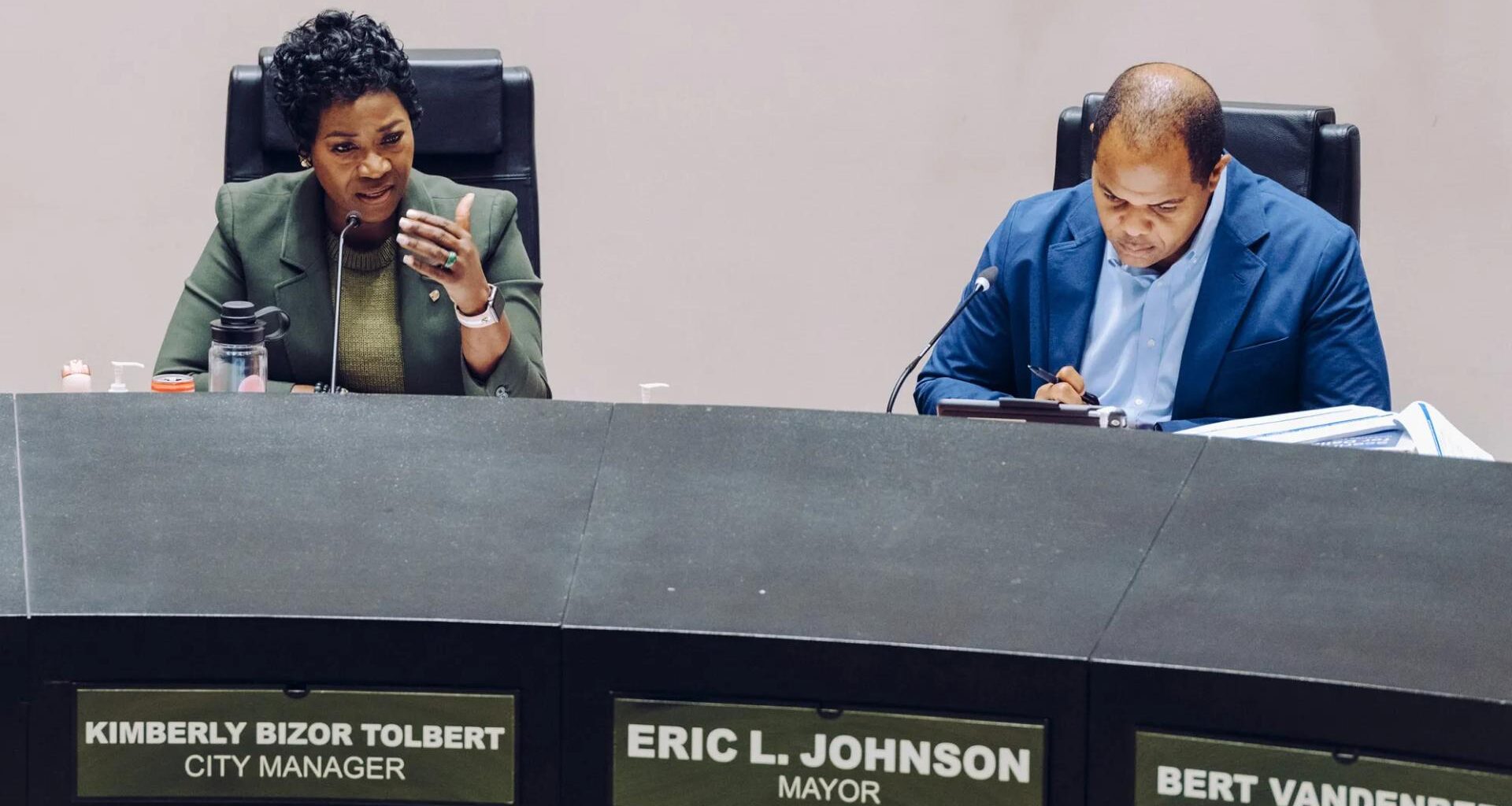
Dallas City Manager Kim Tolbert says the city remains committed to supporting its workforce and hopes negotiations will produce an agreement.
“The city understands the importance of supporting all employees and their families. It is my hope that the Meet and Confer negotiation teams continue working to bring an agreement across the finish line,” Tolbert said in a statement to WFAA.
In an Aug. 4 statement, Tolbert emphasized the city’s approach to compensation, which includes step increases tied to career advancement and annual market-based adjustments informed by salary surveys of 17 comparable cities.
Tolbert said the city’s fiscal year 2026-27 budget would fully fund those compensation components, even as negotiations over a new agreement continued.
Dallas City Council also approved an $82.3 million increase in combined funding for the Dallas Police Department and Dallas Fire-Rescue in its newly adopted budget. That increase covers broader departmental spending, not solely employee compensation.
But Pease and Peterson say competitive pay and working conditions remain essential to retaining experienced first responders, regardless of the city’s broader investments in public safety.