
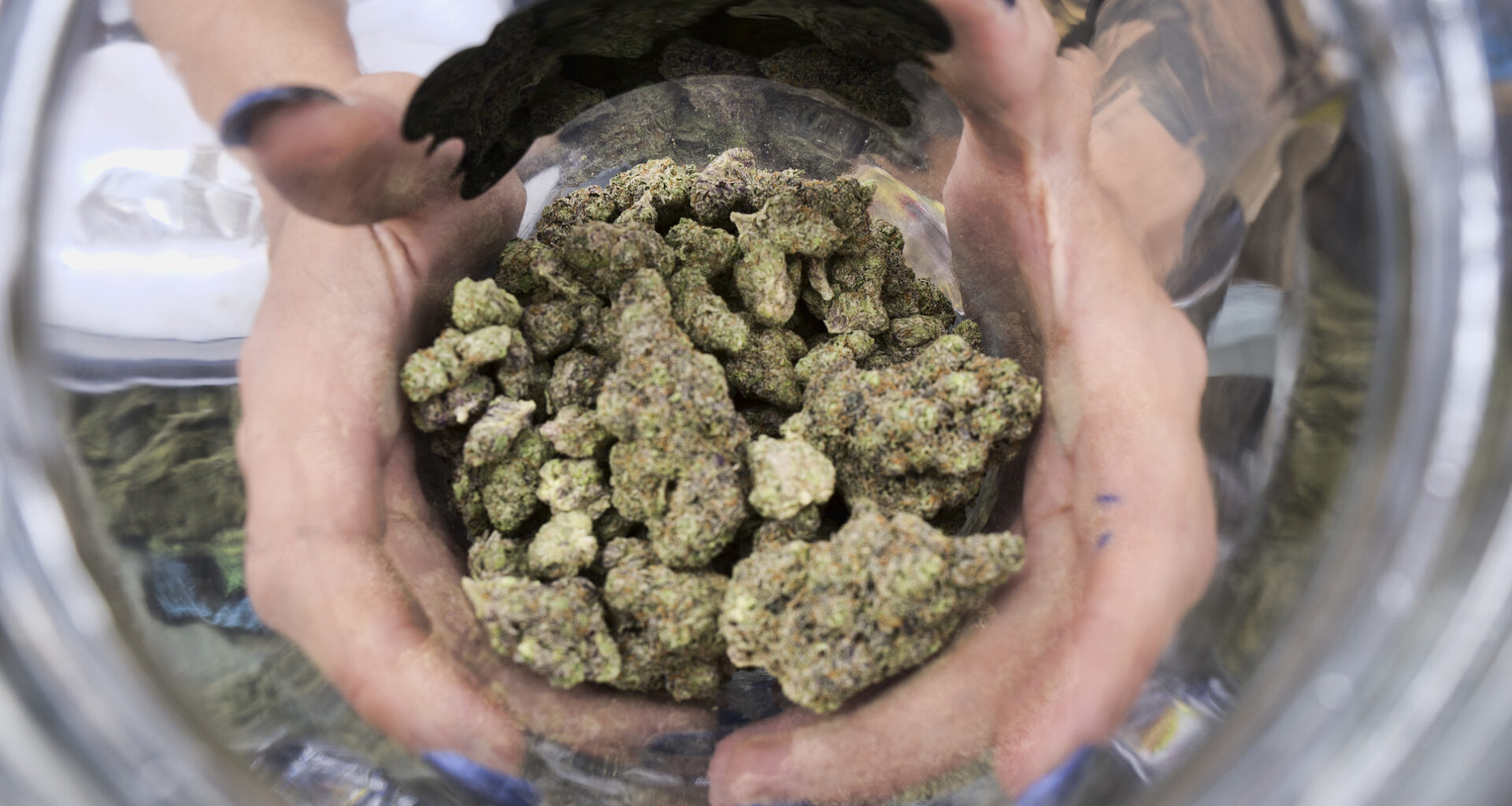
A bud tender displays a jar of cannabis. (AP Photo/Richard Vogel, File)
Richard Vogel/Associated Press
Houston voters this fall will decide whether to force the Houston Police Department to deprioritize low-level marijuana enforcement at a time when data show local police have been arresting more people on precisely those charges in recent years.
Activists behind a statewide effort to reduce the number of people arrested on misdemeanor marijuana charges collected signatures to place Proposition A on the November ballot, arguing that Houston would be better served if police focused on more serious crimes. Voters in Austin, Dallas and other Texas cities have already approved similar measures.
READ MORE: Houston voters to decide marijuana enforcement, no-knock warrant ban this fall
Article continues below this ad
Yet the recent upswing in marijuana cases here is more complicated than any one agency’s enforcement priorities, experts said. Likely more important, they say, was a 2023 state law that put prosecutors at risk of being removed from office if they show leniency in enforcing entire classes of crimes, including misdemeanor marijuana possession.
Local police booked nearly three times as many people into Harris County jail solely or primarily on misdemeanor marijuana possession charges in 2024 than the year prior, county data show. The trend began in September 2023 – the month the law on prosecuting took effect. Marijuana bookings remained elevated last year, though the tallies in recent years still are just a fraction of the volume of charges filed a decade ago.
Arrests spiked most among county deputies, with Houston police not far behind.
“The city of Houston has deprioritized enforcement of arrests related to possession of small amounts of marijuana for several years,” Mayor John Whitmire said. “When a person is charged with this type of crime, it is because the Harris County District Attorney’s Office decides to do so. Oftentimes, these individuals are sent to diversion programs.”
Article continues below this ad
District Attorney Sean Teare’s office didn’t respond to requests for comment. Teare’s office has taken down public data on how many people prosecutors have routed into a marijuana diversion program the county launched in 2017, one Houston-based consultant said.
New rules put prosecutors in precarious situation, experts say
Nathaniel Munier, a longtime local defense attorney, said the shift in marijuana enforcement began with the Legislature’s 2023 bill allowing courts to remove district attorneys found not to be enforcing state laws. The law was intended to prevent progressive prosecutors from ignoring the state’s new abortion ban as well as marijuana laws.
State leaders also have acted to bolster marijuana enforcement, with Attorney General Ken Paxton in recent years suing cities that have voted to approve measures like the one Houston voters will weigh Nov. 3.
In this context, some experts doubt that voters passing Prop. A would drive down the number of people Houston police arrest on misdemeanor marijuana charges.
Article continues below this ad
Thomas Hogan, a professor at South Texas College of Law, said he expects the ballot measure to have “no real impact.”
The police chief and district attorney would have to agree on a specific marijuana enforcement policy to make a difference, and the referendum would not force that to happen, Hogan said.
The advocates behind the referendum, Ground Game Texas, didn’t respond to a request for comment about the proposal and what effect it might have on marijuana enforcement.
Jeff Reichman, who runs the Houston-based consulting firm January Advisors and has analyzed misdemeanor marijuana case data for years, said the ballot measure could at least show residents care about the issue. But Reichman added he isn’t sure what to make of the uptick in marijuana cases.
He questioned whether cases have risen in part because prosecutors are using their marijuana diversion program less often. Teare’s office used to post public information about how many cases are routed through the program, he said, but now does not.
Article continues below this ad
Some attorneys who represent clients charged with marijuana possession said the uptick in cases has been noticeable in part because cases almost disappeared in the wake of the COVID-19 pandemic, as local elected leaders sought ways to clear out the jail population.
“For a time, cops just weren’t even bothering to arrest people, because prosecutors wouldn’t take the case,” Munier said. “They weren’t even calling intake.”
Lawmakers also repeatedly have changed what marijuana products are legal in recent years, he noted, undercutting low-level marijuana prosecutions for a time.
Reichman said he worries these legislative maneuvers have left some residents unaware that their use of marijuana products is illegal.
Article continues below this ad
“Will things change?” Reichman said of the ballot proposition. “It’s hard to know, especially because the ordinance only affects HPD – which accounts for like a third of arrests” in the county.