
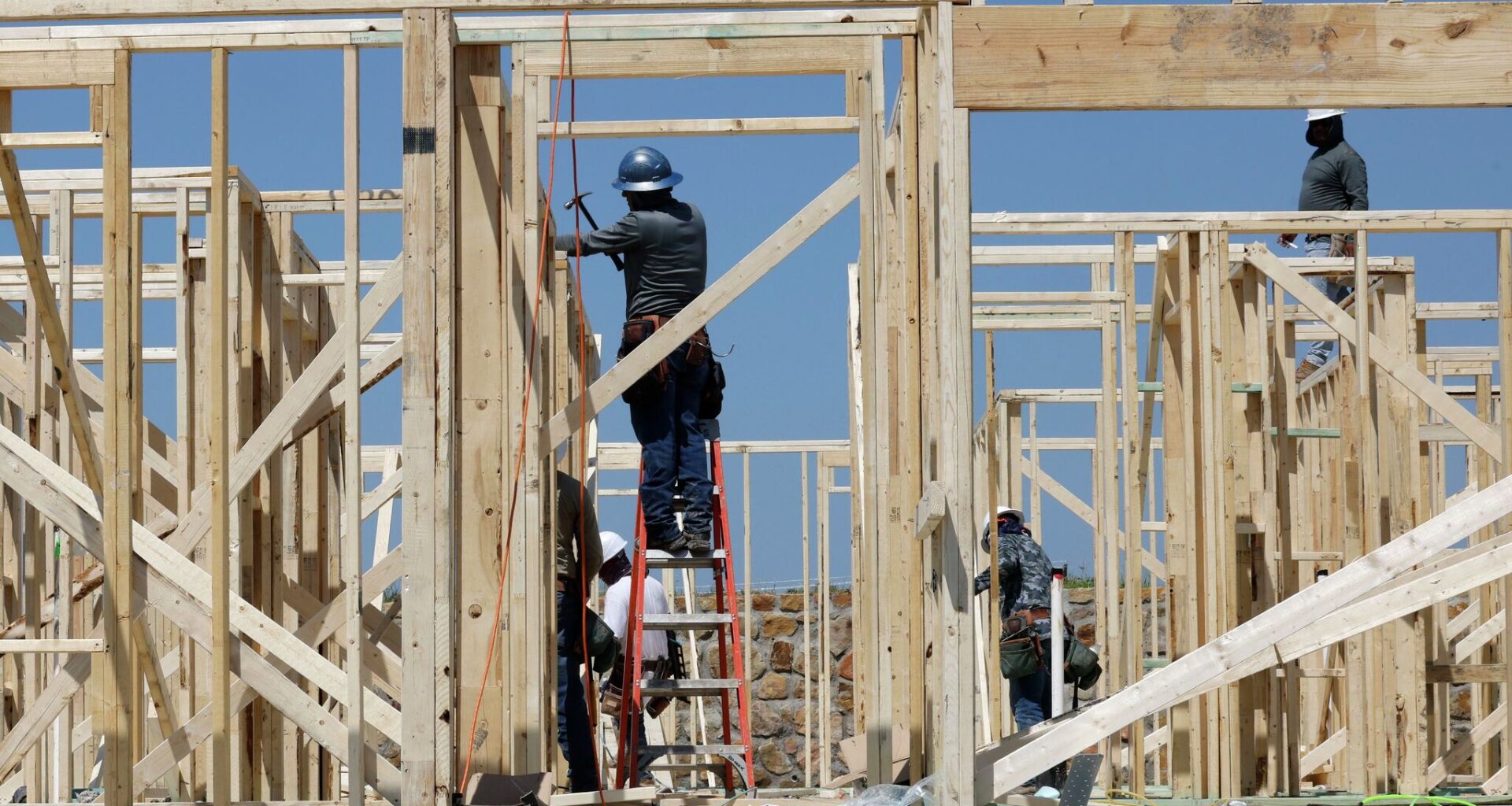
Construction workers frame new houses in 2024 in Crandall, Texas. (Chitose Suzuki/Dallas Morning News/TNS)
Chitose Suzuki/Dallas Morning News
Rising mortgage rates present a financial and mental challenge for both Dallas-Fort Worth homebuilders and buyers.

Mortgage rates passed 7% in late September and have risen higher since. As mortgage rates have fluctuated over the past four years, rates above 7% have had a chilling effect on the market, said Ted Wilson, principal of the Dallas-based market research firm Residential Strategies Inc.
“Psychologically, there’s something about 7% that has been tough,” Wilson said. “And we see a decline in traffic and sales and, of course, it affects affordability substantially.”
Article continues below this ad
The 30-year fixed-rate mortgage was 7.4% as of Thursday, the highest rate buyers have seen since 2023, according to Freddie Mac. D-FW homebuilders had a seasonal slowdown in the third quarter and rising mortgage rates could slow sales for the final quarter of the year.
Related: D-FW home sellers outnumber buyers, but mortgage rates are rising. What does that mean for buyers?
The median home price in D-FW was $379,990 as of September, according to MetroTex.
At the end of February, the 30-year fixed-rate mortgage briefly dipped to 5.98%, according to Freddie Mac. For a buyer financing a $379,990 home loan, the change in the mortgage rate from February to October would translate to an additional cost of about $357 per month.
Article continues below this ad
Mortgage rates were significantly lower as recently as 2021, when rates were generally around 3%. However, rates rose quickly throughout 2022 to rates above 6%.
There was hope rates would come down this year, Wilson said. However, throughout 2026 the 10-year Treasury bond yield — which mortgage rates tend to follow — has been impacted by higher oil prices and uncertainty.
Home start slowdown
A home under construction is seen at 2538 Havenhurst Avenue on Monday, Aug. 17, 2026, in Farmers Branch.
Elías Valverde II/The Dallas Morning News
Most D-FW homebuilders reported a seasonal slowdown as the spring selling season gave way to summer, Wilson said.
Article continues below this ad
“Builders were saying that they were still selling units, but not as quickly as they did last spring,” Wilson said. “But it was not dissimilar to what we experienced during the summer of 2025.”
Homebuilders in North Texas started work on 8,690 homes — a drop from the previous quarter’s 11,290 starts — and down 4.1% from a year ago, according to the report. Over the last four quarters, total starts fell to 39,545 units, down 7.8% year-over-year.
Builders closed 10,051 homes during the third quarter of the year, according to Residential Strategies Inc. The annual closing pace was 41,860 units, an 8.6% year-over-year decline.
Meanwhile, finished vacant inventory climbed to 10,628 units, representing a three-month supply, according to the report.
Related: D-FW’s oldest private homebuilder acquired by Colorado-based builder
Article continues below this ad
More expensive homes generally sold well, possibly because of a rising stock market, and some homebuilders creating products for the very low entry-level market continued to find buyers by offering forms of discounts, Wilson said. However, builders targeting middle price points — the bulk of the market — have seen sales go down, he said.
Existing home sales remained fairly steady during the quarter. There were 92,903 home sales over a 12-month period ending in August, an increase of about 1% from this time last year, according to the Texas A&M University Texas Real Estate Research Center. Additionally, listing inventory was at about a 4.42-month supply at the end of August.
Although there have been some improvements in the North Texas resale market, the affordability challenge created by higher mortgage rates continues to put pressure on home prices, Cassie Gibson, executive vice president of Residential Strategies Inc., said in the report.
“This can be a particularly sensitive issue for buyers and builders in contingent-sale situations where a prospective homebuyer must sell an existing home before they can purchase a new one,” Gibson said.
Driving factors
Job growth appears to have improved in 2026, compared to the previous year, according to the report.
Article continues below this ad
D-FW added 43,100 net new jobs during a 12-month period ending in August, according to the Texas Workforce Commission. Although that pace is less than half of the annual average from 2010 to 2023, Houston and D-FW lead other metro areas in the nation for job growth, according to Residential Strategies Inc.
Inflation is also hitting homebuilders and their margins. Diesel prices impact every part of a home because materials have to be transported to the home site, said Don Dykstra, chairman of Bloomfield Homes.
“Diesel would be the most widespread inflationary item, but other examples would include copper or steel or lumber,” he said.
Factors that could impact the market for builders going forward include population growth, job growth and interest rates, Dykstra said.
“Our big drivers are affordability, which would be lower interest rates, job creation, which would be a stronger economy, and immigration and population growth,” Dykstra said.
Article continues below this ad