
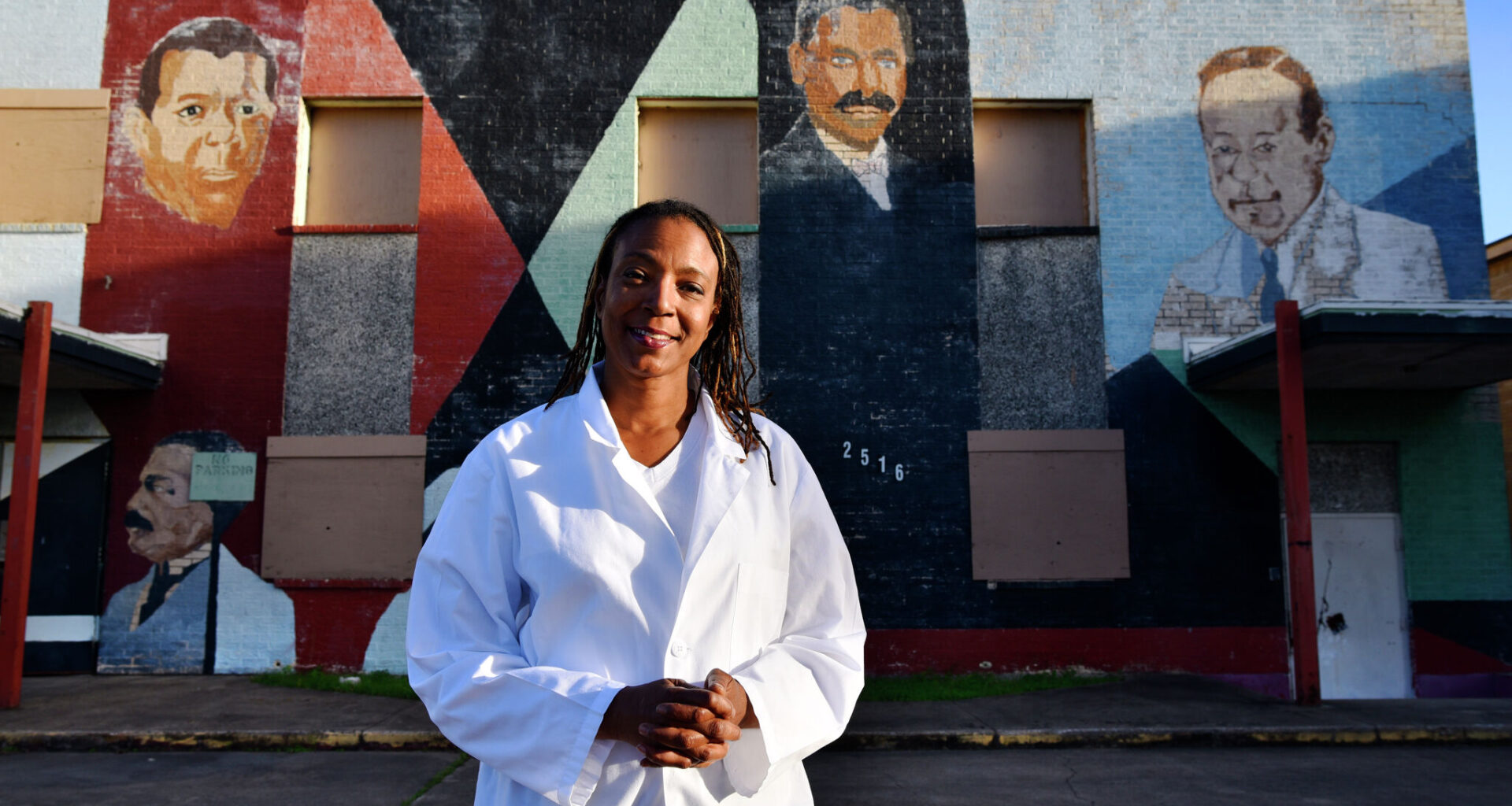
The two-story building, adorned for decades with the faces of the unfortunately forgotten, has been empty far longer than it was ever occupied — going on 42 years now. Just another dilapidated shell along Martin Luther King Jr. Boulevard. Just another undelivered promise. Just another broken dream.
In the early 1960s, when the street then called Forest Avenue fed into Fair Park, this building at 2516 Martin Luther King Jr. Boulevard housed one among 33 hospitals serving the city at the time. It was the only one in South Dallas. Which meant it was the only one with Black doctors who treated Black patients. It went by a few names after doctors Edward Mason, Emmett Conrad, Judge Page and the Rev. Jesse Lott (of next-door Lott’s Mortuary) opened its doors in 1963. Upon its closure in 1984, the 52-bed facility was known simply as Forest Avenue Hospital.
Which I’d all but forgotten about until earlier this week, when I pulled into the empty parking lot to take a call and looked up afterward to see the faded faces of the hospital’s founders, painted in 1978 by South Dallas students using federal funds, staring into the afternoon sun. A quick search on my phone jogged the memory: Michelle Morgan, a dentist and daughter of South Dallas, had bought the 18,000-square foot building for $200,000 in 2016, with the hopes of reopening the hospital.
Its promised resurrection was such big news it made the front page of this newspaper in December 2017 beneath the headline “Reviving a hospital, filling a void.” But the building looks today as it has for decades. Padlocked. Boarded-up. Trashed. Abandoned. A void, still.
Article continues below this ad
A visit to the Dallas Central Appraisal District’s website revealed the previously unreported: Morgan sold the building several months ago to a real estate newcomer with a small Dallas footprint.
“I was very torn about doing that,” Morgan said when I reached her Thursday to ask about why she parted with a building she’d spent a decade trying to salvage. “I just …” A long pause. “It just really hurt my heart. But I had to do something. It was just costing me money every year.”
A decade and dozens of fingers-crossed news stories later, the patient flatlined.
The mural featuring the founders of the Forest Avenue Hospital, painted by South Dallas students, has been staring into an empty parking lot since 1984.
Robert Wilonsky/Staff writer
There was no shortage of people wanting to give Morgan money. The Real Estate Council committed six figures to the project in 2017. Six years later, the Dallas City Council approved millions in economic development grants, but none of that would do any good unless she could secure the millions of dollars contractors told her it would cost to rehab the husk of a hospital long ago abandoned.
Article continues below this ad
“And I just couldn’t get a bank to loan me the money, basically,” said Morgan, owner of the two-location Art of Dentistry.
Which is the oldest story in southern Dallas, where moneymen have long brandished red pens to cross out areas they deemed unworthy of investment.
“I don’t know if it’s redlined or what,” Morgan said. But no one would give her a cent, she said. Not even with a pocket stuffed with IOUs. “Nope, because you have to borrow all the money up front, and no bank would loan me $5 million.”
That 2017 Dallas Morning News story treated the building’s rebirth as inevitable, just around the corner — “within the next year.” So, too, did a KXAS-TV (Channel 5) follow-up in 2018, and a piece on the National Trust for Historic Preservation’s website (“Reviving a Historic Dallas Hospital”); and yet another News column in 2019, which noted that Morgan had pushed back her timeline “while patiently fundraising, which has been slow but promising.” A WFAA-TV (Channel 8) story followed in 2021, offering “the hope that one day this hospital will be reborn.”
There has long been good reason to assume a rebuild was within reach: In the fall of 2017, The Real Estate Council held a highly touted Shark Tank-like competition during which a panel of investors and entrepreneurs heard pitches from people wanting to invest in southern Dallas. There were some 30 “contestants,” Morgan among them, and the panel liked what she was selling — not merely rehabbing a historic building, but bringing doctors back to a neighborhood where health care was in scarce supply.
Article continues below this ad
“I was excited, because I was also involved with the Forest Theater and wanted to bring medical care to MLK, too,” said Frank Mihalopoulos, who, as founder and CEO of Corinth Properties, had resurrected dead malls across the country, including Red Bird. Mihalopoulos, who also serves as chairman of Austin Street Center’s board, was on the panel that awarded Morgan $500,000 and spoke warmly of the doctor and her “good intentions, her passion and her commitment.”
An October 1980 photo of Forest Avenue Hospital in South Dallas, which was founded and funded by Black doctors in 1963 and shuttered in 1984.
Ed Hille/Dallas Morning News
He wasn’t aware, until I told him, that Morgan had sold the building. Neither was Linda McMahon, CEO of the Dallas Economic Development Corporation, who, in 2017, was The Real Estate Council’s president and CEO and working with Fair Park-area nonprofits to salvage this once-thriving stretch of South Dallas.
“She had some great ideas,” McMahon said this week. “We worked on it for a long time, then it just died. She circled around TREC four different times with four different ideas, and at one point we even offered to loan her money, but she never got comfortable with it. It’s not an attractive building, but the history of it was really important, which is what’s so frustrating. Dr. Morgan has a heart for its history.”
In 2023, the Dallas City Council approved kicking in an additional $2.3 million from the Grand Park South TIF, $1.8 million of which would be considered a grant, as the neighborhood was considered a “Medically Underserved Area as characterized by the Health Resources and Services Administration.” But as Morgan worked to secure the loan needed to fund the restoration, Baylor Scott & White Community Care moved into a stretch of storefronts along MLK owned by St. Philip’s School and Community Center.
Article continues below this ad
By the end of 2025, Morgan decided she’d had enough. She was in her mid-60s, and a decade’s worth of meeting with advisors, overcharging contractors and bankers had worn her out. So she sold the building in December to Ike Okeke, a real estate investor and developer from England who owns a handful of smaller properties in South Dallas.
“He has one advantage: He’s younger,” Morgan said. “So he has renewed energy in his favor.”
A rendering of the Forest Avenue Hospital that Dr. Michelle Morgan brought to the city’s Urban Design Peer Review Panel before the Dallas City Council approved committing $2.3 million in TIF dollars to a project that never came to pass.
Dallas CIty Hall
Okeke said this week he has “provisional plans” to remake the building, with apartments upstairs and a cafe below. There would be a medical component, too, he said, likely for a dentist’s office Morgan still hopes to open there.
Okeke said he bought the old hospital because he sees the potential along MLK, where the Forest Theater will reopen on Nov. 1, restaurants like Ruthie’s Cafe are taking root and developer Jack Matthews owns several large (and largely vacant) lots. He spoke, often, of “urban regeneration,” and emailed renderings of what he’s calling IKEO House, a “live-work-health model.”
Article continues below this ad
“I compare Fair Park to two areas: Harlem in New York and a place in London called Brixton,” Okeke said. “I was in both areas before they were regenerated, so I see the potential of it, because of its proximity to downtown. And I see the history. But above all, what gets me excited is Fair Park itself. It’s such an underutilized asset in Dallas, the best asset in Dallas. I think it’s better than Central Park, I just believe it needs a few more elements from the commercial side along MLK.”
As opposed to what’s been in this spot for as long as anyone can remember: a leaky, empty, busted-up memory where people dump their trash out back. The patient only has so much patience.