
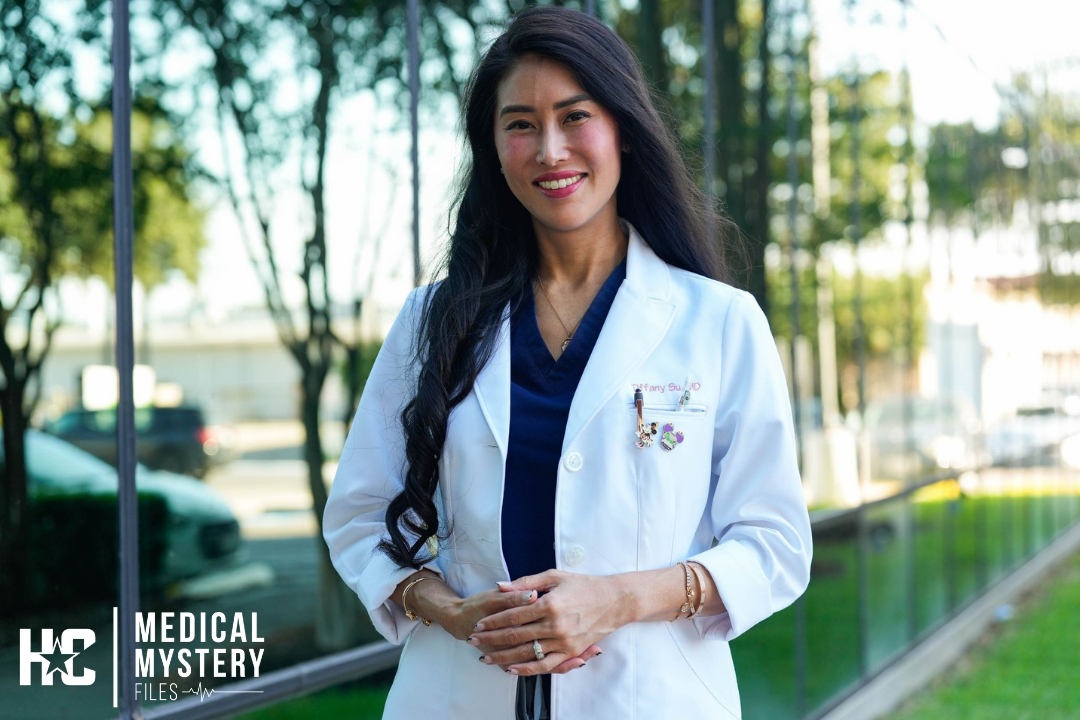
Dr. Tiffany Su is photographed in Houston, Tuesday, Sept. 29, 2026.
Raquel Natalicchio / Houston Chronicle
Dr. Tiffany Su thought her right eye must be playing tricks on her when she suddenly lost her vision while working late one night last summer.
“I didn’t really know what was happening to me,” said Su, an anesthesiologist and aesthetic injector with a practice in Houston. “I honestly thought at that moment that maybe I’m really tired, and maybe I’m not seeing things correctly.”
Su, now 48 years old, next checked her vision by putting a hand over each of her eyes, one at a time. The upper part of the field of vision in her right eye was gray.
Article continues below this ad
MEDICAL MYSTERY FILES: Get stories on real medical cases that left doctors puzzled and patients searching for answers
Su assumed she had a detached retina, a serious medical emergency that could result in permanent vision loss without treatment. She woke up her husband, fellow anesthesiologist Dr. Hui Kang, and told him they needed to go to the hospital.
They were walking out the door 10 minutes later when Su’s vision gradually began returning. The couple was relieved because they knew that retinas can’t reattach by themselves. But they knew they needed to find an explanation. Su, who is nearsighted and wears corrective lenses, had never experienced eye problems.
“My fear was that if I lost my vision again, and it actually stayed and didn’t go away, then I could actually permanently be blind,” she said.
Article continues below this ad
A ticking time bomb
Su and Kang met in medical school at Texas Tech and now work together in the same office in Houston — she as the founder of Skin Shop medSpa; he as the owner of Houston Pain Specialists. Neither of them had any idea what had caused the temporary vision loss.
Su wondered if she’d had a headache or was so overtired that she hadn’t been seeing clearly. Kang worried it might have been a blood clot. He thought that was unlikely because Su had never been diagnosed with a heart problem.
“Even as a physician, if you don’t deal with the eyes, it’s like another world,” Kang said. “It’s another language that we learned in med school.”
Article continues below this ad
CONTACT US: Tell us about a medical condition that was difficult to diagnose
Su’s optometrist referred her to an ophthalmologist, and it took two weeks to schedule an appointment. He suggested the possibility of an embolic event, where a substance like a blood clot or small piece of fat becomes stuck in a blood vessel.
The ophthalmologist gave Su a phone number to call for emergency treatment if she lost her vision again. Embolic events block the flow of oxygen-rich blood, which can result in permanent damage after just a few minutes.
“We knew it’s like a ticking time bomb,” Kang said. “It (could) happen any time.”
Dr. Tiffany Su is photographed in Houston, Tuesday, Sept. 29, 2026. Su is featured in the Houston Chronicle’s “Medical Mystery Files” after she briefly lost vision in her right eye and later learned she had suffered a rare complication from a common heart condition.
Raquel Natalicchio/Houston Chronicle
Searching for an answer
Su decided to take some time off from her practice to focus on her health. She spent the next two months scheduling appointments with a string of medical specialists. She also started taking aspirin to reduce the odds of a blood clot if that was the cause of her sudden vision loss.
Article continues below this ad
She saw a cardiologist who ran some basic lab tests and performed an electrocardiogram to check how her heart was beating. The doctor couldn’t find anything wrong.
A hematologist tested Su’s blood. He determined it was flowing normally and not too thick; thicker blood has a higher tendency to form clots. He also checked whether hormone replacement therapy, which Su had been taking to treat symptoms of perimenopause, was to blame.
Medications that contain estrogen can increase the risk for blood clots, though the overall risk is still low. The doctor told her she may need to stop taking the medication.
“Then all the symptoms, like your hot flashes, come back,” she said. “So, I hated that.”
Blood work ruled out Su’s hormone replacement therapy as the culprit. She was relieved she could keep taking the medication. The tests still left her without an answer.
Article continues below this ad
“With every test coming out negative, I was just getting really frustrated to figure out what was happening to me, and how to prevent it from happening again,” she said.
Finding her ‘aha moment’
Su went back to the cardiologist for a closer look at her heart. He performed a Doppler ultrasound to show how blood flows through the circulatory system, and a transthoracic echocardiogram, which uses sound waves to create pictures of the heart. Both tests looked normal.
The cardiologist then proposed a more invasive procedure known as a transesophogeal echo. Su needed to be sedated so a specialized probe could be passed down her throat and into her esophagus. The test provides clearer images of the heart than a typical echo.
At the same time, the cardiologist also injected a mixture of saline and air bubbles into Su’s blood vessels. The test, called a bubble study, allows doctors to observe how blood flows through the heart.
The two tests showed something unusual. Typically, blood enters the heart through the right atrium, then passes into the right ventricle before moving into the lungs. The air bubbles moved from Su’s right atrium to her left atrium, skipping the lungs entirely.
The test revealed Su had a small hole in her heart called a patent foramen ovale. She had studied PFOs in medical school but never made the connection that it could be her diagnosis.
“It was like my ‘Aha! Finally, we know what’s going on,’ moment,” she said.
She also posted her diagnosis on her clinic’s Instagram page. The post garnered supportive comments from patients and strangers. It also caught the attention of a friend from the medical community.
Interventional cardiologist Dr. Khaled Khalaf had been friends with Su and Kang for more than a decade, having met while their children attended the same school. Khalef reached out to playfully chide Su — and offered to perform the surgery she needed.
“Why does the internet know about your PFO before me? #offended” Khalaf wrote in the text message.
Dr. Tiffany Su is photographed in Houston, Tuesday, Sept. 29, 2026. Su is featured in the Houston Chronicle’s “Medical Mystery Files” after she briefly lost vision in her right eye and later learned she had suffered a rare complication from a common heart condition.
Raquel Natalicchio/Houston Chronicle
A stroke in the eye
Patent foramen ovales are actually very common; roughly one in four people have them. The vast majority — more than 95% — never experience any symptoms, Khalaf said.
The hole forms naturally during fetal development, before the lungs are working. At that time, the placenta delivers oxygen-rich blood through the umbilical cord, and the PFO acts as a shortcut from one side of the heart to the other. It’s designed to close naturally after birth.
When it doesn’t close, tiny blood clots can pass through the hole and travel to other parts of the body. Most of those clots go to the lungs and don’t cause any problems. Some can travel to vital areas like the brain and cause a mini-stroke or stroke-like symptoms, Khalaf said.
“(Su) basically had a stroke in her eye,” Khalaf said, adding that it caused Su to lose her vision. “That’s what led to her symptoms and led to the discovery.”
People at higher risk for blood clots — such as those with certain genetic mutations or clotting disorders — are more likely to develop symptoms from a PFO, Khalaf said. And people who experience symptoms are at higher risk for recurrence, he said.
Fortunately, a PFO can be closed with an outpatient procedure, Khalaf said.
During the procedure, which took place in September 2025, Khalaf inserted a catheter into a blood vessel in Su’s groin and guided it to her heart.
Once there, he placed a device called an occluder into the hole between the left and right atriums. The occluder has two disks that expand on each side of the hole to seal the opening.
“You basically sandwich the hole shut with these two disks,” Khalaf said.
The procedure took roughly 30 minutes. Su went home the same day.
Dr. Tiffany Su is photographed in Houston, Tuesday, Sept. 29, 2026. Su is featured in the Houston Chronicle’s “Medical Mystery Files” after she briefly lost vision in her right eye and later learned she had suffered a rare complication from a common heart condition.
Raquel Natalicchio/Houston Chronicle
‘Back to normal’
Over time — usually between a few weeks and several months — a layer of cells will grow over the occluder so it essentially becomes part of Su’s heart. She needed to take medication for several months to prevent blood clots from forming on the device and now takes only a daily aspirin to prevent clots anywhere else in her body.
“My life is back to normal, as if nothing happened,” she said.
Screening for a PFO is not standard medical practice because most people who have them never experience any symptoms. It’s crucial for doctors to consider the diagnosis, particularly in younger patients who suddenly experience stroke-like symptoms with no apparent explanation, Khalaf said.
“There is a huge disconnect within the medical community itself, just not having it on the radar,” he said.
As doctors themselves, Su and Kang knew the importance of continuing to press for an explanation to an unexplained symptom. All patients should push their doctors to keep searching for an answer until they find one, Kang said.
“Doctors mean well. Healthcare providers mean well,” he said. “But you still need to be involved.”