
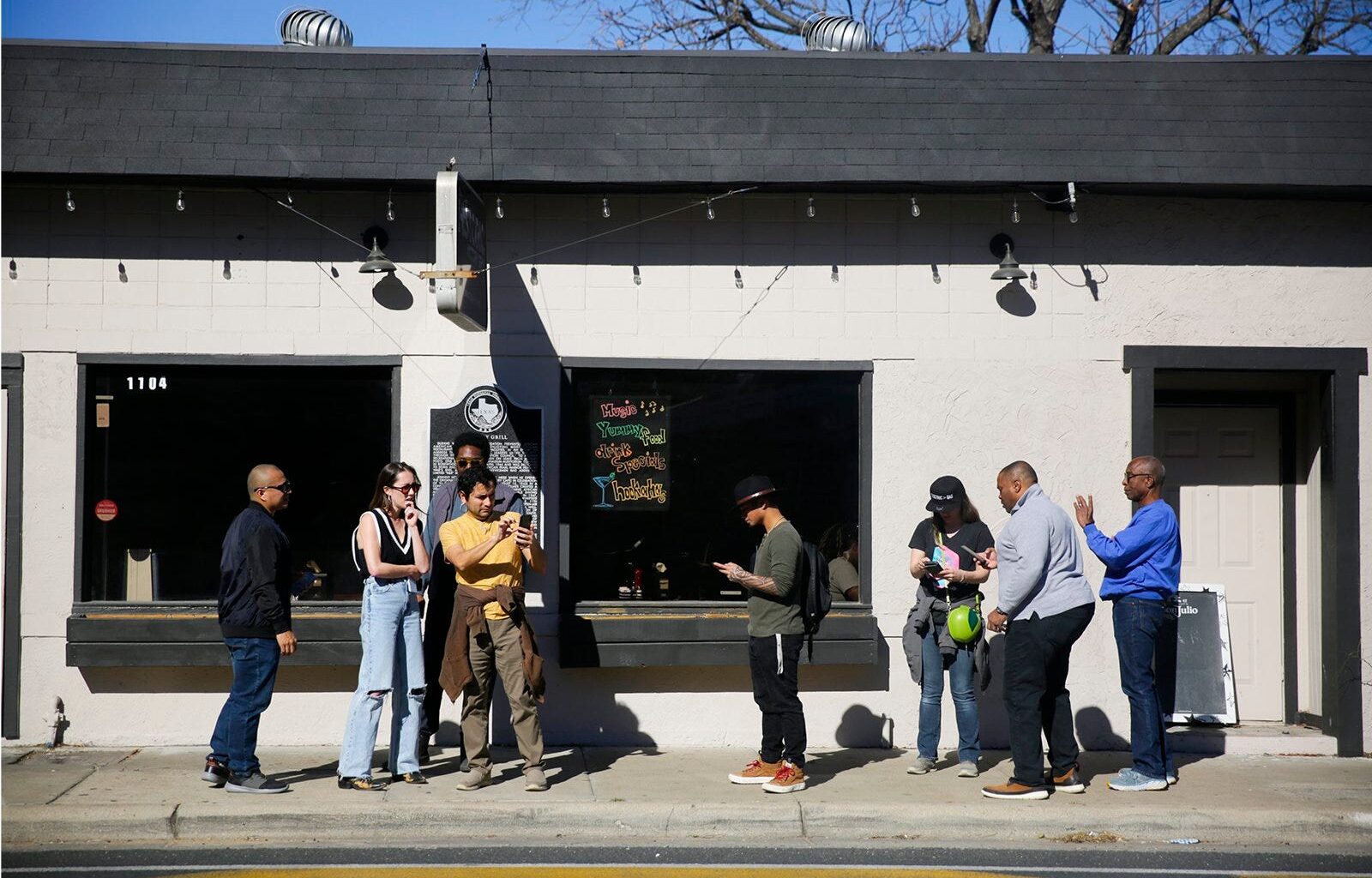
East 12th Street in East Austin on Thursday, Aug. 27, 2026.
Jay Janner/Austin American-Statesman
East Austin voters will choose among six candidates Nov. 3 in the race for Austin City Council District 1 — more than in any other council race on the ballot. Some district residents say the unusually large field has made it harder to settle on a candidate.

“As weird as it sounds, it’s almost like we have too many,” Patrick Davis, who has lived in the district for more than 15 years, said.
Article continues below this ad
The choice will be even harder because the candidates have few major policy differences, according to Brian Smith, a political science professor at St. Edward’s University. That makes trust and name recognition key, he said.
E4 youth digital docents, staff and volunteers test the What Once Was augmented reality module outside the Victory Grill on Monday, Feb. 14. WOW users can layer a pair of animated Black musicians jamming onto the stage of the historic club which was once part of the Chitlin’ Circuit, a network of venues that welcomed Black musicians in the segregated South.
Jack Myer/American-Statesman
The winner will succeed Council Member Natasha Harper-Madison, who is term-limited after representing the district since 2019 and made headlines for her long absence from the council to seek mental health treatment and her chronic absenteeism. A Statesman analysis of city council votes taken since 2023 found that she missed nearly 20% of votes in that time period, by far the highest share among current council members.
Misael Ramos, a member of the Democratic Socialists of America Austin chapter, speaks at a protest by the Texas State Employees Union at University Baptist Church on Friday, Sep. 25, 2026 in Austin. About 80 members of the Texas State Employees Union and CWA Local 6186 gathered to call for the defense of free speech, academic freedom, and public higher education as well as highlight concerns about political pressure forcing changes to academic programs and curriculum.
Aaron E. Martinez/Austin American-Statesman
Residents interviewed for this story said they want Harper-Madison’s successor to listen to East Austin and use the influence of the office to get results.
Article continues below this ad
“We need all the council people to take their positions very seriously,” said Connie Kirk, a civil rights activist who was born and raised in East Austin, adding that she’s looking for a council member who will engage with constituents and respond to their concerns.
Harper-Madison has not endorsed a successor. Her chief of staff, Emmanuel Brantley, defended the council member’s record in a lengthy statement that said, “No elected official’s record can be adequately evaluated without accounting for the work that takes place beyond the Council dais.”
The statement also stressed the “magnitude of the work ahead” for the next District 1 representative.
“The incoming [council member] will inherit major initiatives requiring sustained leadership, alongside an anticipated [c]ity budget shortfall, difficult decisions about social service funding, and significant development challenges,” the statement said. “These responsibilities extend beyond any single [c]ouncil term and will shape the future of District 1 and the broader region.”
Article continues below this ad
Meet the candidates
Alexandria Anderson is a small-business owner and retired Nike sprinter. She chairs the city’s Commission for Women and African American Resource Advisory Commission and serves on the executive committee of the Austin Neighborhood Council. Her endorsements include the Northeast Travis County Democrats and LGBTQ+ Victory Fund.
Alexandria Anderson who is running for Austin City Council in District 1.
Ricardo B. Brazziell/Austin American-Statesman
Steven Brown was born and raised in East Austin and works in health care. He formerly co-chaired Save Austin Now and led its campaign against Proposition Q, a measure that would have increased the city property tax rate by more than 20%. His endorsers include former District 1 Council Member Ora Houston, former state Sen. Gonzalo Barrientos, Austin Police Association and Amalgamated Transit Union Local 1091 (CapMetro union).
Article continues below this ad
Steven Brown, who is running for Austin City Council in District 1.
Ricardo B. Brazziell/Austin American-Statesman
Amber Goodwin has the highest political profile of the candidates, with experience on the Biden-Harris transition team, as chair of Austin’s Gun Violence Task Force and as a Travis County assistant district attorney. She is endorsed by Council Members Krista Laine, Zo Qadri and José Velásquez, U.S. Rep. Greg Casar, the city workers’ union and the Austin Central Labor Council.
Amber Goodwin, candidate Austin City Council District 1, speaks to the Statesman’s editorial board during an interview in Austin on Wednesday, Sept. 16, 2026.
Mikala Compton/Austin American-Statesman
Michael Nahas is a computer programmer and economist who is on the board of the urbanist organization An Austin for Everyone. He formerly chaired the city’s Economic Prosperity Commission and served on the board of Community Housing Expansion of Austin, a nonprofit that operates two low-income housing cooperatives.
Article continues below this ad
Michael Nahas, candidate Austin City Council District 1, speaks to the Statesman’s editorial board during an interview in Austin on Wednesday, Sept. 16, 2026.
Mikala Compton/Austin American-Statesman
Misael Ramos is a business analyst and former state employee who ran for the seat in 2022, finishing second to Harper-Madison. He is backed by the Democratic Socialists of America. In September, he was arrested on a misdemeanor charge of participating in a protest following the shooting of a Venezuelan-born food delivery driver by a federal immigration agent. Ramos’ detention garnered widespread condemnation from progressive leaders and Ramos himself, who denies all wrongdoing in the still pending case.
Misael Ramos, who is running for Austin City Council in District 1.
Ricardo B. Brazziell/Austin American-Statesman
Portia Riggins was born and raised in East Austin. She has worked in accounting and analytics with Texas Realtors, appraisal support with the Travis Central Appraisal District and the city’s 311 system.
Article continues below this ad
Portia Riggins, candidate Austin City Council District 1, speaks to the Statesman’s editorial board during an interview in Austin on Wednesday, Sept. 16, 2026.
Mikala Compton/Austin American-Statesman
What District 1 voters want
District 1 stretches from Interstate 35 to Austin’s eastern border near Pflugerville and includes parts of Manor. The district is home to Walter E. Long Metropolitan Park, Huston-Tillotson University and the African American Cultural Heritage District.
The area’s history shapes the race. Austin’s 1928 master plan pushed Black residents east of Interstate 35. Today, District 1 has the largest Black population of any council district, though it is not majority Black. Residents interviewed for this story said they want the next council member to address housing affordability, displacement, public safety, infrastructure and transit — and to make sure East Austin’s concerns get a hearing at City Hall.
Article continues below this ad
Do you live in District 1? Look up your address: Race, education, income: Here’s how your Austin City Council district compares to the rest of the city
“Our district is actively being erased,” said Miriam Conner, who works in District 1. “Preserving culture and heritage, and also the buildings that hold our stories, is very important.”
Sue Spears-Martin, a District 1 native and community activist, said rising property taxes have made it harder for residents to remain in their family homes. Shuronda Robinson, an entrepreneur and longtime resident, also pointed to housing costs and displacement.
“This is a desirable district to live in, and the pressure of being able to afford your home, afford your rent is something that is really important,” Robinson said.
Article continues below this ad
Smith, the St. Edward’s political science professor, said candidates are competing to earn voters’ trust and establish themselves as advocates for a long underserved area.
“Whoever represents this district is going to have a very difficult job because not only do they have to look out for the city, but they have to represent an area whose concerns have long been underrepresented,” Smith said.
Housing and affordability
The candidates agree that housing costs and displacement are central concerns, but their proposed solutions reveal perhaps their sharpest policy differences.
Article continues below this ad
Goodwin said she would help residents fight gentrification through home-repair assistance and efforts to prevent evictions. She also wants to ensure density-bonus programs produce affordable homes, increase housing near transit and strengthen Austin’s Community Land Trust to help first-time buyers.
Ramos pointed to Project Connect anti-displacement funds, for which he helped write policy, as a way to support residents at risk of displacement. He also said he would direct land-acquisition funding to affordable-housing nonprofits and streamline development to reduce fees.
Anderson said she would work with developers to encourage housing affordable to households earning 20% and 40% of the area median family income and to preserve existing affordable housing. She also supports community land trusts and homestead preservation districts.
Brown said developers should meet affordable-housing requirements before the city grants them entitlements. He supports neighborhood plans and argues that keeping residents in their communities — including by avoiding tax increases that could push them out — is one of the most effective ways to improve affordability.
Article continues below this ad
Riggins said she would focus on preserving existing affordable housing, expanding home-repair assistance, connecting homeowners with property-tax relief programs and supporting housing development.
Nahas has advocated for smaller minimum lot sizes and allowing more housing, saying increasing supply would help reduce costs.
Public safety
Residents interviewed for the story said they want the district to feel as safe as other parts of Austin. Kirk said she has called police multiple times and officers did not respond.
Article continues below this ad
“The cops don’t even hardly come over here,” she said.
The candidates differ on how the city should balance policing with other public-safety services.
Anderson said safer neighborhoods also depend on basic services, including better lighting, safe street crossings, traffic improvements and action on neglected properties. She said she would work with residents to identify problem areas and coordinate with nonprofits and grassroots groups.
Goodwin said she would create a public-safety dashboard to show how the city spends public money and track crime rates against city investments. She also supports coordinating with schools, community organizations and residents on an approach that combines legal aid, rental assistance and violence intervention.
Article continues below this ad
Ramos said he would shift some funding for vacant Austin police positions to other departments or split it between police and another department. He also supports adding social workers and mental-health experts to emergency responses, expanding homelessness outreach teams and working with the Texas Harm Reduction Alliance on homelessness.
Brown said he would hold police accountable while maintaining a strong relationship with public-safety officers. He supports community policing and addressing the causes of crime.
Riggins supports stronger oversight, safeguards against discrimination and mental-health crisis response. She said the city should measure the results of its public-safety spending. Nahas said he would increase police recruitment while expanding alternative responses to mental-health calls.
Infrastructure, emergencies and transit
Residents also raised concerns about roads, traffic and emergency preparedness. Abby Ruiz, who works with Austin Area Firewise Alliance, said residents need more regular information about risks such as wildfires and floods.
Article continues below this ad
Smith said transit is another major concern, particularly because Project Connect does not serve much of East Austin.
“Project Connect doesn’t really touch that part of the city, but a lot of the city’s residents are relying on mass transit,” he said.
Anderson said she would advance projects from the 2016 mobility bond on Martin Luther King Jr. Boulevard and U.S. 969, and fund rapid bus service and transit.
Brown said he would push for rapid bus routes and walkable sidewalks. He also said voters should decide where tax money for Project Connect should go.
Article continues below this ad
Goodwin said she developed a plan based on community conversations to help residents find information about infrastructure.
Nahas wants to limit development to parts of the district near downtown to cut down on congestion and have the city consider alternative methods for road management.
Ramos supports more engineering work to make infrastructure investments last longer, as well as bike lanes, trails and sidewalks connecting downtown to East Austin. He said he would work with CapMetro and appoint people with District 1 ties to transit boards to advocate for rapid bus service.
Riggins said she would prioritize neighborhood infrastructure, road repairs and traffic management, as well as updated emergency plans and better coordination among city departments.
Article continues below this ad
The race
Smith said there isn’t a clear frontrunner in the race. That combined with the sheer number of candidates means the race is almost certain to end in a runoff, he said.
“When you have six candidates with no incumbent, almost anything can happen, so it should be a real interesting race to watch,” he said.
Smith said Ramos’ recent arrest boosted his political profile and gave him an opportunity to stand up for a cause that is important to many Austinites.
Article continues below this ad
Campaign money can also help candidates build name recognition, he noted.
A Statesman review of the latest campaign finance filings shows Goodwin led the field in campaign fundraising, with about $99,100 followed by Ramos with about $44,800. Goodwin reported spending about $61,400 while Ramos reported about $38,600.
The four other candidates all raised less than $40,000.
Article continues below this ad
Robinson, the longtime district resident, said she will be looking for a candidate who can bring underrepresented voices into decision-making and build support on the council for District 1 priorities.
“What’s most important is that we have a representative who can listen to the constituents, but also can actually use the political power and weight to make things happen for the district,” she said. “Not just the idea of it, but the actual reality of it.”