
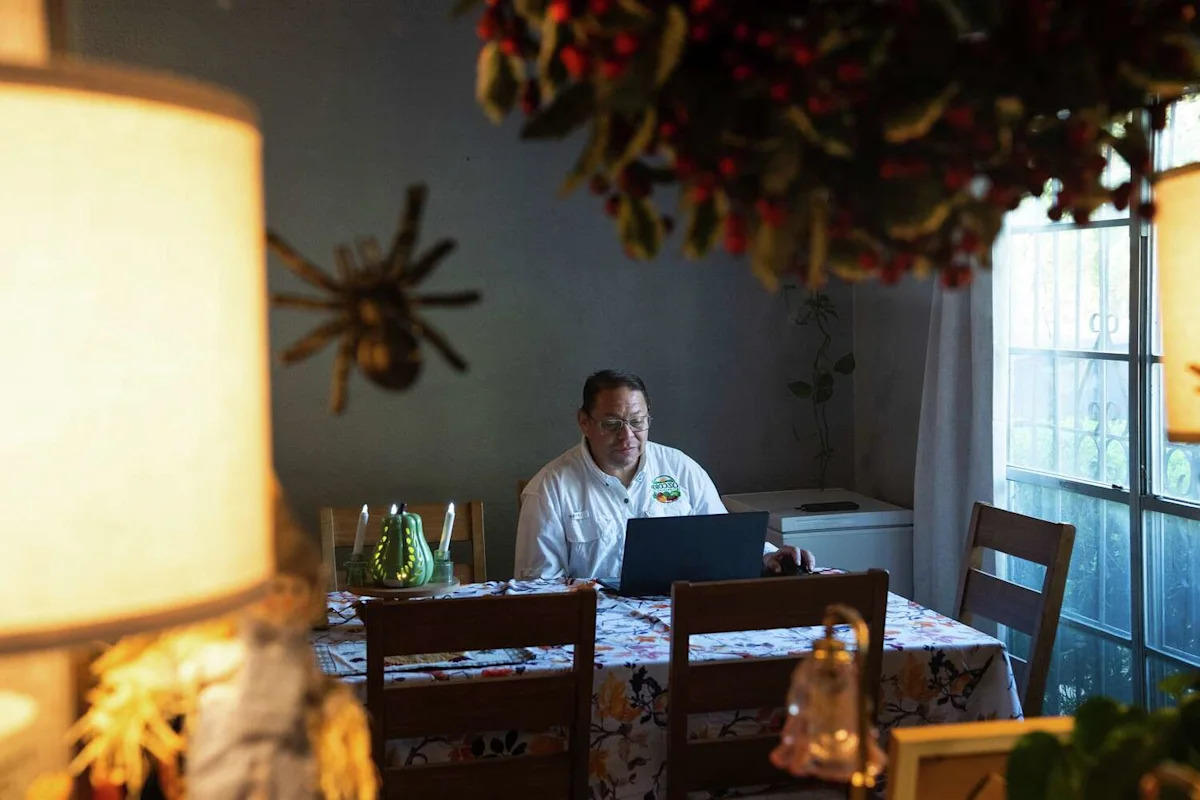
For the time being, Homer Flores takes online evening classes through Palo Alto College instead of attending school board meetings.
The South San Antonio Independent School District trustee jokingly told
state-appointed
Superintendent Saul Hinojosa that while the board is in “timeout,” he would use his spare evenings to invest in his own education.

Homer Flores stands for a portrait outside his home on October 6, 2026. Flores, a South San Antonio ISD trustee, is pursuing an associate degree in logistics and supply chain management after the state takeover suspended the elected board’s authority. (Isaiah Moseley/For the Express-News)
Flores will graduate in the spring with an associate degree in logistics and supply chain management just after South San Antonio ISD marks two years under state oversight. In February 2025,
the Texas Education Agency took control of the district after conducting multiple investigations into the district’s board and
replacing the superintendent and elected
trustees – including Flores – with an
appointed board of managers.
Managers were hand-selected by TEA to run the district while trustees lost any official authority they had to oversee South San Antonio ISD.
“Our engagement with the school district is just at the capacity of a person in the public,” Flores said. “We don’t get any email traffic. We don’t field phone calls from the office on urgent matters – that goes off to the board of managers. Our reach is just arm’s length, so what the public knows is what we know.”
While other San Antonio districts face the risk of TEA intervention in the next year for campuses that have repeatedly failed the state agency’s academic
accountability ratings, South San’s loss of local control came after
decades of dysfunctional board infighting among
warring trustee factions, mismanagement and superintendent turnover. The district has cycled through nine superintendents in the past 15 years.
In 2019, the agency investigated claims that trustees violated Texas law by repeatedly trying to usurp the superintendent’s decision-making power and interfere with staff. TEA later appointed Abelardo Saavedra, a former superintendent of the district, as a
conservator with the power
to monitor and direct the board.
February marks two years since the state took over the district – and it also signals the next checkpoint for the 7,000-student district on the South Side. Under state
policy, the shortest time the state can take control of a school district is two years, but the intervention
can last much longer. For now, the takeover has no clear end in sight, Board of Managers
President Ray Tijerina said.
“If you’re going to turn around scores, that’s one thing, but if you’re going to go and turn around a culture, that’s even harder,” Tijerina said. “But what’s top of our minds right now is making sure that once we’re done and we walk away, it doesn’t go back to the way it was before.”
Eventually seven trustees will return to the dais once again as appointed managers phase out. Before this happens, the district needs to improve its academic ratings and prove the board can work together with district administration.
Left without power or access to the district’s inner workings, South San elected trustees bide their time until they regain local control.
A shadow of an elected board
With their official district emails suspended, elected trustees no longer get daily updates from the superintendent. Instead, they met with Saavedra a few months after the takeover to discuss the potential timeline for their return to power, Flores said. As the months passed, Hinojosa has sporadically
kept elected trustees informed on district finances and major updates.
At that initial meeting with Saavedra, trustees earnestly
congratulated one another on their first re-elections after the takeover. However, Flores hasn’t spoken to any of them outside the official gatherings.
Flores said the earliest that elected trustees might see the board room again would be August 2027, which he called a “fair timeline,” but state officials have given no clear deadline on the return to local control.
When asked when the takeover might end at South San Antonio ISD, TEA spokesperson Jake Kobersky pointed to the upcoming two-year checkpoint. Under state law, the education commissioner needs to provide a transition date to both boards by the second anniversary of when TEA appointed the board of managers.
“I understand the consequences that we face as a board. I’m not here to point fingers at who or what,” Flores said. “We’re a team, no matter what happens. We understand what’s happening. We can only support what the board of managers are doing now.”
Flores hasn’t communicated with appointed managers,
either. He said the unity among the board in power seems to be working to move the district forward, and he doesn’t worry about their interim governance.

Homer Flores attends his online class at Palo Alto College from his dining room table on October 6, 2026. Flores, a South San Antonio ISD trustee, is pursuing an associate degree in logistics and supply chain management after the state takeover suspended the elected board’s authority. (Isaiah Moseley/For the Express-News)
Bridging the governance gap
Whenever the time comes for TEA to hand the district back to locally elected leaders, Karla Gomez Sanchez – who serves as the board of managers’ vice president – will remain a school b
ard member alongside other elected trustees. She filed to run in the district’s November school board election, but S
uth San has since canceled its trustee races a
ter all three seats failed to draw multiple candidates.
When she moved back into the district with her husband in 2012 after living in the Medical Center, she hoped someone would fix the district’s problems before she had kids. Now, with a seven- and four-year-old enrolled at South San schools, she said that someone needed to be her.
In 10 years, when her kids are both
in high school, Gomez Sanchez hopes South San’s dysfunction and rebuilding period is nothing but a distant memory.
When asked if she believes the progress will be sustainable, the mom of two said elected trustees will need to prepare to change their mentality, be vulnerable and drop any ego while working together.
She will soon lead a new effort to engage community members, which began by discussing the role of a board member in a special mid-October board work session. As South San’s history of infighting and state intervention has shown, tension can surface when the roles of superintendent and the board become murky or intertwined.
“I can’t speak for anybody else, but I do think that’s a question for them,” she said of the elected trustees. “I don’t think people normally come in here thinking, ‘I want to throw a wrench in it.’ But we do need to understand that it takes a lot of commitment from every angle.”
The state’s
strict criteria for South San to be governed by an elected board
includes
an overall state grade of a C or higher, compliance with
state and federal special education law, financial stability, signs of good governance and no schools scoring consecutive failing state
grades, according to TEA.
Gomez Sanchez said she hopes elected trustees can bring their years of experience and embrace the new culture and trajectory adopted during the takeover.
“The changes we’ve made are not anything completely radical or unheard of,” she said. “They’re all very common sense: treat each other with respect, keep the kids first, make sure all the focus is on making sure the kids are ready for college, career or for their life. To me, that doesn’t sound very hard. And I don’t see why anybody would say no to that.”

Newly-appointed South San ISD Superintendent Saul Hinojosa addresses reporters during a news conference hosted by the Texas Education Agency on Wednesday, Feb. 19, 2025, in San Antonio, Texas. Hinojosa was charged with leading the district through a state takeover in February 2025. (Sam Owens/San Antonio Express-News)
Building the community’s trust
Engaging with the greater South San community will be a core focus for the appointed
board in the next year, Tijerina said. Managers want to attract candidates – with the best interests of kids in mind – who could run in future elections.
The board spent the first full year of the takeover reevaluating policies and operating procedures. Now that it has
found its footing, managers can turn their
focus outward, Tijerina said.
The district marked major score boosts on State of Texas Assessments of Academic Readiness, or STAAR,
tests and TEA accountability scores; for the schools that didn’t improve, like Palo Alto Elementary, Hinojosa immediately replaced campus leadership and a number of teachers. South San’s overall rating jumped 10 points on the 2026 state accountability ratings – the largest districtwide improvement in Bexar County – from a D to a C.
Despite what Tijerina called “crazy growth,” he said creating sustainable change, from improving morale to making the right staffing decisions, will be
more difficult. He believes change has transformed the district quickly, suggesting that local control may return on the earlier side of the timeline. In addition to the gains in students’ scores,
the district now has a financial surplus, while other districts in the area struggle with multimillion-dollar deficits.
The next steps depend on when TEA decides to start replacing South San’s appointed board members with the elected trustees.
“If we ensure that when we leave, that it stays the same and that culture is maintained and we have that bridge with Karla and maybe some others, that’s how we make sure that this district is in a really good position for the next 30, 40 or 50 years going forward,” Tijerina said.

South San Antonio ISD school board member Homer Flores speaks during a special meeting discussing and possibly take action on three vacancies on the board that were created when three trustees resigned unexpectedly last week on Monday, Sept. 9, 2019. (Carlos Javier Sanchez / Contributor)
What is next for South San?
The transition will likely include a phase-out process, where appointed managers
exit their positions on a rolling basis, swapping places with elected trustees, Tijerina said. That way, the district doesn’t immediately revert back to the previous way of operating.
In the past decade,
managers in Southside and Edgewood ISDs made the jump from serving as appointees
to elected trustees, serving on both sides of the takeover. Southside’s current Board President Jesus “Jesse” Hernandez ran unopposed in 2021 after he was first tapped by TEA to join the board of managers in 2018. In Edgewood, Richard Santoyo also has
served in both roles.
“Everybody needs to pay attention around the state to all these districts that are getting taken over,” Tijerina said. “How are they going to transition back?”
In the meantime, Flores has kept in the know through reading the newspaper or scrolling social media, as his way of interacting with the
district is temporarily reduced to giving a thumbs up on Facebook or running into someone at H-E-B.
When asked if he views the role of a board member differently now, Flores said he respects the board of managers and wants to support the positive vibes in the community. Whenever trustees return to the dais, Flores expects the elected board to continue their success.
“I’ve discovered some exciting ways of learning, and I feel this helps me fulfill my role as a board member. If I’m encouraging kids to study, to go to class, to be better than what they’ve been before, to be a better version of themselves, why can’t I do it?” Flores said.
“When our time is due and we come back, well, that’s when we can engage and talk again.”
Subscribe
There’s more to San Antonio with the Express-News. Subscribe today for just 25¢.
This article originally published at A board in waiting: South San Antonio ISD trustees prepare for an uncertain return.