
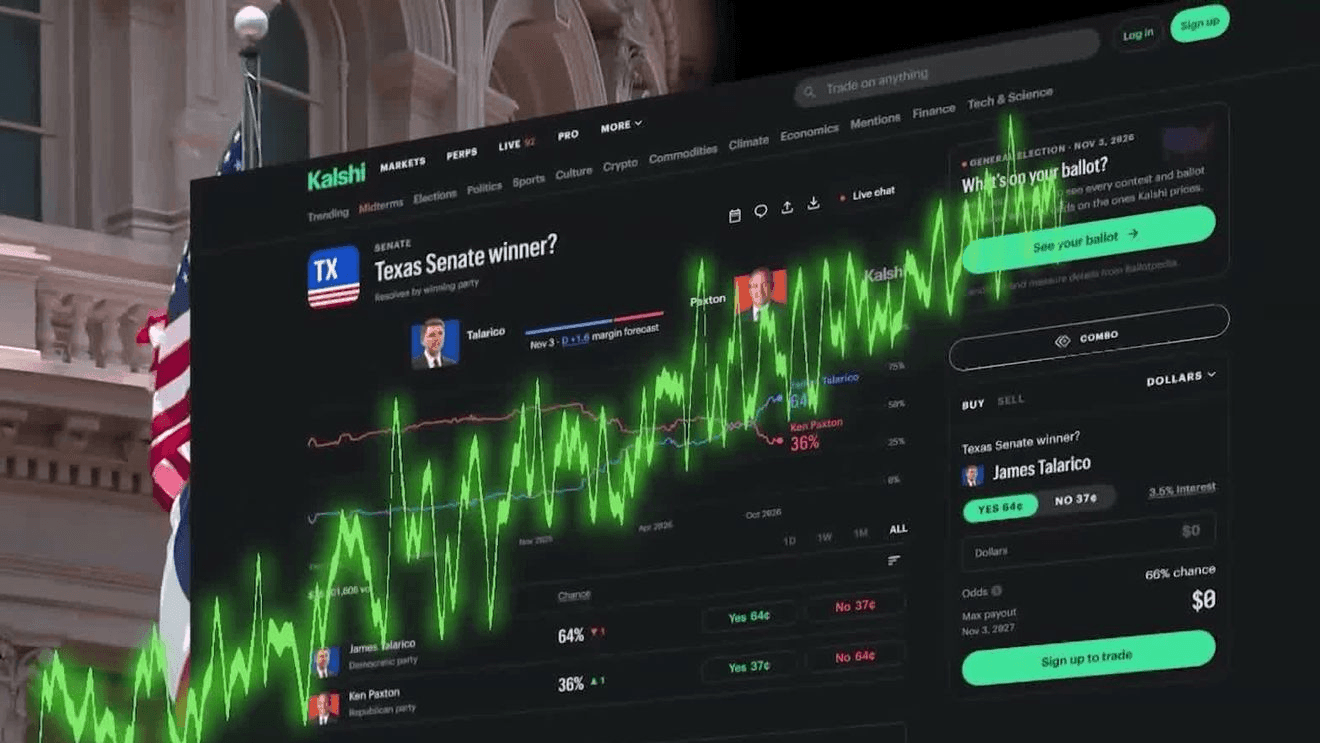
AUSTIN, Texas — As attention intensifies on Texas’ U.S. Senate race, prediction markets are offering a fast-moving look at what traders think could happen — but researchers and legal experts caution those odds are not the same as voter sentiment and do not guarantee an outcome.
Two prediction market platforms, Kalshi and Polymarket, show Democratic State Rep. James Talarico leading, with about 62-63 percent of trades, while 38 percent of traders are backing Republican Texas Attorney General Ken Paxton.
Prediction markets have grown in popularity by allowing users to trade “event contracts” tied to real-world outcomes, including elections. Nicole Kagan, head of research at Kalshi, said the point of the markets is probability, not certainty.
“The real appeal of a prediction markets platform is to provide some probability of something happening in the future. It’s not to guarantee an outcome,” said Kagan. “We might see more fluctuation and change as we move into the final innings of this race.”
Kagan described Kalshi as “a federally regulated financial exchange” where users trade on events in a way she compared to the stock market.
She said the platform pays out $1 if a trader is correct about an outcome and $0 if they are wrong, creating what she described as an incentive to be right rather than simply express an opinion.
Kagan said the Texas Senate market has drawn heavy interest, calling it the highest-volume Senate race on Kalshi during this midterm election cycle. She said more than $30 million has been traded on who will win the Texas Senate race.
Kagan also said that since Sept. 10, when the market flipped toward Talarico, the Democratic candidate has not been priced below 50 percent on Kalshi’s market. She said Kalshi’s margin-of-victory market was pricing the race at about a 1.6 percent difference in favor of Talarico, which she said is still within a plausible margin of error.
Kagan said the market’s movement reflects multiple factors, including what she described as Republican primary infighting, polling and other developments.
She also said the market recently showed some backsliding for Talarico, which she attributed to him having the flu and being “a little bit more withdrawn from the campaign trail just this week.”
ALSO | Abbott raked in $9 million from data center-related donors as he called for regulations
Even with Talarico leading on the platform, Kagan emphasized that the odds reflect trading activity, not a direct measure of how Texans are voting.
“So the way that I would put it is 60 percent is not 100 percent,” said Kagan. “Talarico is currently trading at 62 percent on our market. That is not 100 percent.”
Legal questions remain about how prediction markets operate in Texas and what protections exist for users.
“They are not explicitly allowed to operate in Texas. They do operate in Texas because they claim that they’re under federal jurisdiction,” said Austin attorney Jay Stewart, managing law partner at Hance Scarborough.
Stewart said the companies point to the Commodity Futures Trading Commission, or CFTC, as the federal agency that oversees them, describing their products as “swaps.”
The attorney said the platforms’ presence in Texas raises issues related to state gambling laws and consumer protections.
“Because these industries are not regulated by the state, they do not have licenses. There is no recourse,” said Stewart.
Stewart argues Texans could have limited options if there is a dispute with a platform.
He says Texas law has long treated gambling as an area regulated by states, and he pointed to the Texas Penal Code, Section 4702, as part of the legal debate.
He said the statute prohibits sports betting and election betting — categories he said are among the biggest moneymakers for prediction markets.
“It is solely consumer protection,” Stewart said when asked about the danger of prediction markets compared with traditional sports betting platforms.
He also mentioned how a number of attorney generals have filed litigation and complaints against the prediction markets, adding that those officials want the platforms regulated by states to ensure “the integrity of the game.”
Stewart said Texas did not join those actions.
Campaign finance records show in May 2025, Kalshi CEO and co-founder Tarek Mansour donated $5,000 to the Lone Star Liberty PAC, which has ties to Paxton. A month later, Mansour donated $7,000 to Paxton’s Senate campaign.
When asked about the donations, Kalshi said, “Like many leaders at U.S. regulated companies, ours support candidates on both sides of the aisle.”
Our research did not reveal any involvement with Talarico.
Stewart also raised concerns about gambling addiction safeguards and oversight, saying there is “very, very little consumer protection” and describing the regulatory structure as “self-regulation.”
The broader debate centers on whether event contracts fall under federal financial rules or should be considered gambling under state law.
Earlier this year, Lt. Gov. Dan Patrick asked state senators to study prediction markets ahead of next year’s legislative session.
Stewart questioned what prediction markets could mean for elections.
“We’ll never know because they’re not subject to state regulation,” he said, adding that “Elections are too sacred. We don’t want betting on that.”
Polymarket did not provide an interview response when contacted. Early voting in Texas opened Monday and extends through Oct. 30. The general election date for the 2026 midterms is Nov. 3.