
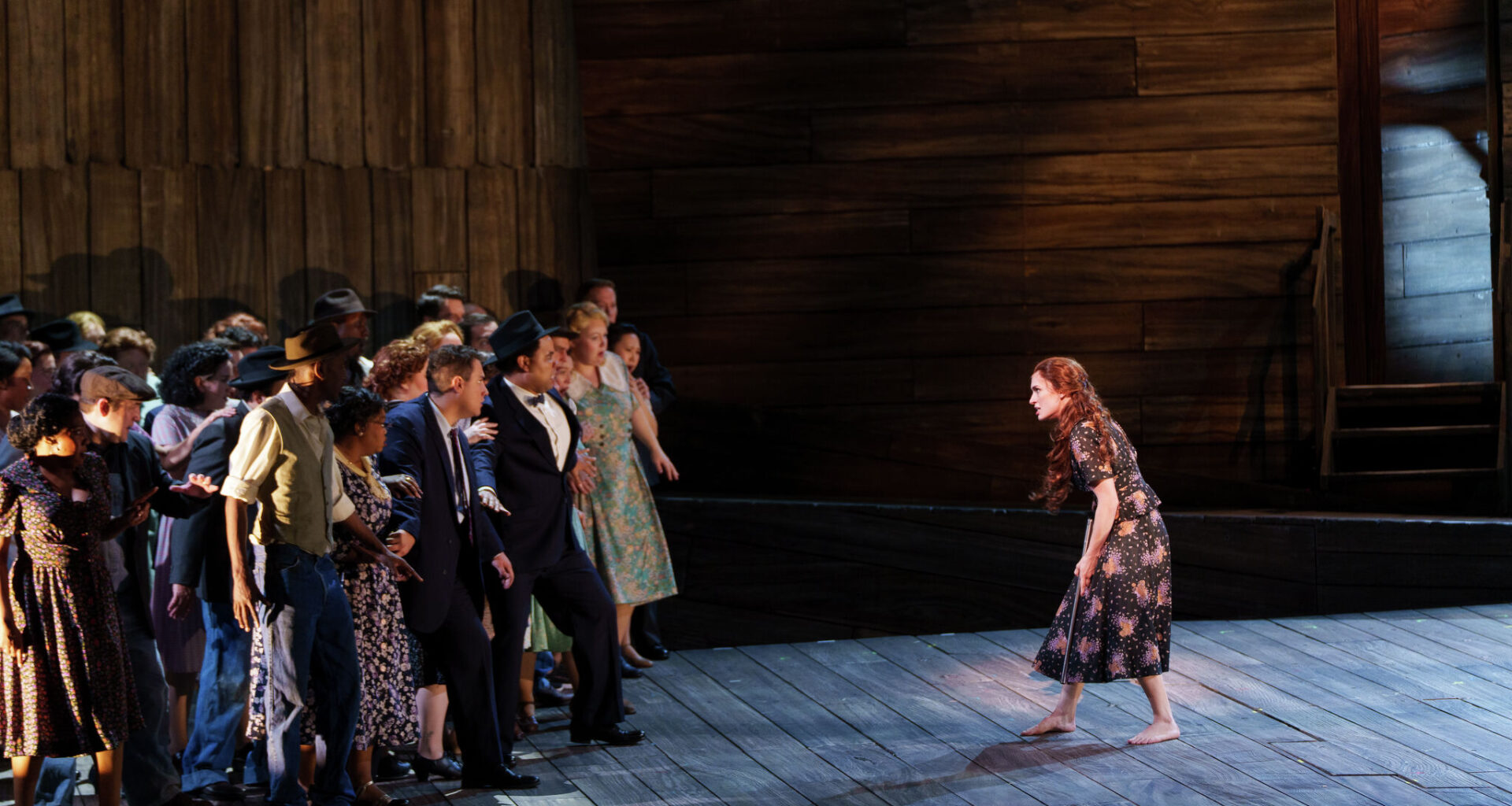
The cast of Houston Grand Opera’s ‘Susannah’
Michael D. Bishop
James Gaffigan in rehearsal for Houston Grand Opera’s ‘Susannah’
Katy Anderson
As Houston Grand Opera opens a new season, the company is looking both backward and forward with “Susannah,” Carlisle Floyd’s landmark American opera. The production celebrates Floyd’s enduring legacy while reaffirming HGO’s commitment to American works, artistic innovation and a more accessible future for opera.
For HGO general director and CEO Khori Dastoor, the timing is particularly meaningful. The season coincides with the 250th anniversary of American independence, Floyd’s centennial and the centennial of “Show Boat,” another seminal work in the American musical tradition. It also ushers in the era of James Gaffigan as HGO’s new music director designate, bringing an internationally acclaimed conductor with deep Houston roots into a leadership role.
When: 7 p.m. Oct. 23; 2 p.m. Oct. 25 and Nov. 8; 7:30 p.m. Oct. 31 and Nov. 6
Where: Wortham Center for the Performing Arts, 501 Texas
Details: $25-$412.50; houstongrandopera.org
“We’re telling our origin story through producing ‘Susannah’ at the highest level,” Dastoor says. “It’s intended to make a very strong artistic statement that opera is an American art form, and that the future of opera relies on our commitment to that ideal.”
Article continues below this ad
Premiered in 1955, Susannah draws on Appalachian folk music, church hymns and familiar American musical traditions. Its story, inspired by the biblical account of Susannah and the elders, follows a young woman whose life is devastated by public judgment, hypocrisy and the destructive power of group mentality.
Although rooted in a particular cultural setting, the opera explores themes that remain recognizable to contemporary audiences: reputational damage, moral authority, social pressure and the consequences of abandoning individual conscience.
Dastoor sees the work as a cautionary tale about the human cost of collective condemnation.
“We’ve all been the good guys. We’ve all been the bad guys,” she says describing opera’s ability to explore complicated human experiences through multiple perspectives. The piece reveals how communities can claim to uphold certain values while denying vulnerable individuals their dignity.
Article continues below this ad
For Gaffigan, the opera’s power lies partly in Floyd’s ability to make familiar musical language serve an unsettling dramatic purpose.
Floyd combines recognizable hymns and folk influences with sophisticated orchestration, creating a sound world that feels welcoming even as the story grows increasingly disturbing. The music can evoke the comfort of a church setting while suggesting that something beneath the surface has gone terribly wrong.
Gaffigan compared Floyd’s technique to that of a film composer, using music to establish an emotional atmosphere that deepens the audience’s understanding of what unfolds onstage.
“What makes it so American?” Gaffigan asks.
Accessible for average Americans
He points to Floyd’s ability to draw from familiar musical traditions and transform them into something distinctive, emotionally immediate and dramatically compelling.
Article continues below this ad
For audiences unfamiliar with opera, “Susannah” offers a particularly accessible introduction. Sung in English, with a tuneful score and a compact dramatic structure, the work does not require specialized musical knowledge to appreciate.
Dastoor described the opera as an effective entry point for newcomers, noting that its approximately 90-minute running time allows the story to unfold without the demands of a lengthy evening.
That accessibility also reflects a broader goal for HGO: making the opera house a welcoming place rather than an intimidating or elitist institution.
“If people don’t feel welcome, they’re not going to come,” Gaffigan said.
The incoming music director wants audiences to trust that HGO will offer an extraordinary experience, even when a production features an unfamiliar title or composer. That confidence, he believes, will allow the company to balance beloved classics with lesser-known works and encourage listeners to explore beyond their usual preferences.
Article continues below this ad
Gaffigan also plans to give greater prominence to HGO’s orchestra. Because musicians in the opera pit are often heard but rarely seen, he wants to create more opportunities for audiences to experience them onstage, including orchestral performances and concert presentations of operatic and vocal repertoire.
He also hopes to introduce audiences to the orchestra’s individual musicians and strengthen public appreciation for the ensemble as an essential part of HGO’s artistic identity.
Floyd’s Houston connections
Floyd’s legacy extends beyond his compositions. As a de facto artist-in-residence at HGO, he helped establish a foundation for American opera and contributed to the development of the company’s training programs. HGO’s Butler Studio has helped prepare generations of performers for careers in opera.
Dastoor said Floyd demonstrated that American opera could become a lasting part of the international repertoire while establishing a model for developing the artists needed to sustain it.
Article continues below this ad
That tradition continues through HGO’s commissioning program, which supports new works intended to reach audiences in Houston before traveling to stages around the world. Dastoor said several major American projects are in development, and she sees Gaffigan’s commitment to new commissions as an important part of their shared artistic vision.
Both leaders also emphasized the broader value of music education and the arts. Gaffigan recalled growing up in New York City’s public school system, where music offered children opportunities for expression, connection and personal growth.
Music, he feels, should not be treated as an extracurricular luxury. It can help people communicate emotions, connect with others and find relief during difficult periods of life.
He identified listening as one of musicianship’s most important lessons, observing that strong musicians and strong relationships share the ability to hear what others are saying.
For HGO, “Susannah” brings these ideas together: a distinctly American work that speaks to universal human experiences, a reminder of the company’s history and an invitation to imagine what comes next.
Gaffigan hopes audiences leave the opera house questioning their assumptions and appreciating the art form more deeply. Ultimately, he wants HGO to become a cultural destination not simply because of its reputation, but because audiences know they can expect exceptional performances.
The production, he said, represents an opportunity to build that trust while honoring the music itself.
As HGO celebrates its past and prepares for its next chapter, “Susannah” offers a timely reminder of what opera can accomplish: bringing communities together through music while challenging them to reconsider how they treat one another.