
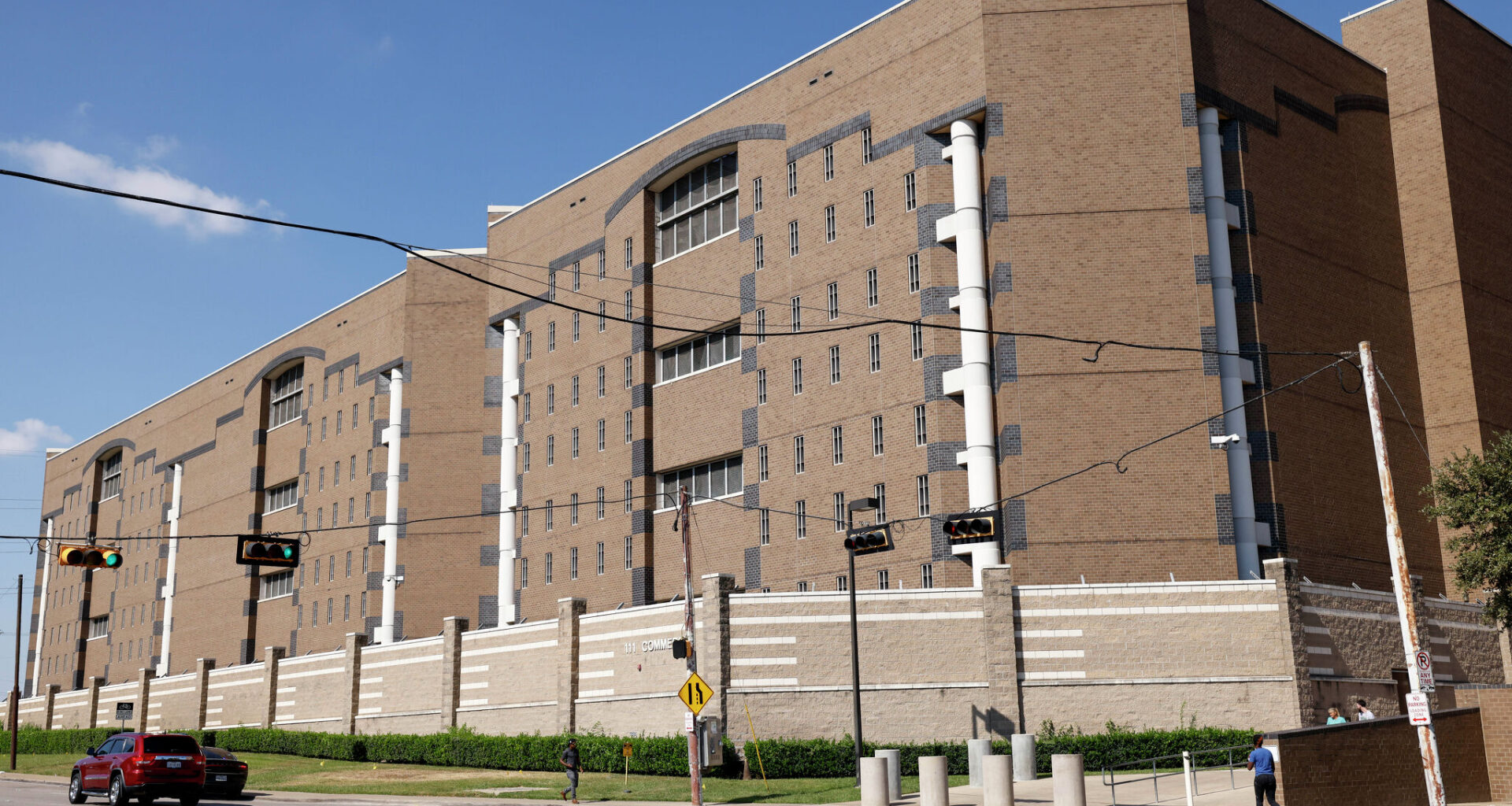
The Lew Sterrett Justice Center pictured, Friday, Oct. 17, 2025, in Dallas.
Elias Valverde II/Dallas Morning News
District Attorney John Creuzot cracks a few jokes Tuesday during a swearing-in ceremony at the Frank Crowley Courts Building.
Shaban Athuman/Staff Photographer
The overcrowded Dallas County jail is finally seeing some relief.

As of Monday, its population had remained at or below 91% capacity for a month straight – its longest stretch with fewer than 6,775 people in custody each day in more than a year, records show. That’s down from about 94% of capacity this time last year.
The drop came as fewer people were booked into the jail in September. But it also coincides with efforts to eliminate paperwork errors and communication failures that have kept people in the Lew Sterrett Justice Center longer than they should be.
Article continues below this ad
In September 2025, District Attorney John Creuzot began assigning prosecutors instead of non-lawyer district clerks to prepare sentencing paperwork. His office projects a 67% drop from last year in cases returned by state officials for corrections before an incarcerated person can be released from jail or transferred to a state facility.
Dallas County District Attorney John Creuzot at the Frank Crowley Courts Building on Tuesday, March 10, 2026, in Dallas.
Juan Figueroa/Staff Photographer
And in May, the Texas Department of Criminal Justice launched an electronic portal in Dallas County allowing the sheriff’s office to upload documents and track their progress instead of relying on email to initiate a person’s transfer to a state facility.
Transfers to state facilities jumped from 490 in April to 760 in June, according to criminal justice department data.
“This has streamlined things, it’s making things much better,” Dallas County Commissioner Andrew Sommerman said during a committee discussion.
Article continues below this ad
The jail’s longstanding backlog problems have also cost taxpayers. Since 2024, the Commissioners Court has paid at least $451,000 to settle 10 civil rights lawsuits or claims involving people detained beyond their time served dates.
Closing gaps
The Texas Department of Criminal Justice (TDCJ) requires counties to submit packets containing a defendant’s plea, sentence, medical status and other information before certain incarcerated people can be transferred or released.
Errors such as an incorrect offense classification, date or missing felony finding can cause the state to return packets for corrections, Creuzot said.
For years, clerks prepared documents after sentencing, entering information by hand and sometimes using outdated forms supplied by prosecutors, Creuzot said. The clerks then sent the packets to the sheriff’s office for submission to TDCJ.
Article continues below this ad
“We were creating paperwork that has problems and then were giving it to clerks who aren’t lawyers and they have to fill in certain things and they’re filling them in wrong and it’s not their fault,” Creuzot told county commissioners last week.
In 2024, Creuzot assigned attorney Jennifer Morse from his office to review the process.
The review found that clerks took an average of 20 days in 2025 to deliver documents to the jail after cases concluded. Judges sometimes took a week to sign judgments that clerks left in baskets for their review, according to a district attorney’s office report.
Morse worked to automate some data entry into roughly a dozen court documents required for each defendant, reducing opportunities for errors.
Creuzot said the review also revealed that state law requires judges to assign judgment preparation to attorneys or clerks supervised by attorneys, a requirement that went unmet for years.
Article continues below this ad
District Clerk Felicia Pitre did not respond to a phone call or emails asking why clerks went years creating judgments without attorney supervision. Commissioner John Wiley Price could not explain the practice, saying “that’s just how it was done.”
In September 2025, Creuzot assigned a prosecutor to prepare judgments in one felony court and expanded the program monthly. It is now in 16 felony courts, though Creuzot expects it to be in all 17 felony and drug courts by the end of the year. Judges also now sign paperwork at the time of the plea.
Last year, Morse said TDCJ returned 510 case packets for corrections. She expects 167 returns this year.
“You left it better than how you found it,” county Commissioner Theresa Daniel told Creuzot, a Democrat who leaves office in January after having lost his bid for reelection.
Paperwork overhaul
Steven Autry, the county’s director of judicial and corrections operations, called TDCJ’s new document portal “a gamechanger.” Previously, it was difficult to dispute claims that the state never received documents after the sheriff’s office sent them, Autry said.
Article continues below this ad
The Dallas Morning News also reported that a man spent 108 extra days in jail after the sheriff’s office failed to send his packet to the state for processing last year.
Now the county and state can track documents in real time for transfers to state facilities. A TDCJ spokesperson said the portal will accommodate paperwork for releases from jail on time served in the next phase. But Autry said correcting the judgment process “is what’s really helped us.”
“If we don’t get the judgment done correctly at first it doesn’t matter how efficient we are on the backend because it’s going to be kicked back,” he said.
Autry said the 17 felony judges and newly elected judges taking office in January support having prosecutors prepare judgments in court instead of clerks.
Some technical issues remain. After the county switched to new criminal case management software in 2023, the jail remained on a separate system that cannot communicate with the courts.
Article continues below this ad
As a result, the district clerk’s office must walk packets to the sheriff’s office within the same building. Separately, county officials in 2023 created a jail population management team to monitor cases daily.
In the first eight months of this year, the team reviewed 42,944 cases for potential delays, said assistant director of jail population management LaShonda Jefferson.
About 12,450 required follow-up with courts, attorneys, law enforcement or other departments for more information. And 6,809 were released at some point after the team became involved.
“Managing the Dallas County jail population remains a shared responsibility, and continued collaboration has been critical to our success,” Jefferson said.