
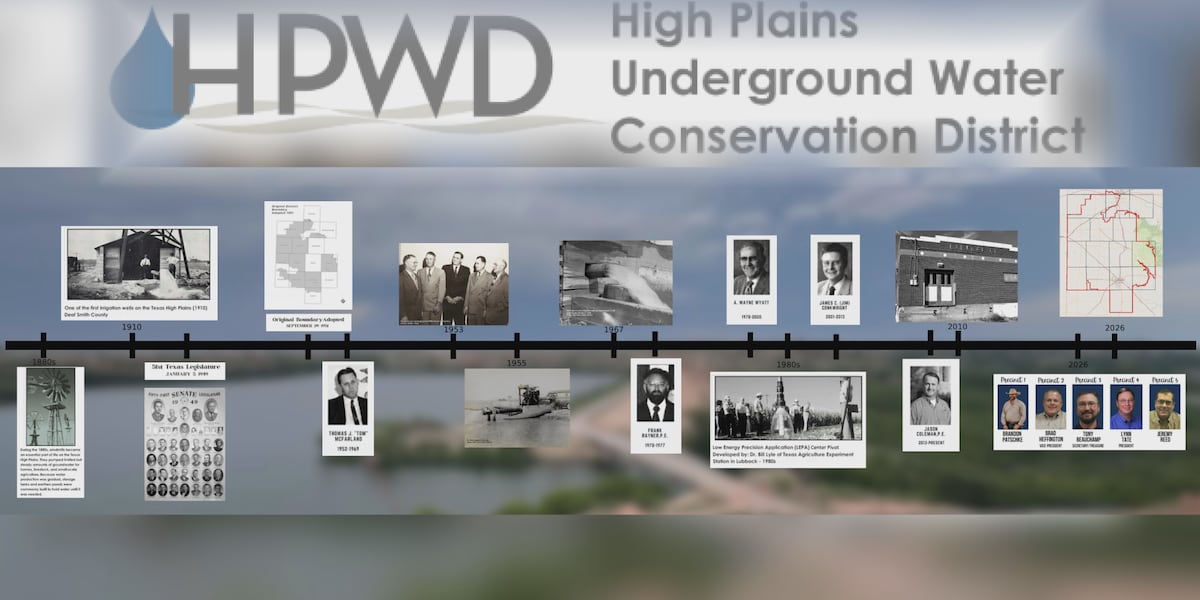
LUBBOCK, Texas (KCBD) – The High Plains Underground Water Conservation District is celebrating 75 years of service. It became a pioneering example for how to manage and protect groundwater locally, as the first and largest agency of its kind in the state.
Since the 1880s, people on the High Plains have pumped water from the ground for homes, livestock and agriculture. According to the High Plains Water District, one of the first irrigation wells was built in the area in 1910.
In 1949, state legislators created underground water conservation districts through the Texas Groundwater Act. Two years later, residents from 13 Southern High Plains counties voted to establish a local district. Following voter approval, the High Plains Underground Water Conservation District Number One became a reality.
District’s mission and growth
Current manager Jason Coleman said the district became a pioneer for locally managing and protecting groundwater.
“In a nutshell, it’s typically summed up as conservation, preservation, protection, recharge, and prevention of waste of underground water resources,” Coleman said.
With groundwater from the Ogallala Aquifer and advancements in irrigation technology, agriculture grew in the area. Pivots reduced some of the labor, but in West Texas the heat and wind meant not all of that water went to the crop. Over the years, innovation and new strategies helped water use become more efficient.
“But certainly, changes over time have, you know, resulted in a fewer number of acres being irrigated on a farming basis,” Coleman said. “There just simply isn’t the same water available as there was years ago. So, most irrigated producers are contracting the irrigated acreage to meet the available water.”
Resources available to residents
Residents pay a small amount of taxes to fund the district’s work — less than $10 a year for the average homeowner with a $200,000 home — and get to vote for its board. Coleman wants residents to know how the district can help them.
Every year, the district takes water levels of wells across the area. An interactive map on its website allows users to look at those levels over a 10-year span. Residents can also request the district check a well on a property before purchasing it.
“One of the things we’ve really been hoping to share is the importance of knowing what the groundwater conditions are on those properties,” Coleman said. “Before a person decides, that’s where I want to spend so much of my hard-earned money and raise my family.”
Education efforts
Coleman said another important aspect is education. The district sends out a monthly newsletter over email and tries to meet people face-to-face as much as possible.
“That results in some invitations to local civic clubs, some school events and others, so that we can talk one-on-one, if possible, incorporate hands-on related activities and demonstrations to help illustrate how an aquifer works, how groundwater moves, and then people generally, with that understanding, pay more attention to their water usage,” Coleman said.
Over the years, the district’s boundaries expanded, and the High Plains Water District now serves 16 counties. It remains not only the first district of its kind, but the largest in the state. As water levels continue to decline, Coleman said the mission of making the best use of the water available is as important as ever.
Copyright 2026 KCBD. All rights reserved.