
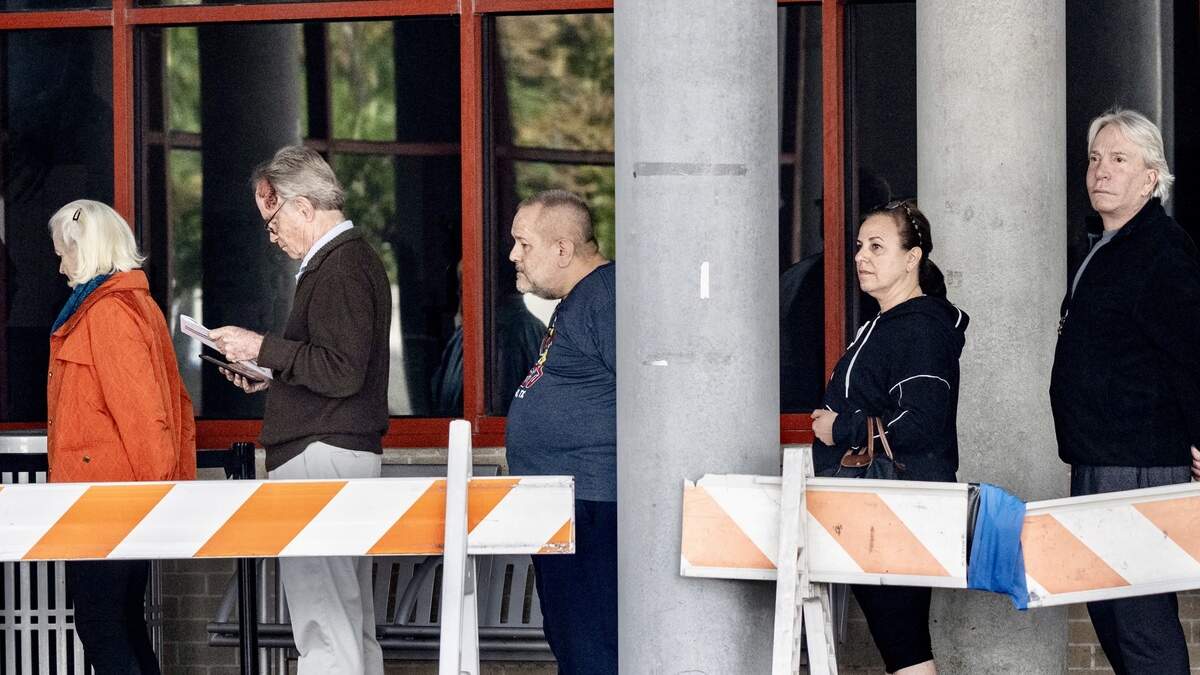
People wait in line at a polling location in Houston on the first day of early voting in Texas for the midterm elections Oct. 19, 2026.
Ronaldo Schemidt
AFP via Getty Images
FORT WORTH
If Republicans lose a Texas or Tarrant County election Nov. 3, they have a ready-made list of scapegoats from Washington to Southlake.
But as Democrats came pouring in to vote at a rate comparable to 2018 — when Beto O’Rourke brought Democrats their best vote totals in a generation — Republicans began to wonder aloud whether any Tarrant County offices might really flip to Democrats.
The worry is real. After the first few days of early voting, those voters who are regulars in the Democratic Party primary made up the largest portion of voters, more than a third. The next largest group showed no party history, and Republicans lagged with about one-fourth of the vote.
Click to resize
Nobody I know thinks Democrats will keep that margin up.
Republicans will vote. They’ll just wait for the lines to subside.
But that Democratic edge doesn’t even allow for the 6% of Republicans who tell pollsters they won’t vote for U.S. Senate candidate Ken Paxton, or more who won’t but may not admit it to pollsters.
So Democratic Senate candidate James Talarico probably has an inside track in Tarrant County.
Republicans cling to House seats
At least three Republican Texas House seats are at risk. State Rep. John McQueeney‘s district in southwest Fort Worth and Tarrant County has been purpling in recent years, so he has TV ads up now against Democrat Beth Llewellyn McLaughlin.
Open seats are at risk of flipping to Democrats in Arlington (Cheryl Bean vs. Democrat Katie O’Brien-Duzan) and in the Mansfield-Burleson area (Ellen Sorrells Fleischmann vs. Democrat Ebony Turner).
Democrats would love to flip the county judge’s seat. Personal-injury lawyer Tim O’Hare of Southlake has been antagonistic and sometimes openly hostile while presiding at Commissioners Court.
But even if Commissioner Alisa Simmons wins the gavel, the Arlington Democrat will be on the wrong end of 3-2 votes. That is, unless either Arlington Republican Tony Tinderholt or northwest Tarrant County Commissioner Manny Ramirez is upset by Fort Worth Democrats Dr. Jared Williams or Nydia Cardenas.
More people, but fewer places to vote
If any Republican loses, the question at the county courthouse will grow louder:
How did it make any sense to cut out 92 voting locations on Election Day?
Why would Republican commissioners cut voting locations for Republicans in a Republican county?
And why give Texas Democrats something new to blame on Republicans?
Voters line up outside the Arlington south service center on Monday, Oct. 19, the first day of early voting for the Nov. 3 midterm election. Rachel Royster rroyster@star-telegram.com
Over and over, we hear the same wisdom from Texas election experts:
When Republicans have a high turnout, they win. When you have more Republican voters than Democrats, you want to make sure they get to vote.
Instead, commissioners shut down voting at nearly one out of three locations.
National best practices call for no longer than a 2-mile drive to vote and a 30-minute wait.
If you have to wait longer, then something is wrong at the county courthouse.
Early voting needed more locations, not fewer
And if anything was worse than cutting Election Day voting locations from 334 in 2020 to 316 in 2022 and now 224, it’s cutting locations to vote early instead of adding more.
The number of early voters in Texas has grown from 6.6 million in the 2018 “Beto election” to 8.1 million in 2022.
Not only did Tarrant County not add more locations, but commissioners actually cut the number of early voting sites while demand in Texas went up 23%.
In 2018, there were 49 places to vote early in Tarrant County. By 2020, the list had grown to 58.
But in 2022, Tarrant County started going backward.
Now, as much as three-fourths of the general election vote total will crowd into 47 locations.
Democrats making hay at Republicans’ expense
U.S. Rep. Jasmine Crockett showed how Democrats can take advantage of the issue when she made a campaign stop Oct. 20 in Mansfield to endorse Simmons, Turner and Williams.
“They needed more, not less,” she said: “Like, this is simple math. … If they can’t figure out how to do basic math, I think that’s yet another reason somebody needs to lose their job.”
State Rep. David Cook, R-Mansfield, is running for the open Waco seat in the Texas Senate.
But he also leads the Keep Tarrant Red PAC, raising money to protect local Republicans.
Cook has been around local politics his entire law career, first working with 28-year Arlington lawmaker Chris Harris.
He wasn’t involved in the decision to cut polling places. But he said he believed Republican commissioners “were just trying to be more efficient.”
Mansfield: 25% more people, 33% fewer voting sites
In 2020 and 2022, voters in the sprawling Mansfield ZIP code had nine places to vote on Election Day.
Since 2020, that suburb has grown from about 72,000 people to about 90,000.
That’s a 25% increase. But on Nov. 3, instead of nine places to vote, they will only have six.
Cook said Tarrant County politics is changing “mainly as a matter of demographics.”
With Republicans’ help.
This story was originally published October 22, 2026 9:45 AM.

Bud Kennedy is a Fort Worth Star-Telegram opinion columnist. In a 54-year Texas newspaper career, he has covered two Super Bowls, a presidential inauguration, seven national political conventions and 19 Texas Legislature sessions..
Support my work with a digital subscription