
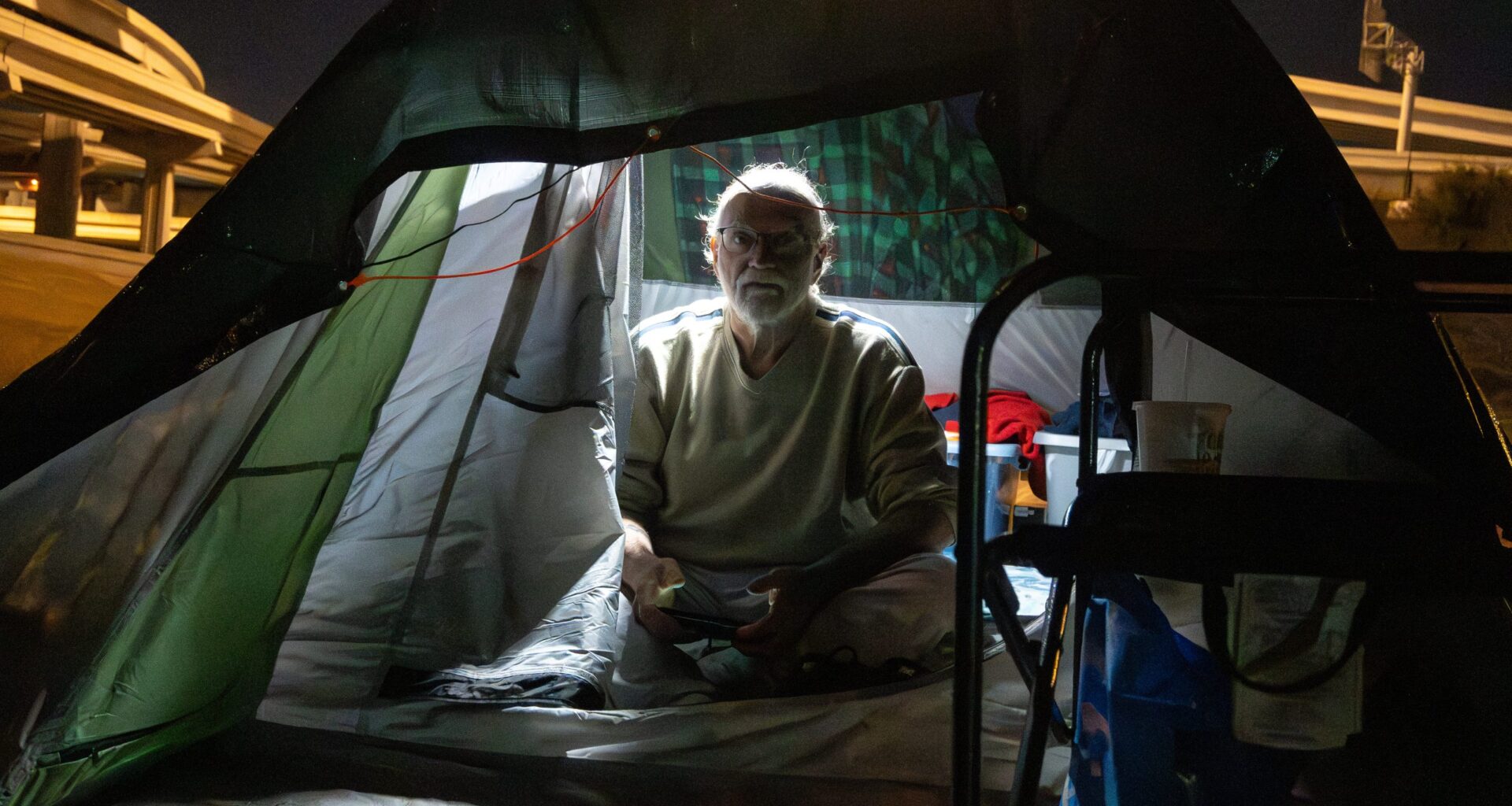
People 55 and older are the fastest growing population experiencing homelessness, prompting a new Fort Worth partnership among public and private entities to provide for the needs of people experiencing homelessness.
Philanthropist and business woman Flora Brewer, who died in 2023, bequeathed $1.7 million in a gift that the city of Fort Worth will match with general fund money for services to people living in tent camps, cars and other unsheltered places. Another estimated $1.7 million annually in federally provided housing vouchers will go to housing unsheltered people as part of the program.
Evan Mead-Brewer said in an interview this was his mother’s “last gift” to supporting homeless people in the community.
DRC Community Solutions to End Homelessness, a nonprofit whose employees reach out to unsheltered people and find them homes, will administer the money for services in the Flora Brewer Bridge Program partnership announced Tuesday.
The Flora Fund at the North Texas Community Foundation is handling the gift from Brewer — to be made over five years — and routing it to DRC. Fort Worth Housing Solutions, which will provide the vouchers, also is part of the partnership.
The city said the program’s goal is to connect up to 105 unsheltered Fort Worth residents aged 55 and older to housing and supportive services.
According to the National Alliance to End Homelessness, adults over 50 are the fastest-growing population experiencing homelessness in the U.S.
Since 2020, the city has experienced a 70% increase in people living outside, city officials said Tuesday in a presentation to the Fort Worth City Council.
According to Fort Worth’s annual homeless census, 1,083 people were living without shelter in the city as of January 2026. Of the unsheltered individuals counted, 34% are 55 or older, and 42% have experienced homelessness for more than five years.
The city council will vote on a contract with DRC on Oct. 27. The first housing matches will begin in January 2027, with the program expected to be at full capacity in 18 months.
“Homelessness is not going away. It’s something that we can’t ignore, and it’s something that we have to get engaged with and do something about,” council member Deborah Peoples said during the work session.
“And to hear that many of our homeless, unhoused individuals are 55 and over should be frightening to all of us, and I am just grateful to all of you for tackling it, and grateful to the Brewer family for carrying on the work of such an extraordinary human being,” she said.
Flora Brewer, an ardent advocate for the homeless, was lauded for her redevelopment of the 24-unit Palm Tree Apartments on Race Street in the city’s Riverside district. The apartments house the formerly homeless and provide on-site resources; the Samaritan House nonprofit in Fort Worth bought them in 2024 and continues to operate the property as permanent supportive housing.
“She was such a fierce advocate for that cause, and it wasn’t until my time here on council that I learned that she was also a fierce advocate for our homeless population,” council member Elizabeth Beck said of Brewer, whose Palm Tree influenced other housing efforts in Fort Worth.
“She left such a huge gap in the community when we lost her and, of course, she found a way (to continue to help),” Beck said at the Tuesday workshop.
Fort Worth has over 1,500 adult beds and 826 family beds for permanent supportive housing. The more people enter the homeless system the more shelters are at full capacity, creating an increase in unsheltered homelessness, said Tara Perez, homeless strategies manager for the city.
DRC, through separate city funding, will increase city-funded street outreach workers to six from two. In addition to identifying older and vulnerable individuals, the workers will provide case management to help participants obtain Social Security, Medicare and Medicaid.
Participants will also receive an assessment and individualized service plan from DRC that may include primary and behavioral healthcare, addiction services, money management skills, housekeeping assistance and meal preparation support. The new partnership is paying for those services.
The city estimates it costs about $35,000 annually per unsheltered person, in public safety, medical and camp abatement costs, according to the city. But the new program’s average cost is around $22,000, a savings of about $12,000 to $13,000 per person per year, or about $1.3 million a year, Perez said.
“This is a huge leveraging opportunity for the city,” Perez said, of the benefits the city receives compared to the outside contribution.
People who experience homelessness die nearly 30 years earlier than the average person, according to the U.S. Interagency Council on Homelessness. Due to age, their time being homeless and health, people over 55 are unlikely to exit homelessness through employment and need a different exit strategy, according to the staff presentation Tuesday.
Rose Bradshaw, president and CEO of North Texas Community Foundation, said Brewer knew programs like this could never be successful with philanthropy alone — but needed to be combined with other resources.
“It just thrills me to no end to know that each one of you bringing the resources that you bring to the table in a coordinated fashion is how we move through this,” Bradshaw said during an interview the group gave to the Report.
“It’s obviously a concern to our city, we know that we’re all coming together in this way is really powerful, and philanthropy alone, we would never be successful.”
Kamal Morgan is a government accountability reporter for the Fort Worth Report. Contact him at kamal@fortworthreport.org.
At the Fort Worth Report, news decisions are made independently of our board members and financial supporters. Read more about our editorial independence policy here.
This <a target=”_blank” href=”https://fortworthreport.org/2026/10/21/elderly-experiencing-higher-rate-of-homelessness-this-initiative-seeks-to-reduce-it/”>article</a> first appeared on <a target=”_blank” href=”https://fortworthreport.org”>Fort Worth Report</a> and is republished here under a <a target=”_blank” href=”https://creativecommons.org/licenses/by-nd/4.0/”>Creative Commons Attribution-NoDerivatives 4.0 International License</a>.<img src=”https://i0.wp.com/fortworthreport.org/wp-content/uploads/2021/04/cropped-favicon.png?resize=150%2C150&ssl=1″ style=”width:1em;height:1em;margin-left:10px;”>
<img id=”republication-tracker-tool-source” src=”https://fortworthreport.org/?republication-pixel=true&post=840082&ga4=2820184429″ style=”width:1px;height:1px;”><script> PARSELY = { autotrack: false, onload: function() { PARSELY.beacon.trackPageView({ url: “https://fortworthreport.org/2026/10/21/elderly-experiencing-higher-rate-of-homelessness-this-initiative-seeks-to-reduce-it/”, urlref: window.location.href }); } } </script> <script id=”parsely-cfg” src=”//cdn.parsely.com/keys/fortworthreport.org/p.js”></script>