
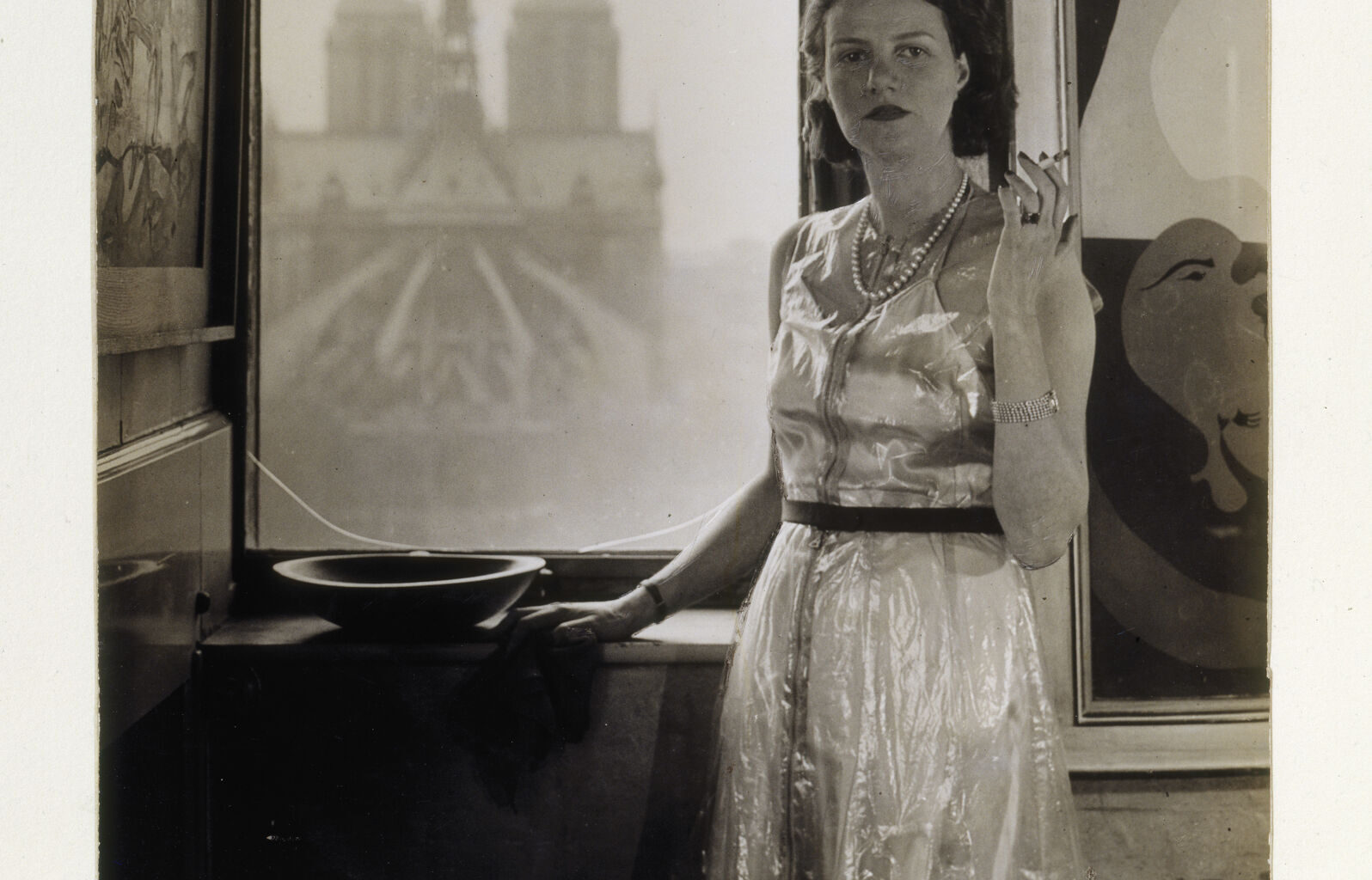
Rogi André, “Peggy Guggenheim at the Window of Her Apartment, with the Apse of Notre-Dame Cathedral, Paris, in the Background,” c. 1940, purchased from the Rogi André studio holdings after the artist’s death, 1970.
Bibliothèque nationale de France, Department of Prints and Photography
As the French Ministry of Culture celebrates the bicentennial of photography this year and next, Texas institutions will play two important roles in the festivities. First, the earliest surviving photograph will travel from Austin to the French hometown of its maker, Nicéphore Niépce, for exhibition.

Second, the Kimbell Art Museum in Fort Worth, in its first photography exhibition, is presenting a show of 150 photographs drawn from the collections of the French national library, the Bibliothèque nationale de France. With about five million photos in its holdings, dating back to the invention of the medium, the BnF is arguably the world’s most important center of photo history. Its examples of the earliest photographs, in particular, are rarely matched elsewhere.
Throughout the early decades of the medium, technological and artistic developments were intimately intertwined, as each technical advance opened up new possibilities for photographers to creatively exploit. For example, Niépce’s images required hours or even days of light exposure to produce. It was not until 1839 that Louis Daguerre (as well as his competitor, Henry Fox Talbot) announced a practical, commercially viable process, and the history of the medium could begin in earnest.
Article continues below this ad
The show’s series of rare daguerreotypes is a particular highlight, since each daguerreotype is a unique object; the ability to make multiple prints from a single negative came later. (Daguerreotypes are sheets of silver-plated copper, which gives them a precious, metallic glow.)
Another pleasure of the exhibition is the view it offers of the splendor of 19th-century French culture, as the early photographers interacted closely with great figures in literature, theater, painting and architecture (as well as other famous and infamous people of all descriptions).
Seemingly every notable Parisian of the 1850s sat for a portrait in the photo studio of Félix Nadar, among them Alexandre Dumas, author of “The Count of Monte Cristo” and “The Three Musketeers.” The portrait of Dumas reflects Nadar’s focus on psychological acuity over extraneous detail. Omitting the theatrical props and backdrops common in other studios, Nadar lit Dumas from above, against a blank background, emphasizing the details of his facial bone structure and his penetrating gaze.
Félix Nadar, “Alexandre Dumas,” 1855, purchased from the Nadar studio holdings through Anne Nadar, widow of Paul Nadar, 1950.
Bibliothèque nationale de France, Department of Prints and Photography
Nadar also toyed with the genre of portraiture in shooting the popular boulevard actress Marie Laurent from behind, concealing her identity while emphasizing the sculptural shape of her drapery and the sensual curve of her neck, as revealed by her hair delicately pulled up by a decorative comb.
Article continues below this ad
Another photographer of the 1850s, Eugène Durieu, worked closely with the great Romantic painter Eugène Delacroix (whose work can be seen across the Kimbell’s courtyard in its permanent collection). Durieu, a former civil servant, produced albums of nude models for Delacroix’s use, saving the expense of pricey live models.
Félix Nadar, “The Actress Marie Laurent, from Behind,” c. 1856, acquired from the widow of Paul Nadar, 1949.
Bibliothèque nationale de France, Department of Prints and Photography
Durieu used the calotype process invented by Fox Talbot that exposed silver iodide on paper. The soft, fibrous structure of the paper allowed for gentler, softer tonal gradations than the metallic daguerreotype — ideal for capturing the organic forms of human anatomy and muscle tone.
Among the most popularly successful photographs of the 1850s were the seascapes of Gustave Le Gray, who had trained as a painter under the academic Paul Delaroche. Because the state-of-the-art technology could not yet capture the full tonal range of sea and sky in a single shot, Le Gray would make one short exposure for the bright sky, then another, longer exposure to capture the nuances of the darker ocean. He then artfully printed the two separate glass negatives onto a single sheet of paper, evoking the work of contemporary Romantic painters.
Gustave Le Gray, “The Great Wave, Sète,” 1857, legal deposit of the photographer, 1860.
Bibliothèque nationale de France, Department of Prints and Photography
For the 20th century, the exhibition turns to the work of the talented immigrants who were drawn to the cultural capital of Paris, embraced their adoptive homeland and became central to its artistic scene. (Two of the show’s sections, on Pablo Picasso of Málaga, Spain, and Sonia Delaunay of Ukraine, focus on artists who were subjects, rather than makers, of photography.)
Article continues below this ad
Even as he found success as a commercial fashion photographer, the Dadaist and Surrealist known as Man Ray (born Emmanuel Radnitzky in Philadelphia) embraced radical experimentation with the medium, using the darkroom as a creative instrument. His “Sleeping Woman” shows his use of the Sabattier effect, where brief exposure of an unfixed, developing print to ambient light causes the light and dark to reverse, creating a dreamlike image consistent with the Surrealist vision.
Between the two world wars, the pioneer of street photography known as Brassaï (born Gyula Halász in Austria-Hungary) overcame the technical challenges of nighttime work to produce solitary, ruminative pictures of the nocturnal subcultures of the City of Light. His long exposures on glass plates under gas streetlamps, collected in the seminal 1932 photobook “Paris by Night,” prefigure the film noir of following decades.
Brassaï, “On the Boulevard Saint-Jacques,” 1930–32, donated by artist’s estate, 2012.
Bibliothèque nationale de France, Department of Prints and Photography
Although she died unknown and destitute in 1970, before her work was rediscovered and preserved from oblivion by a BnF curator, Rogi André (born Rozsa Klein in Budapest) was a sought-after portraitist in her day of the international cultural elite who visited Paris. Her 1940 portrait of the American art collector and museum founder Peggy Guggenheim reflects the medium’s technical advances; unlike Nadar in the previous century, André could bring a portable camera to capture her subjects in their personal living and working spaces. Shown surrounded by her art collection and with Notre Dame Cathedral in the background, Guggenheim is framed by André as a cultural figure in her own right, at home among the city’s timeless monuments.
Understandably, earlier histories of photography emphasized the medium’s revolutionary aspect: the possibility of creating images directly with light, rather than through an artist’s hand. But seeing this show in the digital era, I found what stayed with me the most was the uniqueness of each of the physical prints — not only the one-of-a-kind daguerreotypes, but each of the analog, handmade prints that existed before digitization. I wonder whether the retrospectives of photography’s second and subsequent centuries will have that effect.
Article continues below this ad
Details
“Photography’s First Century: Masterworks from the Bibliothèque nationale de France” continues through Jan. 17 at the Kimbell Art Museum, 3333 Camp Bowie Blvd., Fort Worth. Tuesday-Thursday and Saturday from 10 a.m. to 5 p.m., Friday from noon to 8 p.m., and Sunday from noon to 5 p.m. Adults $18, seniors and students $16, children ages 6-11 $14, children under 6 free, half-price on Tuesdays and on Fridays after 5 p.m. For more information, call 817-332-8451 or visit kimbellart.org.