
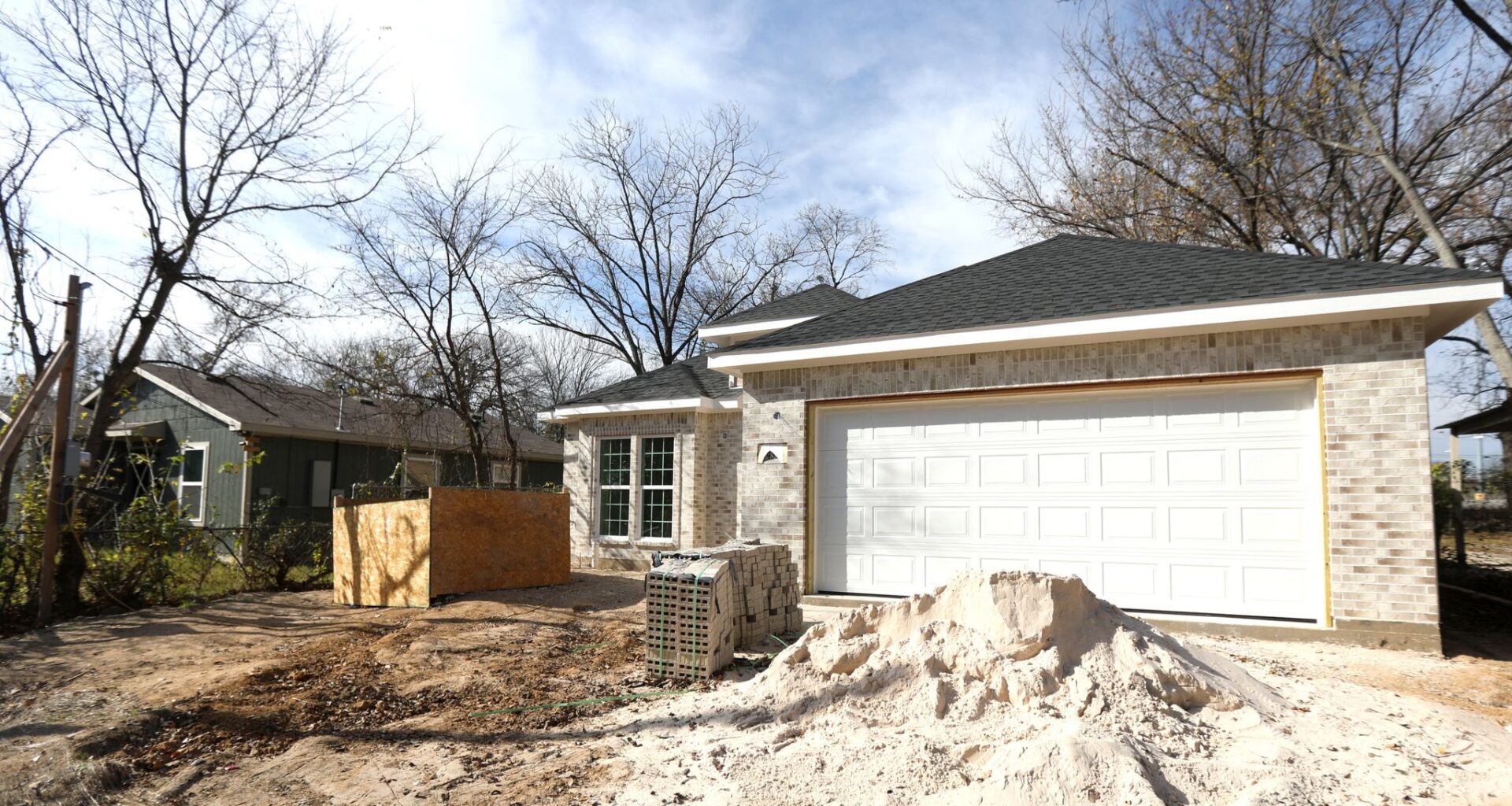
There’s no clear-cut way to tell if a Dallas house will have foundation issues, but the age of the house, soil type and proximity to water can all influence it.
Anja Schlein/Dallas Morning News
A homeowner’s nightmare is becoming more common in Dallas-Fort Worth.

Applications for foundation repair have increased in Dallas over the last few years, with more recorded in areas north of Interstate 30, according to a review of city records.
The data, obtained through a public information request to the city of Dallas, covers foundation repair permits from June 2020 through Aug. 24, 2026.
Article continues below this ad
The city received just short of 5,000 applications for a foundation repair permit during that window. A small share of the applications were later withdrawn or denied.
The pace of applications has increased substantially over the years, jumping from an average of 38 applications per month in 2021 to about 111 in 2025.
But what makes a house’s foundation move, and are specific areas more susceptible to foundation issues? Here’s what to know.
Why does a house’s foundation move?
Most Texas homes are built on expansive soil, including various kinds of clay, which can be impacted by moisture levels and other factors.
Article continues below this ad
Foundation movement is common during the summer and periods of high temperatures, said Adam Green, principal engineer at Crosstown Engineering, which conducts home inspections and evaluations for foundation issues.
He added there’s no clear-cut way to tell if a house will have foundation issues, but several factors can influence stability, including the age of the house, soil type, heat, proximity to water and more.
“When you have a concrete foundation — the older they are, the less reinforced they are,” Green said. “That means they’re more flexible.”
Related: Texas heat can damage your home’s foundation. Here’s how to protect it
What areas of Dallas have requested more foundation repairs?
According to an analysis of city data by The Dallas Morning News, permit requests for foundation repair are most common in the eastern and northern parts of the city. Particular hotspots are in Old East Dallas, Far North Dallas and the northwestern corner of the city near the intersection of Interstate 35E and Interstate 635.
Article continues below this ad
By zip code, the No. 1 permit-requesting area is 75248 in Far North Dallas, with 471 over the six year period.
However, that does not mean this area has the most foundation issues, only that property owners filed the most applications for repairs. Some locations where Green commonly sees foundation issues in Dallas are the M Streets and University Park.
Green said some of the repair hotspots have densely-built homes that are a little older, which can be more prone to foundation issues.
“The technology wasn’t there back then,” Green said. “Now, they know how much steel they should put in the slab, how thick it should be and how they should prepare the soil. Just generationally, we’ve just gotten better at it.”
Article continues below this ad
Being close to water can be a factor as well, Green said, like near White Rock Lake or other bodies of water.
“When it rains, [the groundwater] soaks into the soil, and then once it gets down to the rock, it flows a lot of times in the direction of where the lakes are, even underground,” Green said. “It can cause some activity that way too.”
Green said a house’s soil type and mineral makeup can also play a role. For instance, Hackberry Creek neighborhood in Irving has “some of the most expansive soils in the whole metroplex,” Green said.
“Now when they build there, they know that, and they build deep foundations,” Green said.
Article continues below this ad
Related: What to know about Dallas’s home repair program applications