
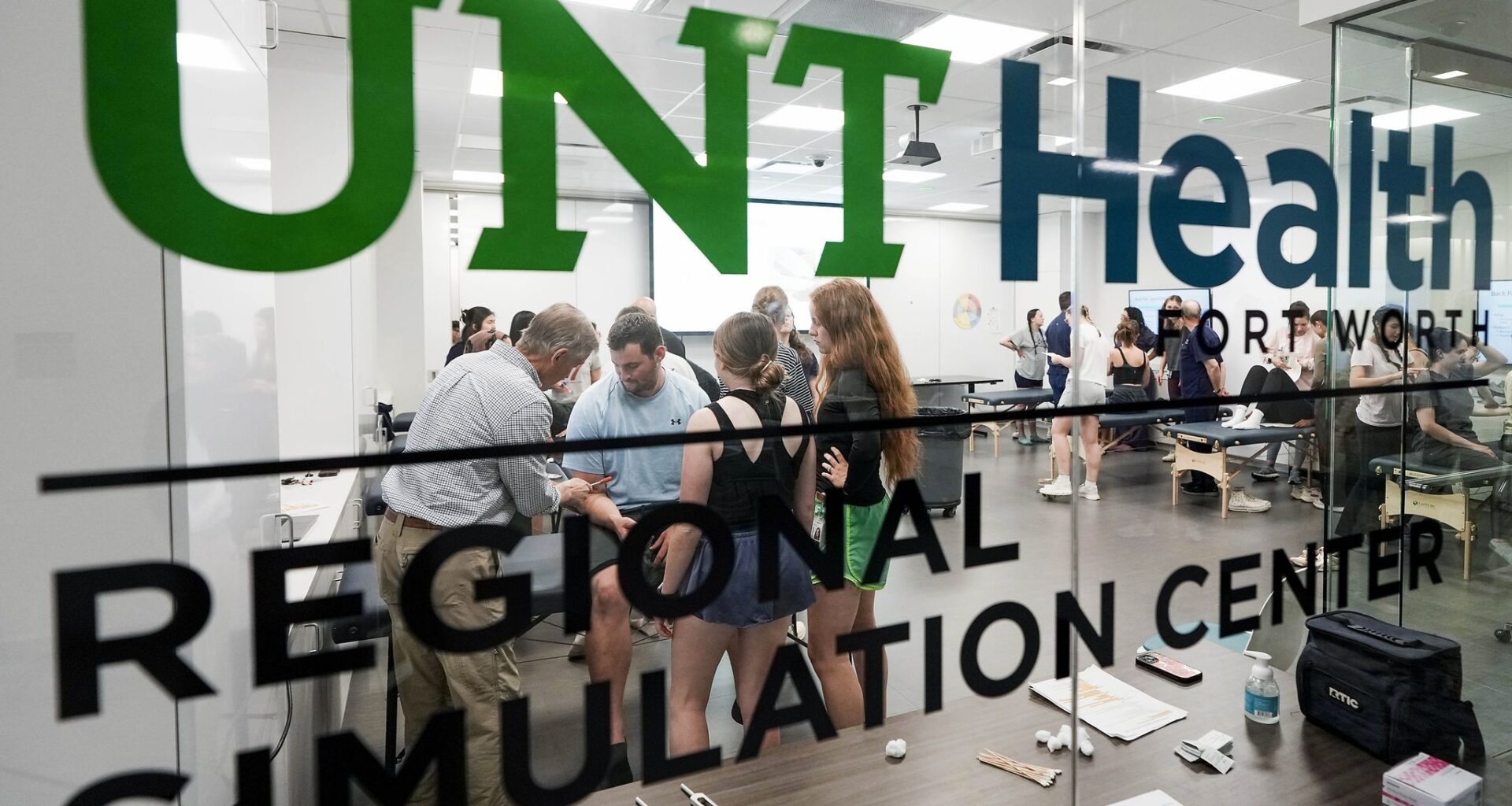
First-year medical students are crowded inside the glass-walled room, a collection of small groups, each organized around a table and a model of a knee.
Dr. Maxie Brewer, a hospitalist at Cook Children’s Medical Center in Fort Worth, walks the students through the scenario. They’ll be pulling fluid out of a septic knee joint. It’s a simulation training, but they’ll start with consents, asking the knee if it understands why they’re doing this and the potential complications.
Another professor, pediatric emergency physician Dr. Sam Selby, calls out a final instruction. If any of the students notice another student making a mistake, Selby says, they should help them out and remind them of what they missed.
Article continues below this ad
It’s a quick prompt, but it points to a particular focus at the medical school: patient safety and error prevention.
The Texas College of Osteopathic Medicine, at UNT Health Fort Worth, is the only medical school in the country that requires students to take a specific national patient safety exam as part of their curriculum.
In addition to the safety principles that are baked into other courses, the Fort Worth medical students all take a two-week-long course during their third year, focused specifically on patient safety. At the end of the course, they’ll take the Institute for Healthcare Improvement’s patient safety exam, which is designed for healthcare professionals.
With this focus, Dr. Frank Filipetto and his Texas College of Osteopathic Medicine colleagues hope they’re training a generation of doctors who can change a pernicious problem in medicine: preventable errors.
“What I wanted to be able to do was teach our medical students skills to change the way healthcare is delivered,” Filipetto said. “That’s our vision.”
Article continues below this ad
The problem in healthcare

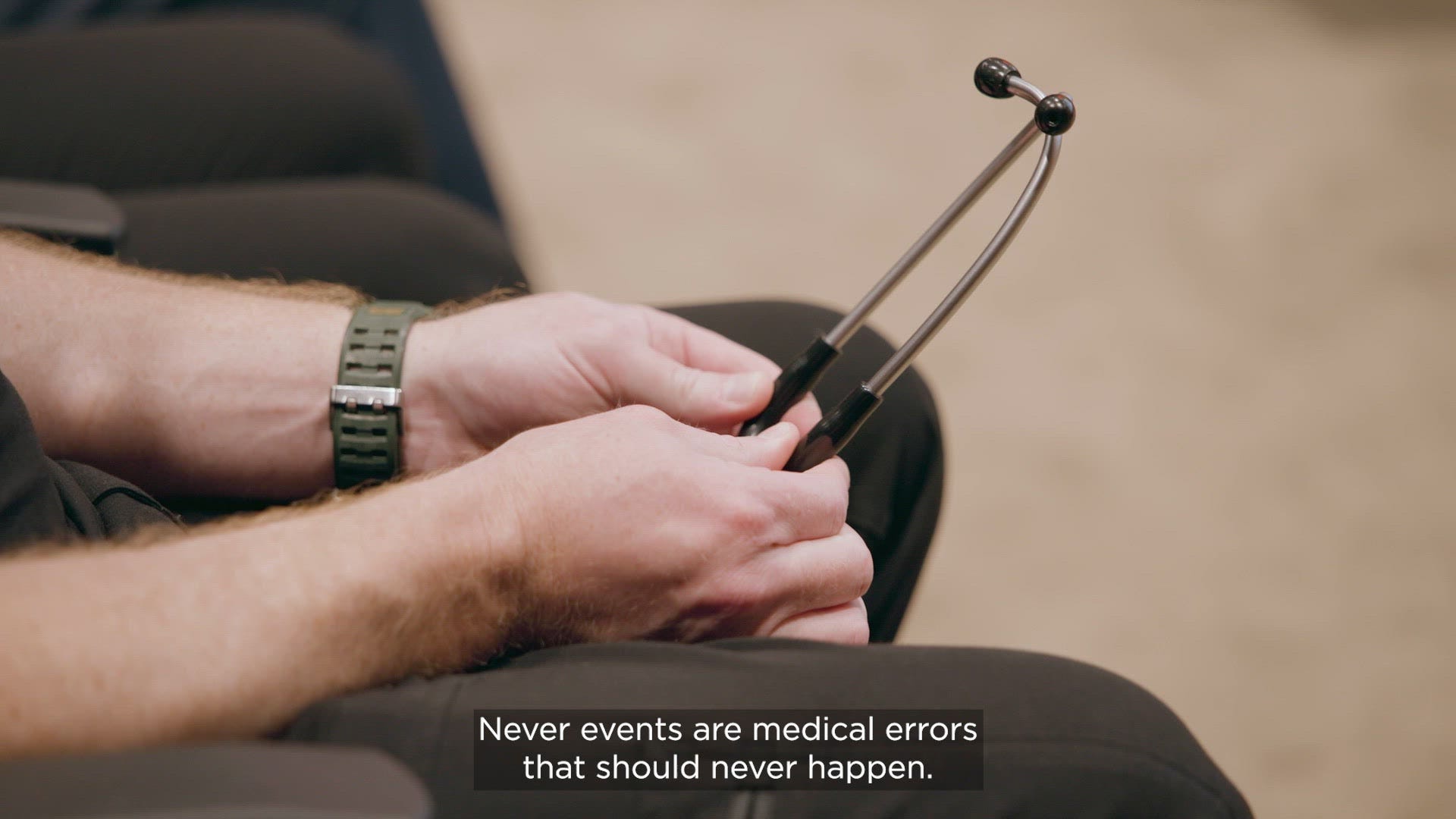
How this Texas college is making healthcare safer for patients
Azul Sordo Ortiz Hernan, The Dallas Morning News
Research studies and analyses have produced widely varying estimates of how many patients die each year due to preventable medical errors.
One study estimated that number to be around 22,000 deaths per year in the U.S. Another, much-cited analysis produced a different figure, at more than 250,000 deaths. That larger figure, if accurate, would make preventable medical errors the third-leading cause of death in the U.S., behind heart disease and cancer.
No matter how you slice it, studies estimate there are, at a minimum, tens of thousands of patients dying each year due to mishaps that could have been prevented.
Article continues below this ad
It bothers Filipetto that researchers don’t know the real number. It bothers him that the number, whatever it is, is so high. And it bothers him that medical schools across the country aren’t doing more to change that number.
Most medical schools, Filipetto said, “do not teach patient safety to the degree that the current graduate of a medical school needs to know safety science. This is not a couple hours. This is not a lecture.”
Selby, the pediatric emergency physician, said patient safety wasn’t a specific focus when he was in medical school.
“I don’t think that it was something that was highlighted,” Selby said. “We obviously wanted to be safe with how we were treating our patients, but I think putting a name to patient safety really helps to bring the awareness.”
While human error is unavoidable, experts say many medical errors stem from systemic issues — a lack of proven processes to catch human error or a culture that doesn’t encourage medical workers to speak up when they think something is wrong.
Article continues below this ad
Both are things medical students can learn to change, Filipetto said. So when he became first the interim dean and then the dean of Texas College of Osteopathic Medicine — a position he held until 2024 — he vowed to make sure the school broke new ground.
The solution?
The Texas College of Osteopathic Medicine’s patient safety course is concentrated into two weeks, during which the students sit in a four-hour class each afternoon and are expected to self-study each morning. Once the medical students have gone through the course, they take the Institute for Healthcare Improvement’s exam.
Patricia McGaffigan, a patient safety advocate at the Institute for Healthcare Improvement, said this type of training can make patient safety into a core value for future healthcare providers.
“Patient safety is integral to everything we do in healthcare, regardless of role or specialty,” McGaffigan said in an email. “When we integrate patient safety as a cornerstone of healthcare education, we shape professional values and capabilities from the start.”
Article continues below this ad
The exam, according to the institute’s website, has an overall pass rate of 75%. Texas College of Osteopathic Medicine students, according to Filipetto, have a first-time pass rate of 92%. Students who don’t pass on the first time can take it again, Filipetto said, upping the pass rate to 98%.
Lillee Gelinas, the college’s patient safety director, said the focus is about more than the exam.
Dr. Maxie Brewer works with medical students in the simulation center at UNT Health Fort Worth in Fort Worth, Monday, May 18, 2026.
Smiley N. Pool/The Dallas Morning News
“I really do think that, at scale, we’re putting physicians into practice with a whole different view about safety,” Gelinas said.
Filipetto tells his students that, if they speak up about a potential problem they see while they’re working in clinical settings, he has their back. He wants them to report near misses, too, so that those things can be fixed before they harm a patient.
Article continues below this ad
He wants them to practice speaking up.
With that practice, he hopes his students will graduate with the tools they need to improve the health care system. That can feel like an overwhelming aim, but Filipetto doesn’t mean it to be. He’s talking about realistic change.
“The system is the environment that you work in,” he said. “Start with your environment.”
It’s a drumbeat that the Texas College of Osteopathic Medicine professors repeat over and over.
In a virtual class, which The Dallas Morning News sat in on, Dr. Albert Yurvati tells the students that, with their patient safety credentials, they’ll head into their residencies with more safety training than the vast majority of their peers.
Gelinas jumps in to underscore this.
“He just emphasized that the majority of residents that touch a patient are not competent in patient safety. Is that hitting you?” Gelinas asks. “The average patient assumes that the person walking in their room is competent in patient safety.”
Yurvati, like Filipetto, tells the students he’ll protect them if they speak up about errors or oversights when they’re working with patients.
In the future, he tells them, they’ll need to find that protection from their institutions. Yurvati hopes they will find a way to push patient safety forward, no matter where they work.
“Do not be afraid to speak up,” Yurvati told the students. “You, as TCOM graduates, can make a difference.”
The Dallas Morning News’ Under the Knife investigation is part of the Association of Health Care Journalists’ U.S. Health System Reporting Fellowship, supported by The Commonwealth Fund.