
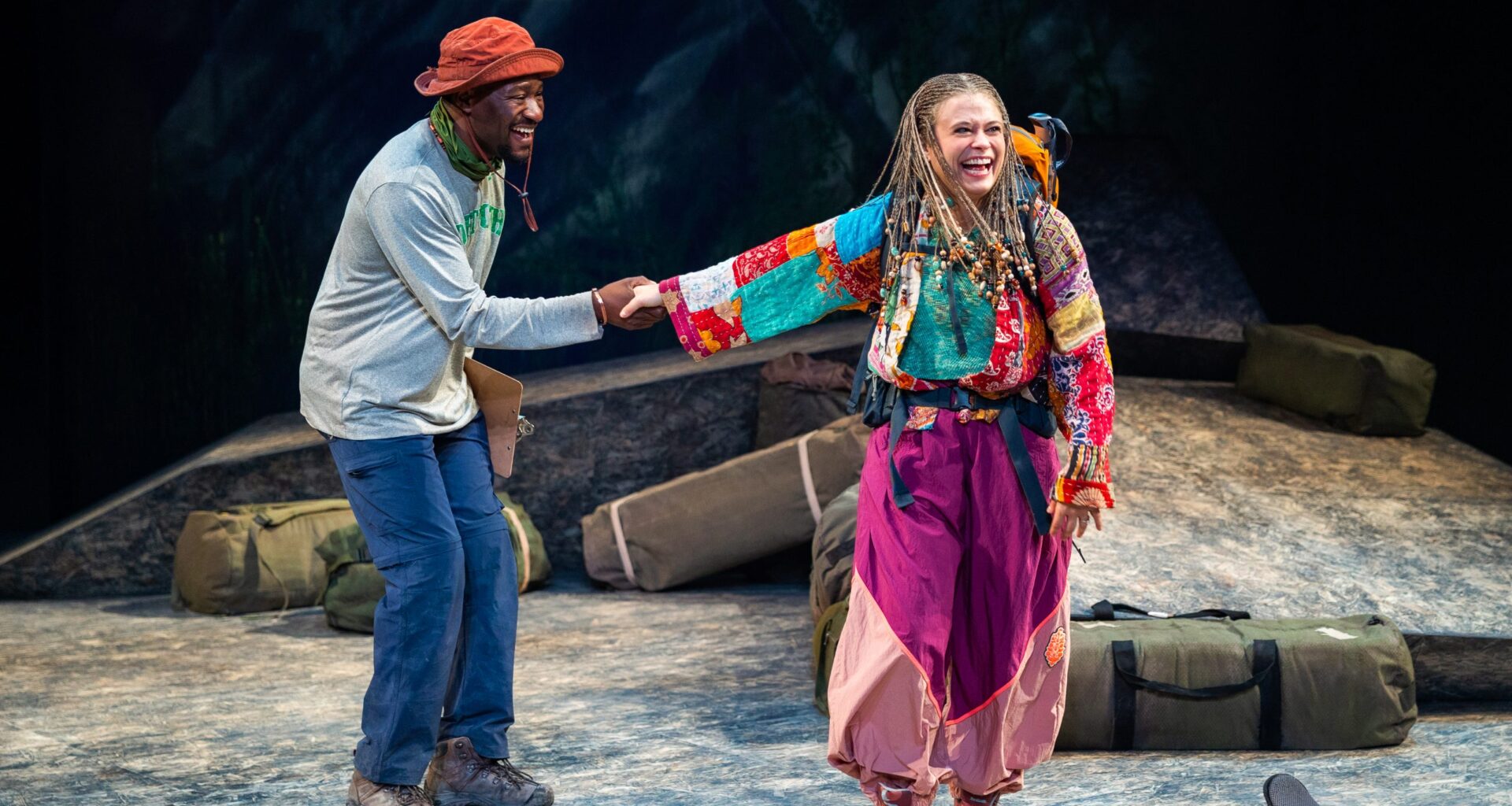
There’s a beautifully written and profound interaction late within Gloria Majule’s 90-minute play, Uhuru (a world premiere at the Alley Theater), that asks us to throw away assumptions, lean in and listen.
The scene serves up the dueling identity experiences/realities of two Black Tanzanian men shortly before summiting the Uhuru peak of Mount Kilimanjaro. Mishale (a magnificent Michael Oloyede), a mountain tour guide, dreams of finding and marrying a white woman so he can leave Tanzania and move to a more fruitful life in the West. Sprite (Oghenero Gbaje), an American of Tanzanian heritage, wants nothing more than to claim the mountain and the country as his own. decolonizing both from historical and present outside white intrusion.
While it’s clear which man’s aspirations Majule feels akin to, there is tender care ensuring that both dreams are given context and weighty empathy. There’s much to learn from both men and buckets of sadness to unpack in how they arrived at their viewpoints.
It’s an odd scene out in what is essentially a light comedic show. One that feels almost too cartoony in many aspects, written and staged with a reliance on easy laughs.
Joining the men on the Uhuru trek are two white, young, peppy, married missionaries, Henry (David Gow) and Frankie (Skyler Sinclair), who run an adoption agency in the country and claim to hold Tanzanian citizenship.
In Majule’s script, Henry and Frankie are tools rather than real characters, meant to trigger both Mishale and Sprite in opposite ways. Mishale hopes to woo Frankie away from Henry while Sprite is incensed at having to share his sacred climb experience with faux-white Tanzanians who can’t even be bothered to learn the language.
A note on language – perhaps the biggest triumph of Uhuru (other than the aforementioned scene) is the inclusion of Swahili in the show. Of course, Mishale and Sprite would speak to each other in the tongue of their country of origin. And indeed, we as an audience should and want to hear that.
Screens placed around the theater provide easily digested surtitles (in addition to some ambient mountain vistas) that keep us all abreast of the conversations. It’s such a simple and elegant device that allows authenticity to flow, adding robustness to Majule’s writing.
With Frankie’s Instagram-ready white-girl braids and Henry’s Jesus slogan t-shirts and continual hand to the sky in prayer, the couple are thinly drawn. Majule’s attempts to make them more interesting by throwing in a secret backstory feels too on the nose given other revelations in the show.
But the play isn’t about them. We know that. No one is interested in their gaze. And by all means, let’s make fun of them. Let the joke be on the colonizers. If only the laughs were harder won or had more bite than laughing at the white kids playing the ukulele and making out.
The tone this sets means that for most of the play, Mshale and Sprite react to the couple, leveling down comedically. Mshale keeps making his moves and Sprite spends most of the play slack-jawed with rage. It gets old quickly.
As does, to some extent, director Shariffa Ali’s staging.
To be fair – a play set on a mountain climb is an enormous creative challenge. There’s not a lot of set changes or things to do other than to go round and round mimicking the ascent.
And there’s a lot of that on the bare particle-board-looking, angled-riser stage. Ali does employ the cute device of pausing the climbing action in frozen beats throughout the show to mimic a tableau snapshot view of the action. It’s fun the first 10 times, but then quickly becomes more of the same, slowing down the action.
More successful are the tent scenes which use just the ribs of the structures to allow us to see what happens when the climbers bed down for the night. It may not be suitable for younger viewers, but Ali handles these moments with impressive elegance.
Uhuru is a play that triumphs despite itself—a classic example of the message outweighing the method. What Majule is expressing is urgent and thoughtful.
If only the urgency elevated the comedy, that would be the mountaintop.
Uhuru runs to November 8 at Alley Theatre, 615 Texas. For tickets, call 713-220-5700 or visit alleytheatre.org. $40-$85.
Related