
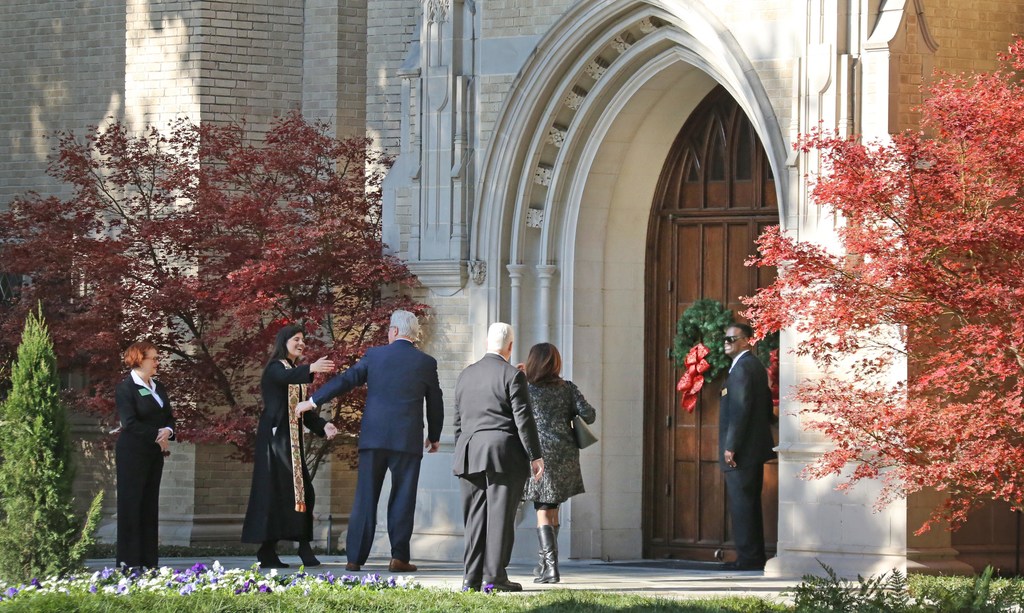
Attendees arrive at Highland Park United Methodist Church in Dallas on Thursday, December 14, 2017.
Louis DeLuca/Staff Photographer
Thousands of members at Highland Park United Methodist Church are facing a pivotal question in the next few days: Should the North Texas megachurch stay with the United Methodist Church, its denomination for more than 100 years, or leave and become an independent Methodist congregation?

The results of a Sunday and Monday vote on the question have far-reaching implications. Highland Park UMC is one of the denomination’s wealthiest, largest and most influential churches. It contributes millions of dollars to ministries in Dallas and beyond and is home to some 15,000 members.
“We know this is difficult and emotional and we feel that way too,” the Rev. Matt Tuggle, Highland Park UMC’s senior minister, said in a Wednesday video. He believes the church should separate from the United Methodist Church.
Article continues below this ad
“Ultimately,” he said, “we believe it’s time to move forward.”
The church has said it will remain committed to its Methodist traditions if the vote to split is successful, but questions about how the church would operate remain unanswered and former church ministers are questioning the speed at which the vote is being held.
“The conference’s actions and the timing of its lawsuit have accelerated this process,” Highland Park UMC said in a statement Thursday about the upcoming vote. “This vote is about determining our future so we can return our full attention to being the church we have always been.”
As the vote approaches, some unanswered questions include:
If the church secedes, where will it source future clergy?
If the church secedes, will it continue its partnership with other UMC-affiliated organizations?
If the church secedes, will it accept gay and lesbian clergy and same-sex marriages?
Article continues below this ad
“The situation at Highland Park is fraught with possibilities,” said William B. Lawrence, the former dean of Perkins School of Theology at Southern Methodist University.
It is unlikely that a “yes” vote to separate will mark the end of the legal dispute between the church and denomination.
“As my ability to predict church disputes [goes], this thing will last for a decade-plus,” Ashish Mahendru, a Houston-based commercial attorney, said of the legal battle. He works with religious organizations and is not involved in the litigation.
How the public dispute started
The Horizon Texas Annual Conference, the regional governing body of the United Methodist Church, sued Highland Park UMC in August, alleging it had quietly tried to cut ties with the denomination in 2022 when it made amendments to certain corporate and internal documents.
Article continues below this ad
The lawsuit prompted a public conflict between the conference and the church. Highland Park UMC has disputed the allegations and said it was blindsided by the litigation.
The church council, a group of nonclergy members called “lay leaders,” recommended the church separate from the United Methodist Church in an Oct. 13 resolution, saying their trust in the United Methodist Church was broken.
The litigation – and the manner in which the lawsuit was filed – was so egregious, church leadership has said, that it amounted to ecclesiastical wrongdoing.
“The Church Council believes the Conference and its bishop have irrevocably broken the bond of trust that once existed between our Church and The United Methodist Church,” the church council said in a letter last week.
The church leadership has said the conference did not adequately communicate with Highland Park UMC before the lawsuit was filed. The conference disputes this characterization.
Article continues below this ad
The conference is holding a virtual information session on the topic for all United Methodists Saturday at 2 p.m. CT on Zoom. More information can be found on the conference’s Facebook page.
The conference said last week a church can’t unilaterally choose to leave the United Methodist Church.
“Any attempt to do so does not diminish the Bishop and Conference’s commitment to continued covenant with Highland Park UMC and its members nor our desire for restoration and reconciliation with this vital community of faith,” the conference said last week in a statement.
Church leadership faces criticism on speed of vote
The church has held two town halls on the subject of the lawsuit since August and both were held before the Oct. 13 resolution. According to an email to congregants, a third information session was held Wednesday night for young people and their parents.
Article continues below this ad
The media was not permitted to attend the town halls. The second town hall Oct. 11 was partially livestreamed and recorded.
In a post on Facebook Tuesday, Susan Gorham Robb, former senior associate minister of Highland Park UMC and a current member, said a vote to leave the denomination is premature. Robb retired in 2021 after serving on staff at the church for 20 years. She said she and others tried to share information at a town hall meeting “but were not allowed for various reasons.” Robb declined to comment on her post when reached by phone.
In response to Robb’s account, the church told The Dallas Morning News News the town hall presenters were the church council and staff leadership. “The meeting was followed by a Q&A portion where any Town Hall attendees were free to speak,” the church statement said.
“Many people I know believe that this vote to separate from United Methodism is moving too fast,” Robb said in her post. “We have time.”
Robb encouraged the church and the conference to sit down with a third-party mediator.
Article continues below this ad
“We all acknowledge that great harm has been done, but we are hopeful that the church can come through this moment as a stronger congregation,” she wrote.
A message on the church’s website appeared to respond to Robb’s post.
“A ‘No’ vote is a vote to remain tethered to the United Methodist Church,” a statement on the church website said Wednesday. “It is important to remember that it is the conference and bishop that sued us, and they have not offered mediation.”
Bishop Ruben Saenz Jr., who leads the conference, has repeatedly said his door is open for reconciliation. The church said in a statement on its website that they do not see a partner for “peace and collaboration” in the conference.
“A ‘No’ vote does not guarantee additional time, conversations or another opportunity to vote,” the church’s statement said.
The Rev. Eric Folkerth, lead pastor at Kessler Park UMC in Dallas and a previous staff member at Highland Park UMC, said churches sometimes take congregation-wide votes. For example, a congregation may vote on buying or selling property. But the vote is usually preceded by an extended period of discussion, he said.
“It seems like they are rushing to take a vote,” Folkerth said in an interview.
In a Wednesday letter to the congregation, Highland Park UMC leadership said the church is committed to caring for its members and growing in faith no matter the outcome. “We recognize that faithful people may approach this decision with different perspectives, and we honor the prayerful discernment of every member,” the letter said.
Highland Park UMC senior minister the Rev. Matt Tuggle in an undated photo.
Highland Park UMC
How would the church change?
Tuggle, Highland Park UMC’s senior minister, has said the church’s theology would remain the same if it splits with the United Methodist Church and that it would seek to form a network with other moderate churches.
“We’ve never been a church defined by extremes,” the Rev. Paul Rasmussen, former senior minister, said in a video message Wednesday. “We’ve always been a centrist church. A big tent where people with different beliefs and perspectives can sit in the same pew, worship the same God and grow together in their faith in Christ.”
But questions remain unanswered. The church did not respond to a question sent by The Dallas Morning News about where it would source its future clergy. United Methodist Church clergy are educated through the denomination’s 13 official seminaries or another seminary that is approved by the United Methodist Church.
Robb said the church could in time become nondenominational, not Methodist. She said the church has benefited from the “brightest and best” students to come out of United Methodist Church institutions.
“I, and others I have talked to, are skeptical that being able to maintain our Wesleyan roots without a strong pipeline of Methodist trained seminarians will be almost impossible after a generation, or two at most,” she said in her post.
She also questioned how the church would hold itself and its clergy accountable to abuses of power without its denomination, which currently has such structures for discipline.
The church also declined to answer questions posed by The News about its future partnership with UMC-affiliated organizations such as Africa University, a university in Zimbabwe it has supported, if it secedes.
Highland Park UMC said it has given $12 million to the United Methodist Church and its various ministries in the past four years. During the Oct. 11 town Hall, Tuggle said the church would have more money to spend on its ministries if it did not pay monthly apportionments to the denomination. The church has partnered with many local Dallas charities and other UMC churches over the years.
Vote comes on heels of UMC schism
The church has said that edits it made to its corporate documents occurred during a period of “discord” and “chaos” in the United Methodist Church. From 2019 to 2024, nearly one quarter of UMC churches left the denomination over disagreements related to same-sex marriages and gay and lesbian clergy. Highland Park UMC never took a vote to leave during that time period when many churches did.
“The Church Council knew, as good stewards of a historic congregation, that it needed to ensure that if the Church maintained its ecclesiastical connection with the UMC, it was legally insulated from the ecclesiastical and doctrinal strife within UMC,” the church said in court documents.
A United Methodist Church vote in 2024 lifted bans on gay clergy and same-sex marriages, but did not require clergy to perform same-sex marriages. Rasmussen, former Highland Park UMC senior minister, announced shortly thereafter he would not hold same-sex marriages at the church, but other pastors could officiate gay marriages at other venues, according to UM News.
Highland Park UMC declined to answer questions about whether the church will accept gay and lesbian pastors and same-sex marriages if it departs the UMC.
“One matter where we agree with the bishop and the conference – this is not about LGBTQ issues,” the church said in a statement Thursday. “We are 48 hours from holding a historic vote for our Church, and this is about nothing other than governance.”
In response, the conference said Thursday evening, “The Conference cannot speak to Highland Park United Methodist Church leadership’s motivations for changing its governing documents in 2022. Our request remains the same: that Highland Park restore its governing documents to reflect our shared commitments as United Methodists.”
In a court filing last week, the conference said, “Although it publicly denied a desire to do so, [Highland Park UMC] discreetly amended its governing documents in the same manner as many disaffiliating churches amended theirs.”
What about the church property?
Mahendru, the Houston-based attorney, said church disputes that make their way to civil courts are usually over property.
Technically, neither party has asked the court to affirm who owns the property, Mahendru, said, and the current lawsuit deals with disagreements over Highland Park UMC’s internal and corporate documents.
In the United Methodist Church, church properties are held in trust with the denomination. But Highland Park UMC has told its congregation that it is “confident in our legal positions.”
“Our thriving congregation of 15,000 loyal Wesleyan Methodists will always have the home and facilities we have nurtured for a century,” the church said in an online statement.
Vote could divide congregation
The upcoming vote will have long-lasting impacts on the personal relationships between members. Lawrence said if Highland Park UMC votes to leave, some members will start attending different churches. Others might stop going to church altogether if they are displeased with the infighting.
“Nobody knows what the collateral damage will be,” Lawrence said.
In her post, Robb mourned what could be a loss of connectionalism – a key Methodist value – with area UMC churches and the broader Methodist tradition.
“Our big tent could become smaller, meaning that the rich, varied views we now hold as a large congregation could become more and more narrow,” she wrote. “We may wish to remain Methodist in spirit, and we may try very hard, but our success beyond a generation or so is far from guaranteed.”