
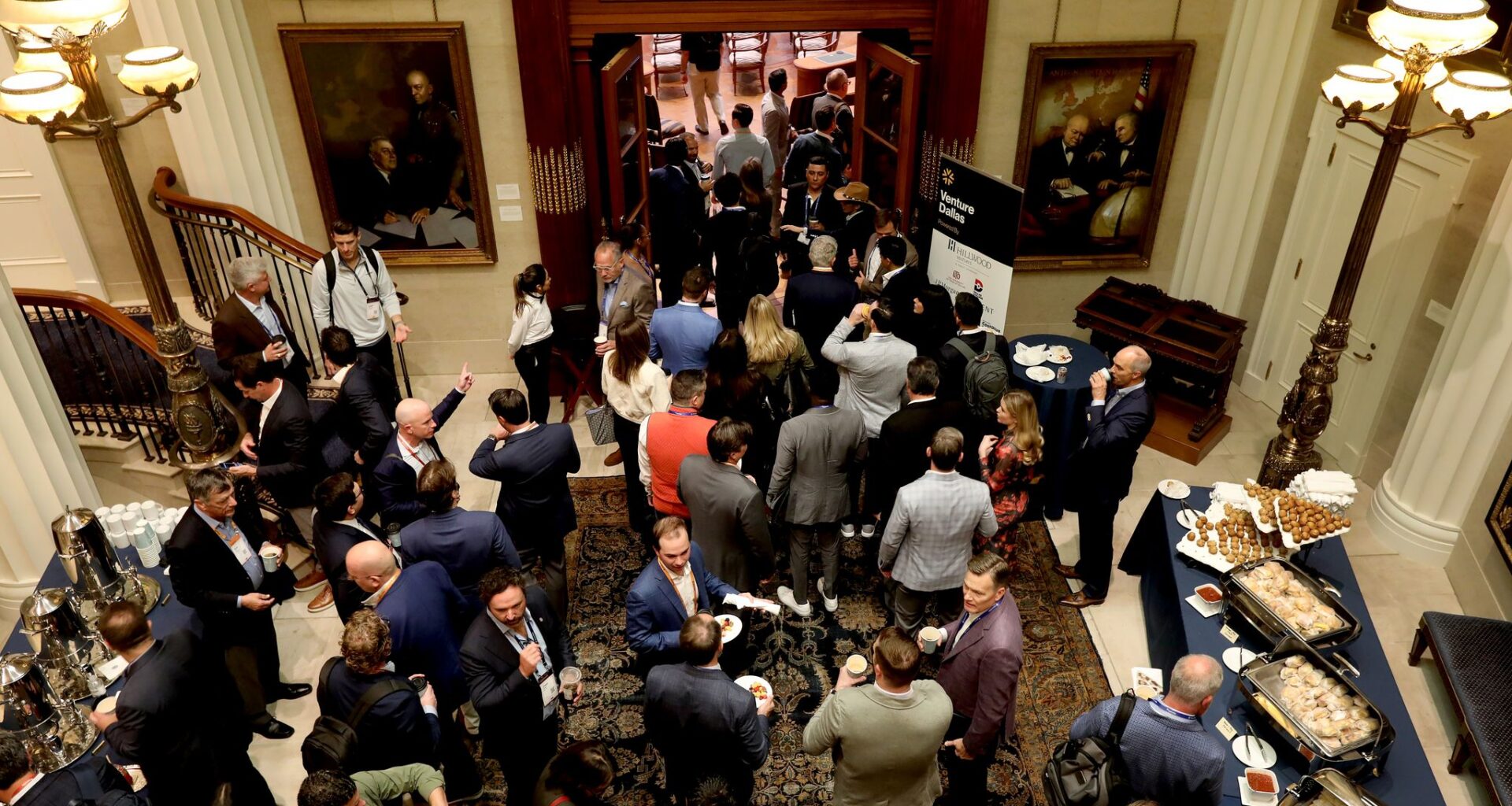
Guests walk into the Venture Dallas 2026 event at Old Parkland in Dallas on Oct. 22.
Anja Schlein/Special Contributor
Venture Dallas kicked off Wednesday at Circle T Ranch with investors posing for sunset photos on top of a Texas longhorn and ended with a wide-ranging talk from Mark Cuban in Old Parkland’s debate chamber.

The sixth-annual conference, led by Venture Dallas co-founder and Perot Jain partner Aaron Pierce, brought together CEOs and investors for conversations ranging from investing in defense to the frontier of neurotechnology.
Thursday’s event began with remarks from Harlan Crow, Sen. John Cornyn and energy founder Justin Lopas and continued with legendary moguls such as Trevor Rees-Jones and newer shakers such as venture capitalists Alex Davis of Disruptive and John Redgrave of DTX Ventures.
Article continues below this ad
Here are some highlights from the conference:
Reindustrialization
Despite speakers coming from all corners of industry, many coalesced around a theme: reindustrializing the U.S.
Cornyn emphasized the national security implications of manufacturing critical products like AI chips and magnets stateside, pointing to investments through the 2022 CHIPs Act and MP Materials’ partnership with the Pentagon. A comment from Cornyn about the need to “build data centers here in America,” received cheers from the audience.
Sen. John Cornyn speaks during Venture Dallas 2026.
Anja Schlein/Special Contributor
Cornyn also praised the reinvigoration of the defense sector, which has seen a boom in investment and competition from innovative startups, after decades of consolidation among so-called “prime” defense contractors.
Article continues below this ad
“What’s so encouraging to me is … to see the work that’s been done to marry the incredible technology that many of you help finance and create, and make sure that our warfighters have what they need in an ever-evolving landscape,” he said. “Who would have thought that Ukraine would be able to produce more drones than the United States of America? And who would have thought that a couple-thousand-dollar drone would require a couple-million-dollar missile to knock them out of the air?”
Related story: Inside MP Material’s rare earth magnet factory in Fort Worth
Cornyn and many other speakers emphasized the unique position Texas is in to take advantage of reindustrialization via streamlined permitting, low taxes and open space. A venture outside Austin is taking that idea to the extreme.
Proto-Town — part startup incubator, part real estate venture and part boarding house — is a 1,200-acre ranch in Lockhart that aims to give founders the physical space and freedom from certain zoning codes and regulations they need to build ambitious ideas and scale. Buzzy nuclear startup Oklo built a working fission reactor in Proto-Town, and founders can live in on-campus housing made of repurposed shipping containers or 3D-printed clay, said co-founder and COO Merle Nye in a panel.
Justin Lopas, co-founder and COO of Austin-based battery and grid startup Base Power, said in a fireside chat that talent and a business-friendly climate were factors in choosing to start the company in Texas. Base Power has been able to bring in talent from industries like software and train them to be a part of the company’s industrial process, and many of their apprentice electricians come from retail and hospitality.
Article continues below this ad
“You can build a prototype … but building hundreds of them per day or thousands of them per day, which we’re now doing at high quality and low cost, is like very hard, and frankly, to be very honest, China has mastered it,” Lopas said. “The entire society is built around building stuff, and the U.S. has lost some of that, unfortunately. And we, and companies like us, are intent on bringing that back.”
Frontier neurotechnology
What if minds and computers could be one in the same? Michael Andregg of San Francisco-based Eon Systems and Matt Angle, CEO of Austin-based Paradromics, spoke on a panel about how they are working on that question from different angles.
Eon Systems re-creates minds in the cloud via brain scans, having already successfully done so with a fly. Paradromics, on the other hand, is building brain implants to address neurological problems like dysarthria, the inability to speak, showing a video demonstration of a woman with an ALS-related condition using the implant to speak to her husband.
“So one of these guys wants to put a computer in your brain, and the other one wants to put a brain in a computer,” as moderator Court Westcott of the Westcott Investment Group put it.
Article continues below this ad
Angle showed off Paradromics’ product, a device about the size of a coin that sits on top of the brain connected to 421 electrodes thinner than a human hair that reach down into cortical tissue. He said that for many folks who are paralyzed or have a motor neuron disease, the neural processes that control what a person actually wants to do are still intact, and that’s what the device reads.
Angle acknowledged similarities between Paradromics, which is now raising money to go through the FDA approval process, and Elon Musk’s Neuralink. But he explained that unlike Neuralink, they’re not trying to be the next iPhone — the primary way people will interact with technology, needing regular updates to keep up with developments in AI.
“We don’t have to wait until every person wants to merge with AI before these companies and these businesses get really big,” Angle said, noting that the speech restoration market alone is worth $30 billion. “The brain-computer interfaces have the ability to turn biological problems, neurobiological problems into solvable technology problems, and so that’s where it’s headed.”
Venture Dallas 2026 at Old Parkland brought together CEOs, investors and others.
Anja Schlein/Special Contributor
Eon Systems is much earlier stage. The fly brain it uploaded only has about 100,000 neurons compared with the roughly 90 billion in a human brain, and its process is one Andregg called “destructive,” as it requires physically slicing a specimen and scanning the slices, obviously untenable with living organisms.
Article continues below this ad
But eventually, Andregg said, they want to make uploading available to everyone. He envisions a future where experts can create digital versions of themselves to provide as a service to multiple customers at once; one in which you can upload a deceased pet to keep living in the cloud. One can fill in the blanks on further implications for human beings.
In the meantime, as Eon Systems is looking at a Series A funding round, its first market is just being “very good at scanning brains,” with the potential to offer services to the pharmaceutical industry and find the root causes of diseases like PTSD and depression.
“Let’s say, before we’re actually running a whole organism, we’ve got a map of where every neuron is,” Andregg said. “So offering this as a service to operate a chemically accurate brain that you could run experiments on, where no person has to suffer, no animal has to suffer.”
Disruptive investing and a $10 billion venture fund
Alex Davis, whose Dallas-based venture capital firm has secured $7.5 billion in commitments for a new fund with a $10 billion goal, said his limited partners trust him because he’s easily accessible and deeply involved with many of his portfolio companies.
“I don’t think there’s a single LP of mine that wouldn’t tell you we’re not the most responsive fund manager probably on Earth because they’re all friends,” Davis, founder of Disruptive, said.
In some cases, Davis said he essentially co-runs Disruptive’s earlier-stage portfolio companies such as Groq, which Disruptive bet on early. The California-based AI chip company entered into a $20 billion licensing agreement for its interference technology with Nvidia. Instead of competing with a company as massive as Nvidia, Davis sought an opportunity to work closely with the AI computing company.
Article continues below this ad
The audience listens to speakers during the Venture Dallas 2026.
Anja Schlein/Special Contributor
On AI, Davis said the industry is still in its infancy. Just as there are AI and AI-adjacent companies that easily triple in value within months, it is also easy for them to quickly go out of business.
“There is no greater opportunity as an investor for the speed,” Davis said.
He added that it’s important for U.S. companies to advance open models, which he said China is ahead on.
Davis moved to Austin from Los Angeles before moving to Dallas. He said he dropped out of college to start a business before becoming an investor.
The new era of defense
Prominent Dallas investor Kyle Bass — who has been working directly with the Trump administration to boost private investment in defense technology — talked with four founders of companies involved in the United States’ military buildup.
Ryan Tseng, co-founder and chief strategy officer of Shield AI, lives in Dallas but grew up in Houston. Shield AI, which Bass praised as “one of the most innovative companies in the world,” develops defense technology and autonomous aircraft with a significant footprint in the Dallas area. Shield AI’s estimated post-money valuation in March was $12.7 billion.
Tseng said two factors made the Dallas area appealing: a strong manufacturing and engineering talent pool and a favorable regulatory environment.
“Great talent and governance makes it possible to build complicated things differently, better and at scale in a way that’s not really achievable anywhere else in America,” Tseng said.
Related story: Investors prosper and consumers pay as the Iran War exacts an uneven economic toll 6 months in
Will Edwards, CEO of Firehawk, is also based in Dallas. He brought a prop to the Old Parkland debate chamber — a hydrostatic rocket. He said Firehawk can make about 40,000 of them each year, and they’re shooting down between 40% to 60% of drones at any given time.
“My goal is to make components cheaper, systems cheaper, and then also try to work with them who are on this stage to beat our enemy, China,” Edwards said.
Edwards said he and his wife were living in Washington, D.C., but were looking for a city with “money, land to blow things up and patriotic people.” That brought them to Dallas. He added that the federal government has gotten Firehawk systems onto the battlefield sooner than their contracts originally intended.
Two co-founders of California-based defense companies also spoke: Lukas Czinger, CEO and co-founder of Divergent, and Chad Steelberg, CEO and founder of Tiberius Aerospace.
Trevor Rees-Jones’ journey
Each time Venture Dallas co-founder Aaron Pierce asked oil and gas billionaire Trevor Rees-Jones to explain how he thought through complex business decisions, Rees-Jones insisted he never actually thought all that carefully.
“The plan was created as time went on, and usually never in advance,” Rees-Jones said. “Usually after the fact, the fact being a dry hole or some failure or setting myself on fire once again, and I was able to put it out.”
Although he was an entrepreneurial child who caught tadpoles and birds to sell to neighborhood kids, Rees-Jones went to law school and worked as an attorney on oil and gas bankruptcy cases before starting Chief Oil.
The audience listens to speakers during the Venture Dallas 2026.
Anja Schlein/Special Contributor
He hated being a lawyer. Once, Rees-Jones woke up sweaty from a nightmare that he was back in the job that motivated him to keep persisting as a businessman. Still, 10 years into the work, Rees Jones’ attorney friends were taking in large paychecks while he could only afford 500 square feet of office space and part-time assistant.
Eventually, of course, Rees-Jones succeeded. He walked through the historical ups and downs of the oil and gas business, noting how he took advantage of each cycle and selected sometimes unlikely locations for drilling.
By 2005, when Chief Oil and Gas had taken off and gas prices were surging, Rees-Jones had a plethora of rigs to run. That was a point where he said he did think through his strategy in advance.
“You just need to know to buy low and sell high,” Rees-Jones said.
Today, Rees-Jones’ Christian faith helps motivate his philanthropic work. He focuses on helping children who are abused and disabled, both in and outside of the United States. He looks to support character development in children, which he said is important because there aren’t enough leaders that display good character today.
Mark Cuban on Trump, AI and more
Mark Cuban said his discount pharmaceutical company is not in the medication business, and when he owned the Mavericks, he was not in the basketball business.
Instead, Cuban believes Mark Cuban Cost Plus Drugs is in the “trust business,” which means being transparent about prices and markups. And as owner of the Mavericks, his job was to enhance people’s experiences. Cuban said he personally called former customers and season ticket holders.
“I wanted everybody around me to hear that I was calling, and I wasn’t saying, ‘Hey, it’s going to be a great game,’ ” Cuban said. “I was like, when you come to a Mavs game, it’s the one place you and your kids get to stand up and yell as hard and as loud as you want, and everybody loves you for doing it. And by the time you take them home, they’re exhausted and they fall right asleep.”
Harlan Crow (from left), chairman of the board of Crow Holdings, Aaron Pierce, chairman and co-founder of Venture Dallas, and Joe Lonsdale, founder and managing partner of 8VC, listen to Sen. John Cornyn speak.
Anja Schlein/Special Contributor
Cuban said AI is book smart but not street smart. Therefore, he believes it is useless without humans. He uses it to take care of tasks many entrepreneurs push to the weekend and never complete. For the first time in 20 years, he’s been able to read fiction books.
On politics, Cuban maintained that he “hates” both parties, calling them divisive and power-hungry instead of productive. He said that President Donald Trump ushered in an era of extreme behavior online to attract attention that several Democrats have replicated.
Cuban said he worries about what he calls “Trump Devotion Syndrome.” As for his own voting choices, Cuban believes that “character is destiny.” This year, that meant about 70% of the candidates he voted for were Democrats. In previous years, that’s been flipped.
“The same values we have in our families — why don’t we look for those same things when we vote for people?” Cuban said.