
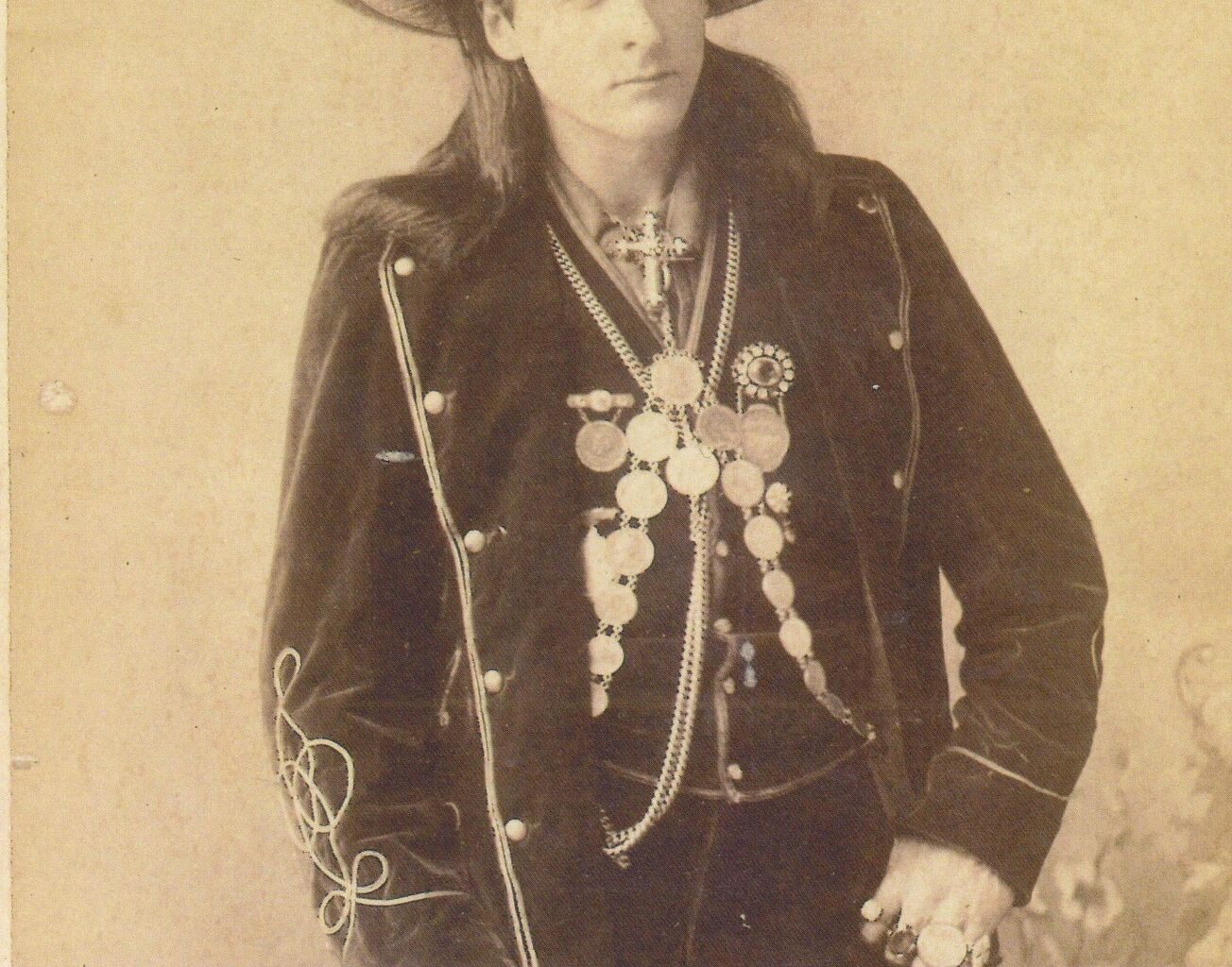
Medicine show star J.I. Lighthall was known as the “Diamond King” for his bedazzled costume and sparkly accessories. Touring the South, he stopped in San Antonio to sell his quack cure-alls in noisy, musical shows in Main Plaza. His “Indian Oil” or “Spanish Oil” was no match for smallpox, which befell him during his last visit here.
Courtest Gene Fowler
Main Plaza, outside San Fernando Cathedral, was the setting for “Doctor” Lighthall’s medicine show. Crowds gathered to watch the spectacle on the eve of the smallpox epidemic of 1886, one of the worst in San Antonio’s history.
UTSA Special Collections

Is there an address for the building specifically set aside for quarantining smallpox patients, San Antonio’s old “pest house”?
Article continues below this ad
Strange as it may seem now, there were several successive buildings dedicated to containing this disease, officially eradicated in 1980, thanks to vaccination.
Smallpox came to San Antonio many times, at least as far back as the Spanish colonial era. The disease was brought to the New World by Europeans and notably ravaged the San Antonio mission population in 1739.
Interestingly, the Patient Zero of each epidemic often was represented as a person of color – “a Chinaman off a train,” “a colored Pullman porter” or “a Mexican girl,” but at least one major bout of the disease may have come to town with a traveling medicine show led by a white man from Illinois.
Article continues below this ad
While more affluent smallpox patients with stable housing and relationships were allowed to stay in their homes, sufferers who were expelled by their landlords and those with no one to care for them were taken to the pest house. Families of the afflicted were swept out along with the obviously infected and brought to stay with them for the duration of the illness.
Responsibility for a local contagious-disease facility began with the city of San Antonio and was transferred around the turn of the last century to Bexar County, so there was at least one city “pest house,” followed by one supported by the county through its periodic updates.
RELATED: Cholera epidemic
Dedicated to containing smallpox – a highly contagious and often fatal illness spread by close contact with the afflicted – these specialized hospitals kept moving beyond the outskirts of the city as it grew, until the need for one disappeared.
Article continues below this ad
Through it all, there was always a separate tuberculosis hospital, as that disease was historically endemic. The mortality rate of smallpox was as high as 45 percent, and it ran its course much more swiftly, necessitating isolation.
The city’s first “epidemic hospital” was “located west of the Alazan Creek,” says the San Antonio Express, March 20, 1885. Probably near Monterey and Brazos streets, “about a mile and a half from Main Plaza,” it was “a substantial building, consisting of two large and well-ventilated wards.” Though a date isn’t given, City Physician and Health Officer J. Braunnagel, M.D., “this building has never been used since its construction.”
It probably hadn’t been there long, as City Council received a petition in November 1885 “that the pest-house … be fenced and that a sign (reading) “Smallpox” be kept on the same.”
If this was done, it was none too soon. With the new year of 1886, San Antonio was buffeted with winter woes, including a heavy snowfall and the arrival in town of measles, mumps, pink eye, chicken pox, typhoid, cholera, spinal meningitis and – first and foremost – smallpox.
Article continues below this ad
Maybe it was a coincidence, but the dreaded infection seemed to blow in with the reappearance of “Dr.” (not really) James I. Lighthall (1856-1886), a medicine-show performer who sold a line of nostrums supposedly from old Native American recipes, though some contained morphine.
On Jan. 1, 1885, Lighthall paraded his caravan of painted wagons, heralded by their drum-heavy band, along Commerce Street. He threw coins to a growing crowd from a nail keg, showing off his red suit and the diamond-encrusted accessories that gave him the name “Diamond King.”
Lighthall had been to San Antonio before on his tours of the Midwest and South. His noisy shows outside San Fernando Cathedral on Main Plaza drew people from all over the area to watch him pull teeth – he was not only not-a-doctor but also not-a-dentist – and make outrageous, cure-all claims for the bottled swill his mother cooked up in Peoria.
This stay was cut short when the Diamond King himself and at least one of his employees came down with smallpox. Their tent camp was quarantined and marked with the yellow flag associated with the disease. Mobs of locals threw snowballs at some of his men when they tried to escape with their wagons.
Article continues below this ad
Meanwhile, “the pesthouse became filled with the dying,” says a historical article in the Light, Jan. 28, 1940. Real doctors “worked day and night,” while desperate “sufferers and relatives swamped the Diamond King’s camp” for help, despite the inability of the pretend-physician to heal himself.
As of Jan. 25, 1886, the King was dead, though his assistant recovered. “Some of the reports said his case was a mild one but that he made it worse by drinking ice water after the pustules broke out,” said author Gene Fowler, who researched Lighthall for a video, “Diamond King Medicine Show,” available on YouTube.
“Smallpox became so prevalent that the local newspapers felt called upon to write fiery editorials denying reports and condemning ‘invidious correspondents’ who were broadcasting the news of the epidemic to the world.”
The Light, Feb. 20, 1886, checked out the pest house and returned a detailed report: It was “throroughly well-plastered and contains three large airy and comfortable chambers,” a male ward, female and children’s ward and a kitchen and nurse’s room. There was also “a smaller room to which bad cases of delirium that might disturb other patients are removed.”
Article continues below this ad
The wards were “kept beautifully clean and warmed by stoves to a comfortable temperature,” says the Light. “Bedding and generally accommodations are all excellent, and the whole is placed under the general supervision of … experienced and trained nurses.”
The reporter interviewed patients and found them “quite convalescent and evidently grateful” for their treatment, except for W.H. Hawthorne, “steward of the deceased Diamond King’s camp,” who seemed to have a more virulent case.
The last smallpox patients weren’t discharged from the pest house until late March 1886. Judging from case reports with patients’ addresses, some who caught the disease lived near the facility, which was just outside the city limits.
Article continues below this ad
An attempt was made to burn it down the following year. The fire originated in a storeroom where bedding was kept but was extinguished “with a few buckets” by the occupant of “a room adjoining the city pest house,” says the Express, April 8, 1887.
Police Officer Martinez “found buggy tracks up to a broken window” and concluded that the fire was “the work of an incendiary” or arsonist. He “followed the vehicle tracks a long distance toward town, but they were soon lost in the main-traveled road.”
The real culprit, concludes the report, was NIMBY or Not in My Back Yard, because “the objectionable institution … had the effect to decrease the value of property thereabouts.”
Thanks to Beth Standifird of the San Antonio Conservation Society Foundation library and to the staff of the Texana/Genealogy Department of the San Antonio Public Library for their assistance.
Article continues below this ad
Next week: A place for the poor and the poorly
historycolumn@yahoo.com | X: @sahistorycolumn | Facebook: SanAntoniohistorycolumn