
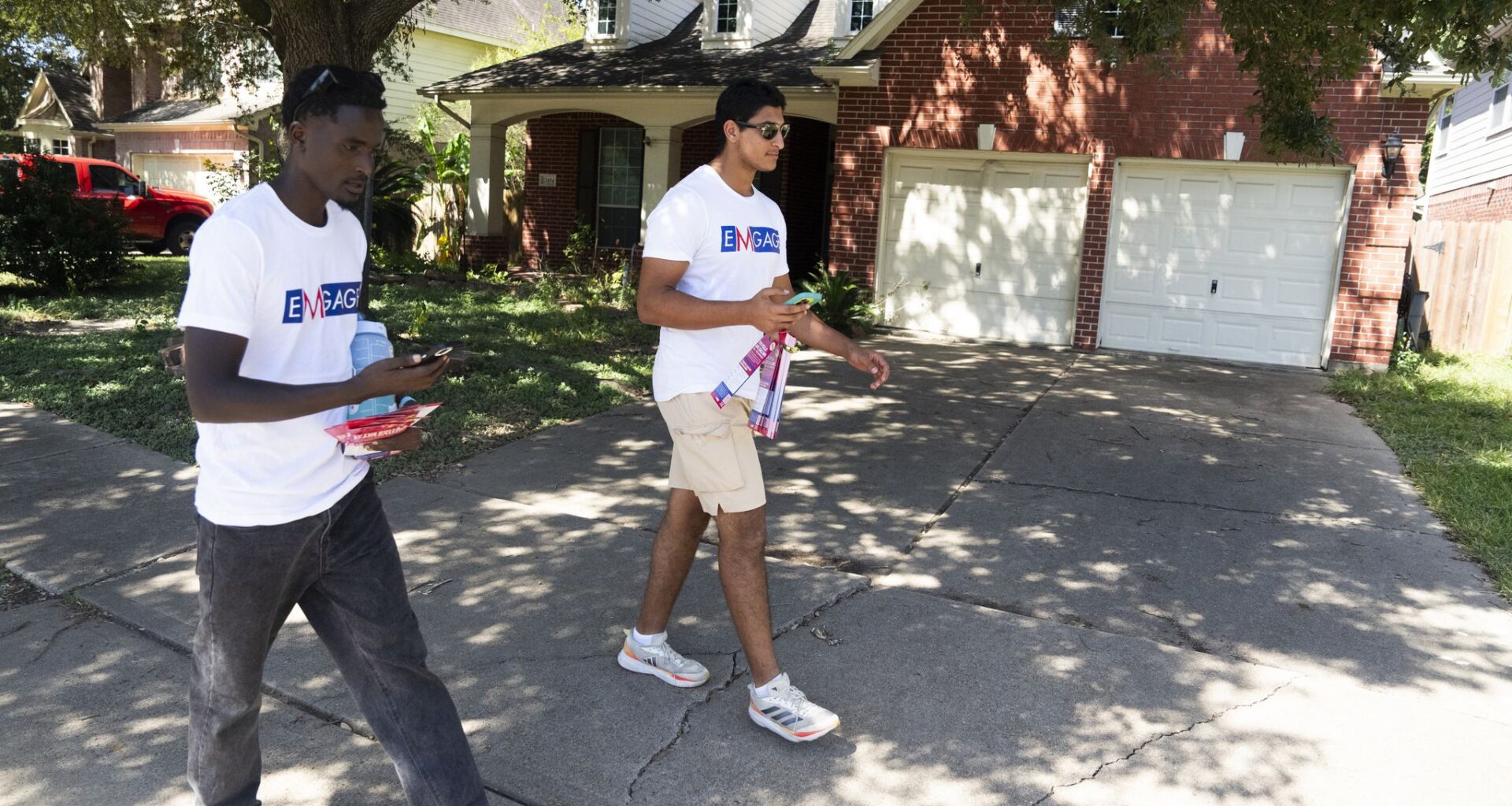
Innocent Rusine, left, block walks with Abdullah Younes near South Dairy Ashford Road to encourage people to vote.
Jason Fochtman/Houston Chronicle
Diana Elias and Anel Jimenez doorknock ahead of the election with Mi Familia en Acción.
Raquel Natalicchio/Houston Chronicle
Voters line up for the first hour of early voting at Metropolitan Multi-Service Center.
Elizabeth Conley/Houston Chronicle
Voters line up for the first hour of early voting at the Metropolitan Multi-Service Center.
Elizabeth Conley / Staff Photographer
Signs line West Dallas and Dunlavy streets on the first day of early voting.
Elizabeth Conley/Houston Chronicle
Canvassers from Mi Familia en Acción go door to door in Pasadena.
Raquel Natalicchio/Houston Chronicle
Jesus Zamora, 31, went out canvassing with Mi Familia en Acción in Pasadena.
Raquel Natalicchio/Houston Chronicle
Diana Elias and Anel Jimenez went canvassing with Mi Familia en Acción in the Pasadena area before early voting began.
Raquel Natalicchio/Houston Chronicle
Jesus Zamora, 31, and Carlos Alvarino, 25, canvass with Mi Familia en Acción in the Pasadena area.
Raquel Natalicchio/Houston Chronicle
Carlos Alvarino, 25, went doorknocking with Mi Familia en Acción in the Pasadena area.
Raquel Natalicchio/Houston Chronicle
Carlos Alvarino, 25, doorknocks with Mi Familia en Acción.
Raquel Natalicchio/Houston Chronicle
Carlos Alvarino holds materials to leave for people who didn’t answer the door.
Raquel Natalicchio/Houston Chronicle
Innocent Rusine, left, coordinates with Abdullah Younes before block-walking near South Dairy Ashford Road to encourage people to vote.
Jason Fochtman/Houston Chronicle
Volunteers brought voting material to leave at people’s homes.
Jason Fochtman/Houston Chronicle
Innocent Rusine, left, block walks with Abdullah Younes near South Dairy Ashford Road to encourage people to vote.
Jason Fochtman/Houston Chronicle
Hasina Fazly, left, coordinates with her brother Hassibullah before block-walking near South Dairy Ashford Road.
Jason Fochtman/Houston Chronicle
Hasina Fazly reviews voting information to hand out before block-walking near South Dairy Ashford Road.
Jason Fochtman/Houston Chronicle
Carlos Alvarino walked up a quiet Pasadena street on the last Saturday morning before early voting began, knocking on doors that no one answered. He moved on, house by house: two-story new builds, older bungalows with window units, homes with cars parked in the driveway that made him think the residents were home, even if they wouldn’t come outside.
He rapped on a door near Avenue L and 10th Street. It cracked open, just a few inches, to a tall man with white hair wearing a light jacket and pajama pants. A dog yapped.
“My name is Carlos. I work with Mi Familia en Acción,” Alvarino said, quickly explaining the Latino civic engagement organization. “We’re doing very quick survey questions —”
Article continues below this ad
“Hablas español?” the man asked.
Alvarino switched to Spanish. The man smiled and stepped onto his walkway.
EARLY VOTING: See where turnout is highest in Texas
The canvassers were used to doors staying shut, but when someone did come out, they had two questions ready. First: What issues do you have in your community? And then: Are you planning to vote? The order was intentional, a way to connect the tangible issues someone might see every day to the abstract effort of voting for politicians who might never show up near your home.
Article continues below this ad
Some residents worried about neighborhood security; others flagged slow trash pickup. One woman said her children’s wheelchair ramp from their house to the sidewalk constantly flooded, and when she tried to contact local officials, they ignored her.
“People try to reach out,” said Jesus Zamora, field director of Mi Familia en Acción, “and they just feel like no one listens.”
Each doorknock aims to revise this sentiment and reverse Texas’ historically low voter turnout, one of the lowest in the nation, especially in recent elections. Among the state’s largest counties, Harris County’s turnout percentage often ranks near the bottom.
And these efforts seem to be paying off: Early voting numbers in Harris County have shattered daily records. More than 20% of first-day voters had either never voted in a midterm election or hadn’t voted in one since 2018, according to an analysis by the political consulting firm Ryan Data & Research. Even at polling places in areas that, based on numbers from the last three midterms, have had some of the county’s lowest turnout rates, lines curled through parking lots and along sidewalks.
In the weeks before early voting began, we set out to talk with residents about what kept people from the polls in past elections — and what, if anything, is different this year.
Article continues below this ad
VOTER GUIDE: The Houston Chronicle guide to Texas races
In Pasadena, Alief, Galena Park and surrounding areas, we heard about politicians who don’t listen, distrust in the political system and the simple difficulties of going to the ballot box while trying to raise a family and go to work. We met organizers sharing information to make voting easier, working to close the gap between a complicated process and the realities of daily life.
Canvassers from Mi Familia en Acción went door to door in Pasadena before early voting began.
Raquel Natalicchio / Houston Chronicle
We also found voters galvanized by frustrations and fears that render politics personal. Gas prices are high. The war in Iran goes on. Gov. Greg Abbott has declared a Muslim civil rights group a foreign terrorist organization. ICE shot and killed a man in Houston over the summer, then ran over another in the fall.
Francis Gallegos, a 22-year-old social worker who has lived in Pasadena her entire life, registered to vote when she turned 18. But no one in her family had ever voted, and politics just seemed like “adulting stuff,” so she never went to the polls.
Article continues below this ad
But this year, watching how federal immigration policy has impacted her community and her family, she felt obligated to read up on the candidates instead of “just running off of a TikTok video.”
And, for the first time in her life, she cast a ballot.
‘I want to get out there’
In Pasadena, on that Saturday morning before early voting began, Diana Elias, 35, walked down the street. Some houses already had Halloween decorations up. Ring cameras chirped: “Hi! You are currently being recorded.” She knocked on doors, waited for answers.
Though doorknocking has always been a task met with rejection, canvassers have had an even harder time getting people to come to the door this year due to fear of immigration agents. (Some, said Melissa Allala, Get Out the Vote Director at AliefVotes, have been willing to talk through a window.)
Article continues below this ad
Elias grew up in an immigrant family. Her mother, she said, worked for years to get her U.S. citizenship. Her brother has been adamant about voting the last several years and has gotten their mom to the polls, too.
“I haven’t voted in the past three years,” Elias said. “I didn’t think it was impactful. Until this year, where I see everything that’s happening to the Latino community… So yeah, I’m gonna vote this year for sure.”
Ann Ramos, a 39-year-old teacher in nearby Galena Park, an area of just over 10,300 people with a majority Hispanic population, said politicians ask what people need during the campaign season, and then ignore voters once they get in office. She understands why people wouldn’t vote. Leonardo León, a 47-year-old steelworker and father of seven, said he’d never seen a politician in his neighborhood.
But Ramos votes, because she needs to know she tried. And León plans to cast a ballot, his second since becoming a U.S. citizen several years ago. He recently told his 20-year-old daughter she should register.
On the other edge of Harris County, Hasina Fazly stood on the pavement at the edge of a quiet, gated community and studied a map on her phone that marked her route for the day. She was in Alief with Emgage USA, a nonpartisan Muslim American civic engagement nonprofit, approaching two-story brick houses that surrounded a 65-acre manmade lake, hoping to encourage their occupants to vote.
Fazly, an Afghan native, hopes to cast her own ballot once she gets U.S. citizenship. She’ll be eligible in a few years. But she recognizes the barriers to the ballot box. She knows plenty of people in Alief who are too busy, too tired or know too little about their elected officials to vote, turning instead to religious leaders when they have a concern, or even a problem that city services might traditionally address.
Only a few people opened their doors, but Fazly smiled just as widely each time. And when women in hijabs like her own came to the door, they met her greeting with easy familiarity: “As-salaam alaykum.” “Wa’ alaykum as-salaam.” Peace be upon you. And peace be upon you, too.
She ended each conversation with the same request: “Will you tell three more people to vote?”
Everyone she met that afternoon promised they would.
Hasina Fazly reviews the voting information she’ll leave at people’s homes.
Jason Fochtman / Houston Chronicle
Local change beyond the ballot
Jeremy Reid strolled the paved path tracing the soccer field and sculpture garden outside Alief Neighborhood Center. Children climbed the jungle gym and kicked a soccer ball back and forth. It was a sunny afternoon, four days before early voting kicked off.
Reid, 36, has lived in the Alief area since 2005. He believes voting matters, but he’s never felt compelled to cast his own ballot because he doesn’t think election results bring change at the local level.
Alief, just west of the Sam Houston Tollway and south of the Westpark Tollway, has a population of about 105,000. The community, which boomed in the 1970s and early 1980s in response to Houston’s oil industry, is about 42% Hispanic, 23% Asian, 27% Black and 6% white. More than half the people who live there were born in another country. Its residents speak about 100 languages.
Tommy Wan, a founder of AliefVotes — an organization launched by high schoolers in the summer of 2022 to educate students on civic engagement — thought the language barrier could contribute to keeping people from the polls (Harris County ballots are available in four languages: English, Spanish, Vietnamese and Chinese ).
And, he said, people simply have other priorities: Raising children, working long hours. Surviving.
But when AliefVotes hosts events that address everyday problems, people show up. The group reserved a small conference room at the community center for their Oct. 10 event, “Building Alief’s Nature Network,” and they had to carry in extra chairs and orange stools for everyone who came to learn about urban farming and nature-based solutions to infrastructure challenges.
When organizers asked round-table style questions about environmental concerns, Alief resident and former disc jockey Helen Stone talked about the noise and fumes from the large trucks that barreled down her street. Other attendees named the intersections that reliably flooded and pointed out places that could benefit from new vegetation or trees.
The event ran about an hour and a half, but the organizers got their first round of applause early — when Wan promised translations in Mandarin, Spanish, and Vietnamese for anyone who needed them.
Early voting turnout in Harris County shattered previous records.
Elizabeth Conley / Houston Chronicle
‘The only thing we can do’
Two days after the Nature Network event and 30 miles east, a volunteer with Mi Familia en Acción set up a table at a Pasadena library across from city hall. She had nonpartisan voting materials and Halloween candy, and she waited for people to approach her. She asked everyone who stopped by to sign a pledge to vote.
Across the street, a city planning commission meeting was open to the public. No one showed up.
Pasadena, a petrochemical hub in the county’s southeast and its second-largest city by population, is home to almost 150,000 people. Although its population is now about 70% Hispanic, the city has historically repressed the voices and votes of nonwhites.
In the 1980s, when the city was still majority white, but demographics were beginning to shift, it was the state headquarters of the Ku Klux Klan. In 2013, when Latinos made up about two-thirds of Pasadena’s population, longtime Mayor Johnny Isbell pushed for new city council boundaries that a federal judge ruled intentionally diluted Latino voting power (Isbell, who denied the accusations, was term-limited out of office in 2017). Federal supervision of Pasadena’s elections remained in place until 2023.
That history shapes Pasadena, from its politics to its infrastructure, to this day, said City Council Member Emmanuel Guerrero, who unseated a 30-year incumbent in 2023 when he was just 26.
“The racial inequality, the gerrymandering, the limitation to resources are what limited people,” he said. “We’ve still never had a Latino mayor.”
Even in his two successful city council campaigns, Guerrero has seen up close how few of his constituents typically vote.
In Guerrero’s 2025 race, only 475 people voted. He said he’s knocked on the same doors eight or 10 times, only for those people not to vote. Many, he said, feel that “al cabo todos los políticos son iguales.” All politicians are the same anyway.
Cristina Womack, who leads Pasadena’s Chamber of Commerce and its election information work, often hears her neighbors say voting is pointless. But when they do, she reminds them of what happened in another 2025 city council race. The two candidates ended the race in a deadlock, with 272 votes each.
“They flipped a coin, and that was how it was decided,” Womack said. “So literally, one vote does matter.”
On Thursday evening, Jaime Acevedo drove straight from a shift as an HVAC technician, a trade he’s worked in for 20 years, to the BakerRipley Pasadena Campus. The sun was just beginning to set. Dust covered his blue jeans, his hands were cut and grimy from the day’s work, and he wore an America 250 ballcap. He walked into the building where some had gathered for BakerRipley’s services and about 20 others had come to cast their ballots.
After the first four days, Harris County reported 415,725 votes cast, including 384,304 in person — about 15.4% of the county’s 2.7 million registered voters. The in-person total was 60% higher than the 249,383 who voted in person during the first four days of 2018, the last Texas midterm election in which both the governor’s mansion and a Senate seat were at stake.
Acevedo, 59, has lived in Pasadena for 30 years. He’s originally from Mexico, and he became a U.S. citizen about five years ago. He said many of his neighbors, even those who are eligible to vote as naturalized citizens like himself, have shied away from the civic process as American politics have grown more hostile toward Latinos. When immigration agents are rounding up working people in your community, he said, you want to step in and help, but you can’t for fear of breaking the law or getting hurt.
“The only weapon that we Hispanics have is voting,” Acevedo said in Spanish. “It’s the only thing we can do to achieve change.”
Julián Aguilar contributed reporting.
Abdullah Younes puts voting material on a door South Dairy Ashford Road to encourage people to vote.
Jason Fochtman/Houston Chronicle