
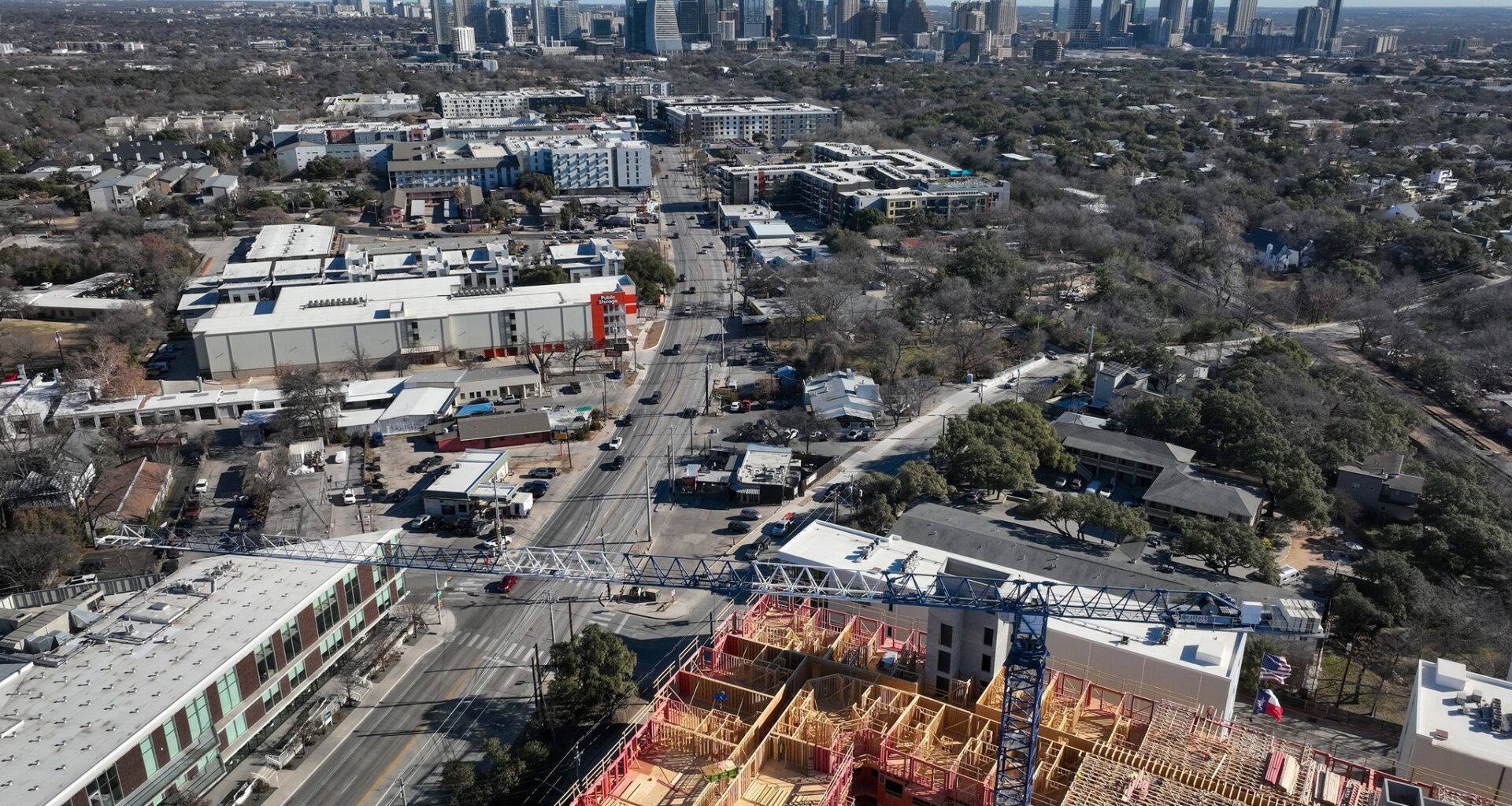
An aerial view shows a housing development under construction along South Lamar Boulevard near West Mary Street in Austin on Friday, Feb. 6, 2026. The South Lamar Corridor Improvements project has been delayed, and the city has more than $1 billion in unspent voter-approved bond funds.
Jay Janner/Austin American-Statesman
When Austin leaders put a nearly $295 million bond package on the November ballot, they knew voters could ask a fair question: Why borrow more when the city still had hundreds of millions of dollars in unfinished projects from earlier bonds?

The American-Statesman reported in April that the city had more than $1 billion in voter-approved but unissued bond funds, tied to projects dating as far back as 2006. Dozens of bond projects have since been canceled after they were later deprioritized or deemed unfeasible or too costly, according to public data.
Article continues below this ad
An aerial view shows a housing development under construction along South Lamar Boulevard near West Mary Street in Austin on Friday, Feb. 6, 2026. The South Lamar Corridor Improvements project has been delayed, and the city has more than $1 billion in unspent voter-approved bond funds.
Jay Janner/Austin American-Statesman
A cyclist rides along 51st Street in the Mueller neighborhood in Austin Wednesday, Feb. 25, 2026.
Mikala Compton/Austin American-Statesman
As the polls opened this week, city staff have forged ahead with an effort to assure voters they have a firm plan for all that borrowing power.
Earlier this month, the city launched a public dashboard that tracks the status of $2.45 billion in bond projects voters authorized in 2016, 2018, 2020 and 2022. In a Friday memo to the mayor and council, staff announced they would also publish quarterly program reports that will flag bonds with large balances or significant delays and provide updates on individual projects.
On Tuesday, staff told council members and the American-Statesman that the city is now on track to obligate 90% of its prior bond dollars by the end of next year, and to spend at least 90% by the end of 2028.
Article continues below this ad
Canceled, Outstanding Projects
The new bond dashboard lists more than 60 bond projects from the 2016, 2018, 2020 and 2022 bonds as canceled. The city defines a canceled project as one “no longer planned to proceed as originally identified,” because of changes in priorities, feasibility, funding, scope or site conditions.
Among the canceled projects:
Affordable housing at Moontower Flats, Escuela Nueva and St. Johns Redevelopment North
Improvements to the Ben White Boulevard and Interstate 35 intersection
Intersection improvements at Burton Drive and East Oltorf Street
The Red Line Trail
Improvements to the William Cannon Drive corridor
Accessible parking and access at Edward Rendon Sr. Metropolitan Park at Festival Beach
A pedestrian bridge at the Asian American Resource Center
Maintenance at various fire stations across the city, including foundation repair and driveway replacements
A bridge at Redbud Trail over Lady Bird Lake
Street lighting at Cameron and Dessau roads, East Oltorf Street and East Stassney Lane
Article continues below this ad
When asked about why these projects were canceled, the city directed the Statesman to the canceled project definition on the dashboard’s FAQ page: “Cancellation does not necessarily mean the underlying community need has been eliminated.”
The Statesman previously reported that the city asked voters to approve borrowing for projects before it had fully defined their scopes, schedules and budgets. By the time the city was ready to move forward with some projects, they were often deemed unfeasible because costs had risen.
Bond project updates
In Friday’s memo, staff said the city had completed all bond projects authorized in 2010 and 2013, so would not include them in the quarterly progress reports. The 2006 and 2012 bonds are “substantially complete and will also be removed,” staff said.
Article continues below this ad
“The focus of the report is ongoing bond programs,” Marcus Hammer, Assistant Director of Austin Capital Delivery Services, said in a statement.
However, the first quarterly report identifies projects with remaining balances or significant delays under bonds approved dating back to 2006.
According to the report, a major renovation project at the Mexic-Arte Museum has nearly $3 million unspent from the 2006 bond. The 2012 bond had $4.4 million remaining, including funds for the Medic 24 station, the Waller Creek District parent load account and replacement of the Dougherty Arts Center.
The exterior of Mexic-Arte Museum on Congress Avenue in Austin, Friday, Feb. 20, 2026. Mexic-Arte museum is seeking an increase in bond money as the City of Austin grapples with a $1 billion backlog in bond funding.
Sara Diggins/Austin American-Statesman
The 2016 bond had $194 million remaining. Flagged projects included two stretches of Airport Boulevard, improvements along the William Cannon Drive corridor and a section of the Northern Walnut Creek Trail from Oakbrook Drive to Interstate 35.
Article continues below this ad
The 2018 bond had $141.4 million remaining. The report flagged a range of projects, including accessibility improvements at Dittmar, Hancock and Gus Garcia parks and recreation facilities; the Bergstrom Spur Urban Trail; affordable housing projects; and fire station improvements.
The 2020 bond had $179.7 million remaining. Flagged projects included the West Bouldin Creek Connector, the East Oltorf safety corridor, bicycle barriers, several speed-management projects and safe-route improvements near Barbara Jordan Elementary School.
The 2022 bond had $228 million remaining. The report flagged land acquisition and affordable housing funds, along with projects such as Verbena Flats, Ada Anderson Place, Manor Apartments and Bailey at Stassney.
Article continues below this ad
The full list of bond projects and their statuses can be found in the quarterly report.