
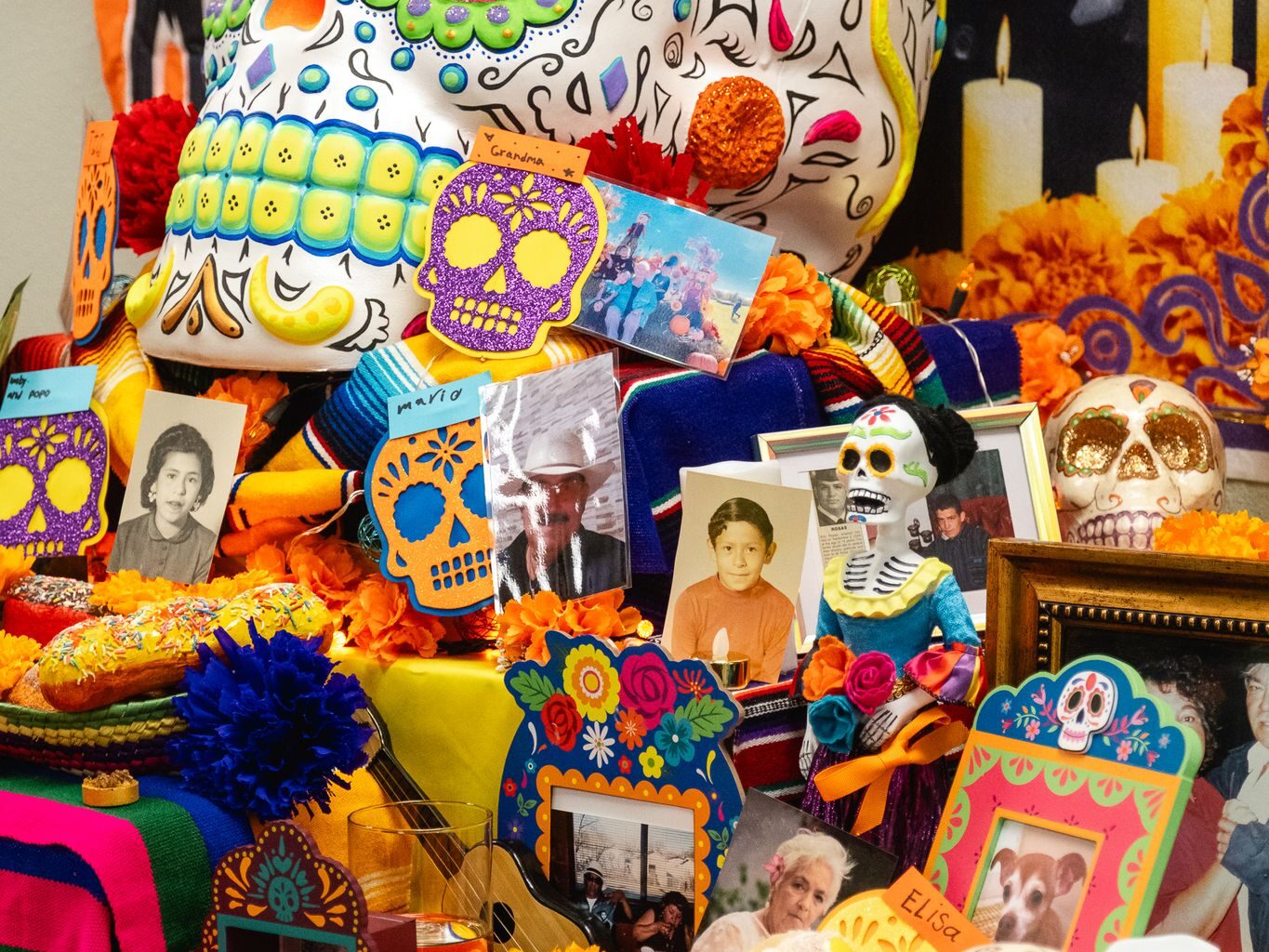
A traditional Día de los Muertos altar, like the one created at Agnes Cotton Academy last year, includes photos, marigolds, calaveras, papel picado and vibrant decorations.
JoMando Cruz
From left, Siana Ramirez, 10, and Javier Rubio, 9, color butterflies for a Día de los Muertos altar at San Anto Cultural Arts. The West Side nonprofit will host its Día de los Muertos celebration on Nov. 1.
Alma E. Hernandez/For the San Antonio Express-News
From left, Keli Rosa Cabunoc, development and outreach manager at San Anto Cultural Arts, and Cuauhtli Reyna, executive director at San Anto, make flowers for the organization’s annual Día de los Muertos altar.
Alma E. Hernandez/For the San Antonio Express-News
One of many altars created in honor of departed loved ones is shown at Muertos Fest in 2024.
Clint Datchuk
Angel Contero says she grew up in a “filtered” household, one that didn’t celebrate her Mexican heritage.

“My access to my Mexicanness, my Hispanicness, was a little bit limited because of the way my grandfather was raised. He was raised in a neighborhood where if you spoke Spanish, there would be repercussions,” she said.
Article continues below this ad
The traditions that many Mexican American homes celebrate — making tamales at Christmas, creating ofrendas for Día de los Muertos — Contero didn’t learn about until she was an adult.
“As I got older, I started wanting to know more, and I started to really love certain things about my culture,” she said.
Contero, a San Antonio-based graphic designer and illustrator, not only observes Día de los Muertos, she also helps others celebrate it through the items she sells at her business QueBonita Craft Co.
“I’m exploring my culture through my art,” said Contero, who sells customized remembrance candles and mini ofrenda kits.
Article continues below this ad
As Día de los Muertos celebrations begin to take place across the city, San Antonio Explained looks at the holiday and its centuries-old custom of creating ofrendas to honor departed loved ones.
What is Día de los Muertos
Día de los Muertos, also called Día de Muertos or Day of the Dead, is a holiday rooted in ancient Mesoamerican rituals and influenced by Roman Catholic customs.
It honors the deceased and welcomes the return of their spirits for a temporary reunion. It is a celebration that views death as a natural part of life, treating it as a continuation and not an end.
Article continues below this ad
Día de los Muertos is celebrated in Mexico and other parts of Latin America on Nov. 1 and 2, though celebrations often start days earlier. In the U.S., it is celebrated in Mexican American communities, though it’s grown to become a more widely recognized tradition.
Some families blend Día de los Muertos traditions with the religious customs of All Souls Day, which falls on Nov. 2.
What is an ofrenda
A Día de los Muertos ofrenda is a collection of items displayed in memory of someone. Ofrendas typically include photos of the deceased and items that represent some of their favorite things, including food, hobbies and sports teams. Candles, flowers and vibrant decorations are also included.
Article continues below this ad
An ofrenda (Spanish for offering) is displayed as an altar that’s typically created on a tabletop and can be made in tiers that range from three to seven levels. The words ofrenda and altar are used interchangeably.
Each altar is unique, Day of the Dead observers say. An altar can be an elaborate multi-level art installation or a single-level tribute with minimal embellishment.
ALSO READ: Where to celebrate Day of the Dead in San Antonio
Traditional altars contain three tiers, which represent the afterlife, life on Earth and life before birth. Items included in a traditional ofrenda should represent the four elements — water, fire, wind and earth. These can be represented by a glass or pitcher of water, lit candles, papel picado (perforated paper cut into designs) and pan de muerto (traditional Mexican sweet yeast bread).
Article continues below this ad
Other traditional items include incense, calaveras (sugar skulls that can also be made of chocolate or clay), marigolds (fresh or made of paper) and salt, which is meant to help purify the soul.
READ MORE: Muertos Fest will pay tribute to Texas music legend Augie Meyers
The debate about the proper way to create an ofrenda sometimes circulates among both experienced builders who grew up with the tradition and those new to the custom and eager to embrace to it.
“I wouldn’t say there’s a right way or a wrong way to do an ofrenda because the heart and soul, the point of an ofrenda is to honor your loved ones and welcome them back,” said Keli Rosa Cabunoc, development and outreach manager at San Anto Cultural Arts, a West Side nonprofit that promotes community-based arts and engagement. The center has celebrated Día de los Muertos with a community altar and procession for nearly two decades.
Article continues below this ad
“There’s always the cultura police, people who want to see a traditional altar,” she said. “For me, it’s that you’re honoring somebody and that you’re doing it from a place of love.”
When are ofrendas displayed
Altars start going up in mid-October, though some observers wait until closer to Nov. 1.
Tradition calls for the first altars, those dedicated to pets and animals, to go up on Oct. 27. Each day that follows is dedicated to honoring lost or forgotten souls, those who died tragically or children who died.
Article continues below this ad
Tradition varies, according to the National Museum of the American Latino, with some customs calling for elements to be added to an ofrenda in a particular order and on a certain day.
Altars are traditionally taken down Nov. 3, though some observers say their families keep simple ofrendas displayed throughout the year.
“We would have a little altar with the Virgen de Guadalupe, and we would have pictures of loved ones and candles. That was something we always had in our home,” said Marco Vargas, a local artist who works as the mural coordinator at San Anto.
Why create an ofrenda
Some families create collective ofrendas, tributes to more than one family member that contain photos from different generations. Ofrendas can honor departed relatives, pets, favorite musicians, well-known public figures or a group of people representing a social justice cause.
Article continues below this ad
Creating an ofrenda is a way to learn about history by hearing stories from older generations, observers say. It’s also a way to connect with family members by sharing memories.
Maricela Olguin, who teaches Día de los Muertos workshops at the Guadalupe Cultural Arts Center on the West Side, remembers creating an ofrenda with her great-grandmother, who would tell stories while sorting through family photos.
“We would laugh and giggle,” she said. “I mean, it’s an offering to a loved one. It’s not anything to be sad about.”
ALSO READ: San Antonio Explained: A college student’s holiday gift drive became a city tradition
Article continues below this ad
Olguin, whose workshops include how to make traditional ofrenda items like papel picado and sugar skulls, advises people not to get caught up in adhering to every tradition.
“I always tell people that there is no right or wrong way to make an ofrenda,” she said. “It’s a personal thing. It’s how you choose to honor someone.”
Creating ofrendas also shouldn’t be viewed as a custom only for Latinos.
Article continues below this ad
“I think anybody can do it,” Olguin said. “I doesn’t matter your race, your religion, your background. Anybody can honor a loved one in any way they choose.”
RELATED: How do you observe Dia De Los Muertos, or Day of the Dead?