
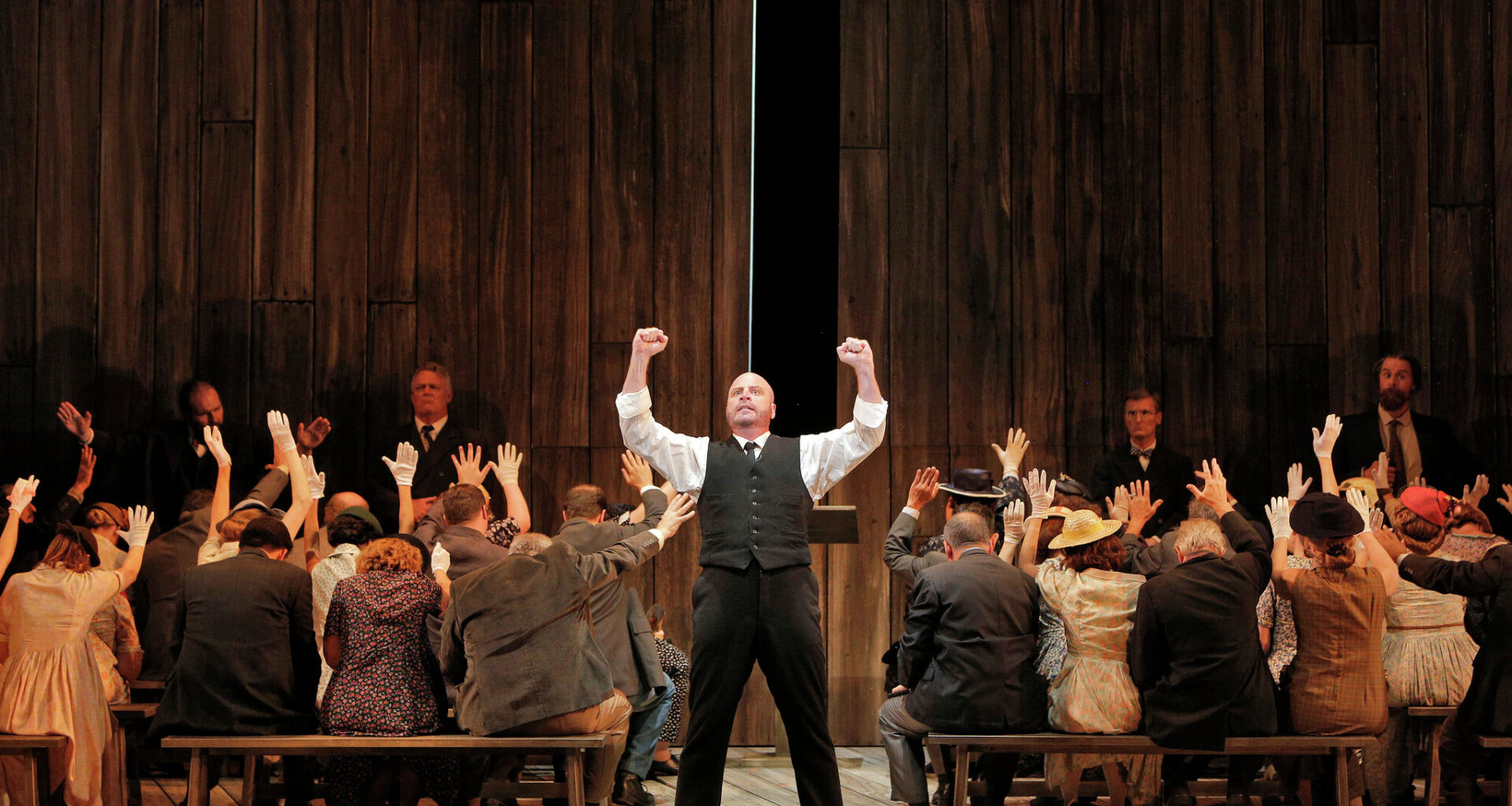
Houston Grand Opera’s ‘Susannah’
Cory Weaver
Houston Grand Opera’s ‘Susannah’
Cory Weaver
The Houston Grand Opera opened its 72nd season Friday with a compelling performance of Carlisle Floyd’s “Susannah,” capturing its tragic story as Susannah’s integrity and innocence is pitted against the fear and judgment of her community. Perhaps most harrowing in the HGO performance came in the final scene: the long, juggernaut-like crescendo of the HGO Chorus – the whole of that community – at first murmuring in wordless anger as they approached from offstage and then, upon arriving, continuing their escalation of sound as they demanded furiously, “Git out’n the valley, Susannah! Git out! Git out tonight!”
In the lead role, soprano Sylvia D’Eramo mastered Susannah’s transformation from a carefree, kind, and friendly girl to a shattered outcast, who ultimately pours out her rage with gun in hand. D’Eramo sang with a voice that was capable of both tender high notes and the power to overtop the orchestra even at its loudest.
When: 7:30 p.m. Oct. 31; 7:30 p.m. Nov. 6; 2 p.m. Nov. 8
Where: Wortham Theater Center, 501 Texas
Details: $25 and up; houstongrandopera.org
But her voice also took on significant edginess in its upper range during Susannah’s impassioned moments. This suited Susannah’s rage, but perhaps not her despair. Rod Gilfry brought out the two sides of the Reverend Olin Blitch effectively in both his singing and acting: outwardly, Gilfry’s Blitch is the confident and charismatic preacher newly introduced to the community of New Hope Valley; inwardly, he is a weak and lonely man who commits a rape, pleads for forgiveness, but cannot atone. Gilfry’s baritone had a satisfying resonance, and his best moments revealed warm and soft lyricism as Blitch sings of his loneliness to Susannah or when he begs her forgiveness for having violated her. But in his upper range at loud dynamics, the musical line blurred as his pitch became less secure.
Article continues below this ad
Two tenors making their debuts with the HGO, Aaron Blake and Bille Bruley, both delivered strong performances. As Little Bat McClean, the awkward boy whom Susannah befriends, Blake created the character of a shy and hobbling youth in vivid detail. Blake’s virtuoso singing shone brilliantly in Bat’s moments of anguish and regret over the community’s accumulating outrage and over his betrayal of Susannah. As Sam, Susannah’s brother, Bruley expressed the crucial qualities of the role as confidant and protector to Susannah, while mixing in some happy staggering because of Sam’s fondness for drink. The sweet sound of Bruley’s tenor brought out Sam’s essential loyalty to Susannah, but his voice also bore fiery power for Sam’s vengeance on her behalf.
As in the Bible story on which Susannah is based, the destructive force in the plot comes from trusted and powerful men in the community, the Elders, who abuse that power. There are four of them in Floyd’s opera – Elder McLean (Malcolm MacKenzie), Elder Ott (Ziniu Zhao), Elder Hayes (Martin Luther Clark), and Elder Gleaton (Luka Tsevelidze) – always watchful, commenting, and conspiring in this fine performance. Their wives – Mrs. McLean (Deborah Nansteel), Mrs. Ott (Leia Lensing), Mrs. Hayes (Scarlet Jones), and Mrs. Gleaton (Elizabeth Hanje) – serve as the Elders’ gossiping and enabling counterparts. That behavior, as made clear in the adept performances, is founded on prejudice and jealousy.
In Erhard Rom’s scenery, the pieces on stage comprised simple but effective wood-plank flats for the town church and Susannah and Sam’s cabin in the woods. Rom complemented the physical set design with projections against a lowered scrim between scenes and against the mountains-and-sky backdrop within scenes.
These projections shifted smoothly between walls of aged two-by-fours to represent the modest buildings of the community, the thickly wooded mountains of eastern Tennessee, and the shady forest where Susannah and Sam live. Rom’s designs were evocative to the point of entrancing, yet there was also fine-tuning to be done when the vivid starry night sky was projected onto the cabin exterior and the mountains in the background along with the sky itself. Likewise, the planks of the stage decorations resembled store-bought laminate in comparison with the weather-worn wooden planks of the projected images.
Article continues below this ad
But the strengths of the performance overwhelm such complaints. Among these, the HGO Orchestra led by music director designate James Gaffigan, adeptly navigated Floyd’s music, bringing out its sweeping lyrical beauty that is interwoven with evocative folksongs and dances, and also with portents of tragedy – initially less obtrusive, but ultimately searing.
Among its many fine moments, the orchestral playing stood out particularly in Caitlin Mehrtens’ harp accompaniment to Susannah’s grief-stricken aria, “The Trees on the Mountain,” and in Justin Best’s bass clarinet solo in the reprise of that aria melody, now drained of all ardor, to begin the opera’s final scene.
The uniform success of portrayals and their emotional impact lead back to the clear and persuasive interpretation of Patricia Racette, who makes her mainstage directorial debut with this production. Likewise, our understanding of both the larger community and of Susannah and Sam’s familial bond begins in this production with the choreography of Courtney D. Jones: the opening-scene square dance paints the picture of a rural, tightly knit community; the spur-of-the-moment dancing between Susannah and Sam during the “Jaybird Song” establishes their close and happy relationship. The sum of such thoughtful and detailed work on the part of the cast, orchestra, and creative team is a new and inspiring HGO production, a consummate celebration of the centennial of Carlisle Floyd’s birth.