
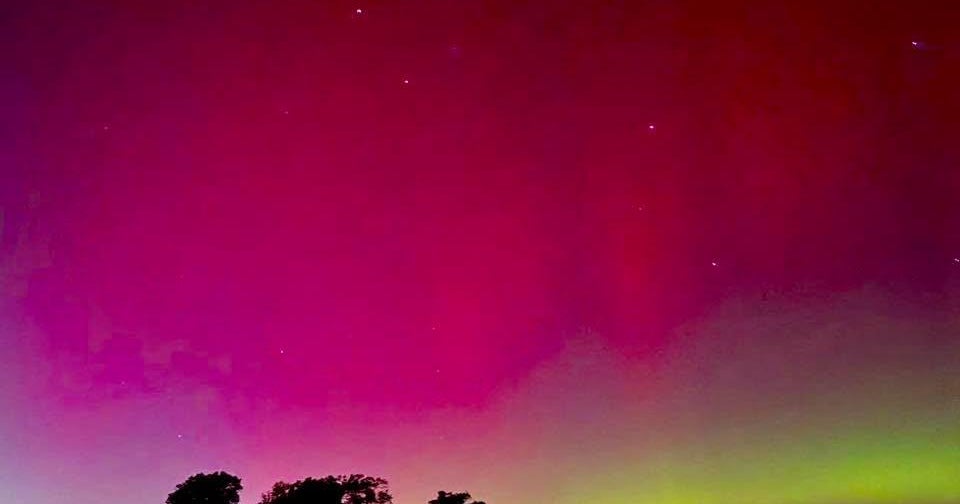
We may be under southern skies, but you wouldn’t have known it last night. North Texans were treated to a rare surprise: the northern lights, glowing brightly in shades of pink across the sky.
For many, it was a once-in-a-lifetime sight right in their own backyards.
“I was standing right about here, and you could see the pink over the tops of the trees,” said Amanda Gatlin, who witnessed the lights from her home in Keller. “The sky had a pink haze to it. I pulled it up on my camera, and it just lit up… it was beautiful. My kids and I have been wanting to see this forever.”
She wasn’t alone. Across North Texas, from McKinney to Decatur to Bridgeport, people captured the colorful display lighting up the night sky.
“Normally, it’s centered around the poles of Earth, but this time it was able to reach pretty far south,” said McKenna Dowd, planetarium coordinator at the University of Texas at Arlington.
UTA Planetarium Director Levent Gurdemir explained that the northern lights appear when charged particles from the sun collide with gases in Earth’s atmosphere, producing vibrant colors.
“The color is directly representative of the amount of energy,” Gurdemir said. It also depends on the elements in the atmosphere, whether it’s oxygen or nitrogen, which determines the colors you see.
The National Oceanic and Atmospheric Administration (NOAA) issued a “G4” severe geomagnetic storm alert ahead of the display, the second-highest level possible. The intensity of the storm allowed the aurora to stretch unusually far south, creating a rare show for Texas.
NOAA said similar conditions could happen again tonight. Dowd plans to be ready.
“My plan is definitely to set up my camera, face north, and not move,” she said.
Ironically, Gatlin had just returned from Ireland a few weeks ago, hoping to catch the northern lights, only to have cloudy weather.
“We missed it there,” she said. “But this was such a neat surprise to see them on my own doorstep.”
For those hoping to catch another glimpse, NOAA recommends getting away from city lights and using a smartphone camera, which can often capture colors that aren’t visible to the naked eye.
More from CBS News