
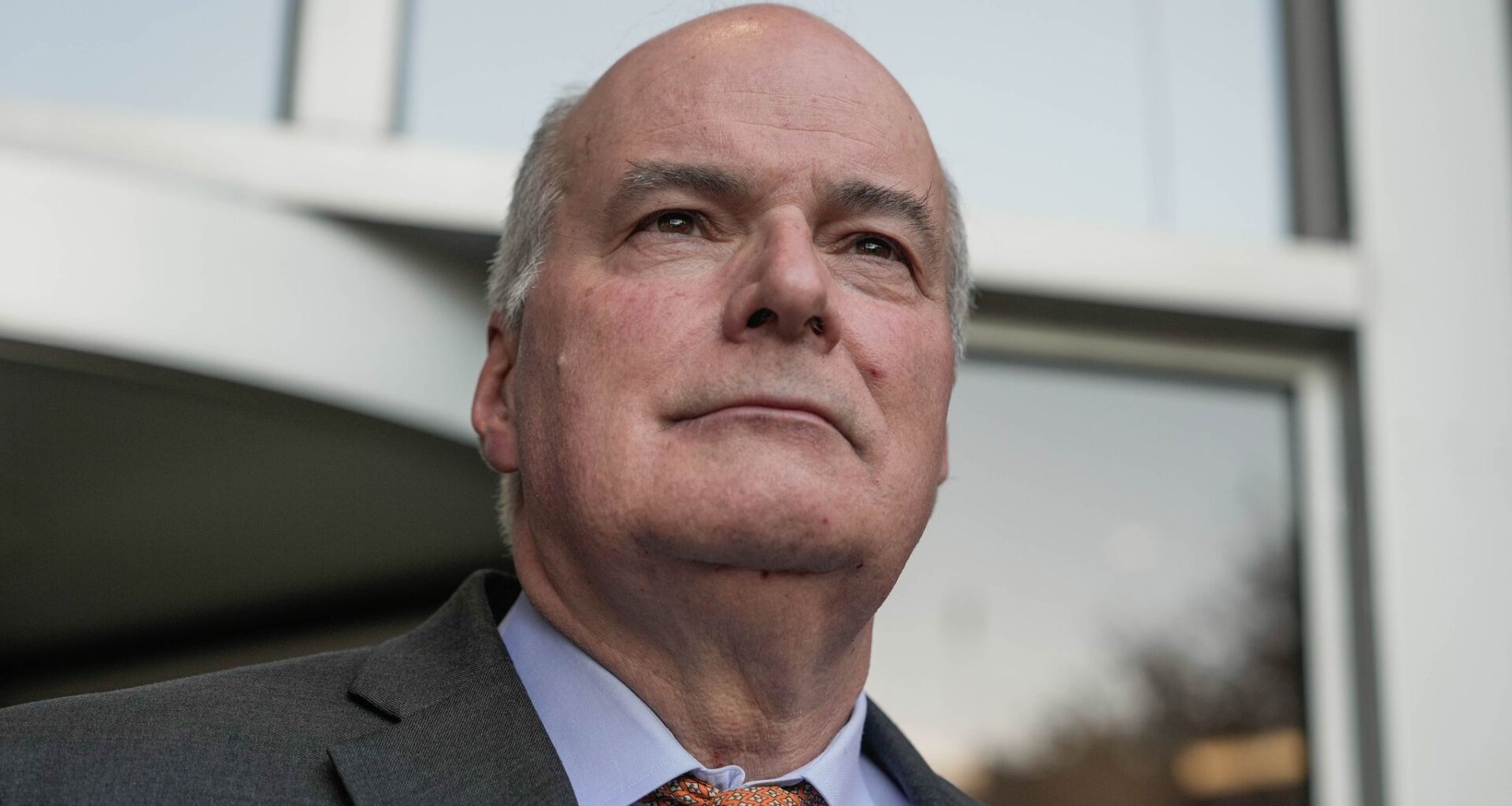
Dr. John Stevenson Bynon Jr. exits federal court after a hearing on charges alleging he made false statements that rendered patients functionally ineligible for organ transplants, according to federal authorities, in Houston, Thursday, Feb. 5, 2026.
Raquel Natalicchio/Houston Chronicle
The planned October trial of a former Memorial Hermann transplant surgeon has been canceled after federal prosecutors appealed a judge’s decision to prevent a jury from seeing some of the government’s evidence in the case.
Dr. John Stevenson Bynon Jr. was scheduled to go to trial Oct. 28 on five counts of making false statements relating to health care matters. Bynon is accused of entering false data into an organ-matching system for liver-transplant patients and effectively blocking them from organ offers.
MORE ON HOUSTONCHRONICLE.COM: Houston transplant surgeon case may be difficult for prosecutors as judge limits evidence
Article continues below this ad
On Thursday, however, the 5th U.S. Circuit Court of Appeals in New Orleans docketed a notice of appeal filed by prosecutors from the Southern District of Texas’ major fraud section. The notice says an Oct. 14 order by U.S. District Judge Lee Rosenthal and subsequent oral orders from Oct. 15 and Oct. 16 would wrongly hamper Bynon’s prosecution.
Prosecutors say the orders prevent them from introducing evidence they consider “crucial to the government’s case.”
The appeal comes as prosecutors have publicly acknowledged serious challenges in their case. In pretrial hearings in recent weeks, prosecutors have said Rosenthal’s rulings would prevent them from proving all of the elements of their case. In one hearing, Suzanne Elmilady, deputy chief of the major fraud section of the U.S. Attorney’s Office in Houston, said her office was trying to decide whether the government could still present its case to a jury.
On Thursday, a planned pretrial conference related to Bynon’s case was canceled and the trial date was removed from the court’s calendar. A notice referred to the government’s appeal as the reason for the delay.
Article continues below this ad
It’s unclear how long the appeal will take to resolve.
Bynon is accused of using the matching systems to change weight and age criteria to determine what kind of donor organs he would accept for his patients, significantly limiting the pool that might be available to him and his patients. He has pleaded not guilty.
Federal prosecutors accused Bynon of “manipulating the patients’ chance of survival” when they announced his indictment in February.
In a 64-page order setting out the rules for Bynon’s trial, Rosenthal placed limits on how prosecutors could describe the manipulation. The Justice Department, for instance, would not be able to say Bynon was required to tell patients of his changes to the matching system. The patients who didn’t receive organs, if they testify, would not be able to talk about their suitability for receiving organs or about their outcomes after the criteria were changed. Family members of patients who died would also be prevented from giving that testimony.
Such testimony would be “irrelevant and unfairly prejudicial at the guilt-innocence stage,” Rosenthal wrote.
Article continues below this ad
The government would also not be allowed to present patient photographs, describe the patients as “victims,” or refer to Bynon’s alleged acts as “lies” or “manipulations. Limits were also placed on prosecutors discussing Memorial Hermann’s internal investigation into the organ transplant program.
In a statement Friday, Aaron Reitz, the U.S. attorney for the Southern District of Texas, said Rosenthal’s rulings “wrongly prevent the jury from hearing evidence central to the prosecution’s case.”
“We are therefore appealing those legally incorrect decisions and want the jury — not a lone judge — to make the final call on the merits of the evidence,” Reitz said.
With a trial looming, prosecutors faced a decision to appeal the evidence decision before a jury was seated and the case would become subject to rules about double jeopardy. The government cannot appeal a not guilty verdict.
Bynon’s attorney, Samy Khalil, said there was no clear timeline for how long the appeal would take. Bynon’s lawyers have pushed to have his case litigated quickly, and have twice unsuccessfully sought to have the case dismissed.
Article continues below this ad
“The government has made the decision to appeal Judge Rosenthal’s pre-trial orders excluding certain evidence rather than test the strength of its case before a jury of Dr. Bynon’s peers,” Khalil said. “So the trial — and Dr. Bynon’s ability to publicly clear his name in a speedy fashion will be postponed until the government completes its appeal.”
Each count against Bynon carries a maximum sentence of five years in prison.